RTI INTERNATIONAL
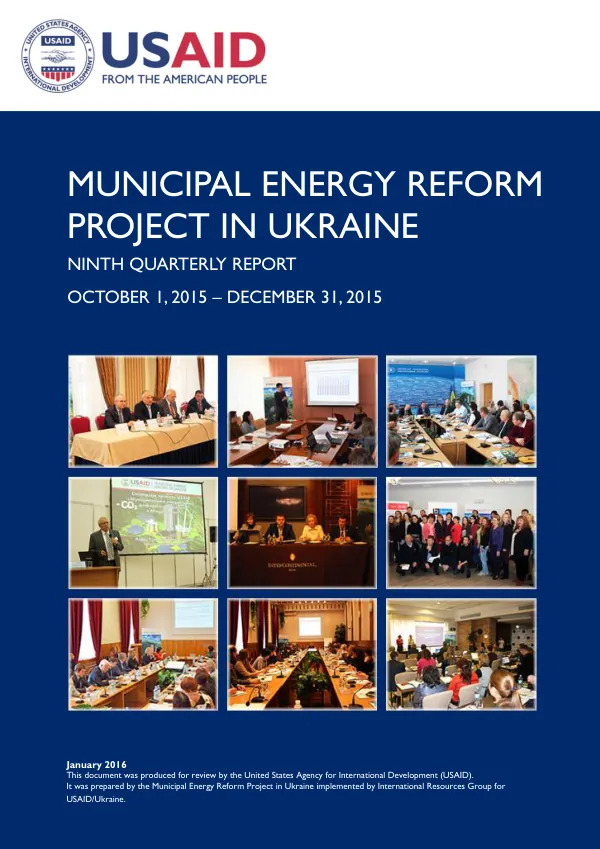
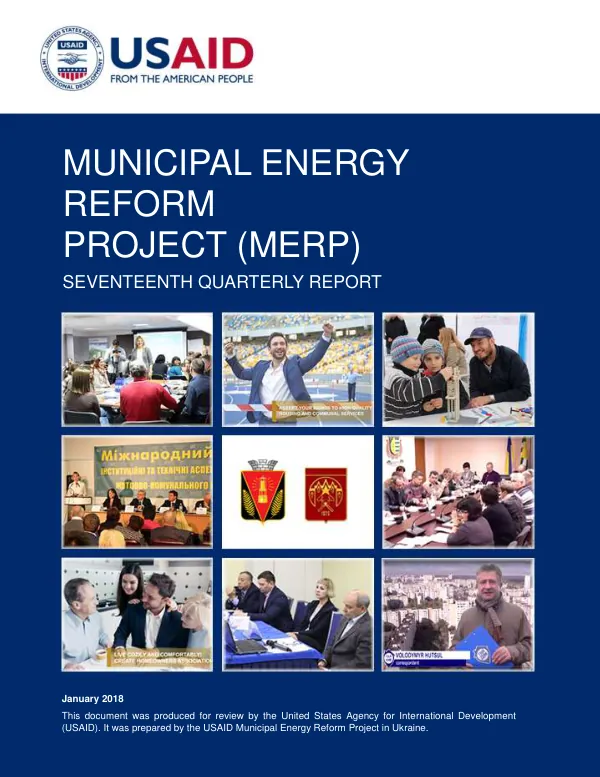
USAID MUNICIPAL ENERGY REFORM PROJECT – SEVENTEENTH QUARTERLY REPORT
The Municipal Energy Reform Project (MERP) in Ukraine has made significant progress in improving the clean energy regulatory and legislative environment.
2018 · 75 pages
Sign in to readA free account is required to download.
Abstract
The project has implemented various activities to enhance the capacity of the Government of Ukraine (GOU) in Low Emission Development Strategies (LEDS). The MERP has also promoted investment in clean energy technologies and applications, and has established a Clean Energy Advisory Center (CE RC) to provide technical assistance to municipalities. The project has achieved notable milestones in the development of the Energy Performance Contract (EPC) and the Energy Management (EM) systems. The EPC has been implemented in several municipalities, and the EM system has been established in the Odesa Oblast. The project has also facilitated the development of the Municipal Energy Information System (MEIS) to monitor and evaluate energy consumption. The MERP has also made progress in promoting energy efficiency in the residential sector. The project has supported the development of the "Energy Efficient Cities" program, which aims to reduce energy consumption in residential buildings. The project has also facilitated the implementation of energy-efficient technologies in public buildings. The project has also made significant progress in promoting clean energy in the transportation sector. The MERP has supported the development of the "Clean Energy for Transportation" program, which aims to promote the use of clean energy in transportation. The project has also facilitated the implementation of electric vehicle charging infrastructure in several municipalities. The MERP has also made progress in promoting energy efficiency in the commercial sector. The project has supported the development of the "Energy Efficiency in Commercial Buildings" program, which aims to reduce energy consumption in commercial buildings. The project has also facilitated the implementation of energy-efficient technologies in commercial buildings. The project has also made significant progress in promoting clean energy in the industrial sector. The MERP has supported the development of the "Clean Energy for Industry" program, which aims to promote the use of clean energy in industry. The project has also facilitated the implementation of clean energy technologies in several industrial facilities. The MERP has also made progress in promoting energy efficiency in the agricultural sector. The project has supported the development of the "Energy Efficiency in Agriculture" program, which aims to reduce energy consumption in agriculture. The project has also facilitated the implementation of energy-efficient technologies in agricultural facilities. The project has also made significant progress in promoting clean energy in the residential sector. The MERP has supported the development of the "Clean Energy for Residential" program, which aims to promote the use of clean energy in residential buildings. The project has also facilitated the implementation of clean energy technologies in several residential buildings. The MERP has also made progress in promoting energy efficiency in the public sector. The project has supported the development of the "Energy Efficiency in Public Buildings" program, which aims to reduce energy consumption in public buildings. The project has also facilitated the implementation of energy-efficient technologies in public buildings.
Related documents
![Request for proposals for selecting a subcontractor to conduct a research and develop infrastructure solutions for bioenergy development in Poltava region (2013) [Ukrainian]](https://covers.devme.ai/gen/157270.webp)