DELOITTE CONSULTING, LLP
USAID-Funded Nepal Hydropower Development Project (NHDP)
The Nepal Hydropower Development Project (NHDP) is a USAID-funded initiative aimed at promoting local shares in hydropower projects.
2018 · 8 pages
Sign in to readA free account is required to download.
Abstract
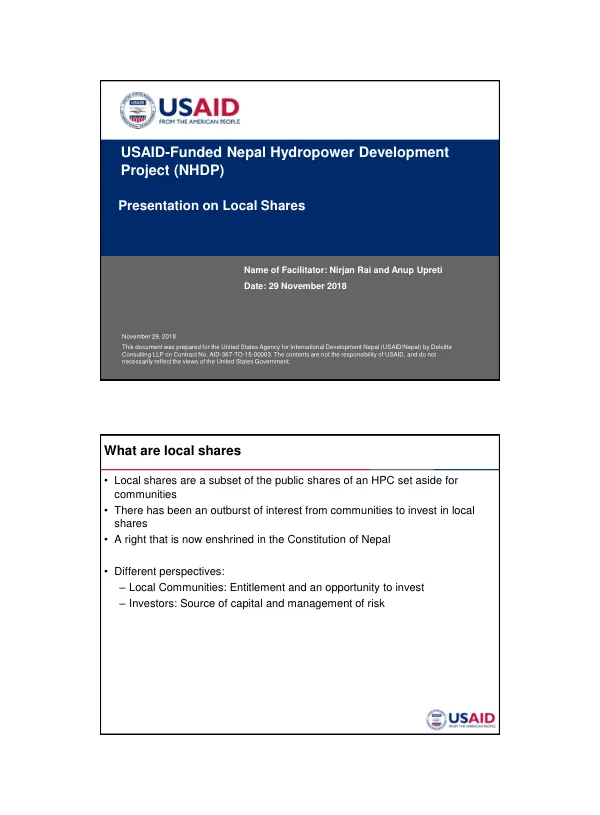
Local shares refer to a subset of public shares set aside for communities, which has gained significant interest from local communities. The concept of local shares is enshrined in the Constitution of Nepal, providing communities with an entitlement and opportunity to invest. The evolution of local shares in Nepal is exemplified by the 22.1 MW Chilime Hydropower Project, which has been a pioneer in this area. Chilime's favorable power purchase agreement, early debt repayment, and dividend distribution have made it a unique case. However, the Securities Board of Nepal (SEBON) faced challenges in regulating this new phenomenon. The allocation of local shares is guided by the Securities Issuance and Allotment Guideline, which specifies that up to 10% of issued capital can be allocated to local shares. This 10% rule has become a benchmark for local shares, with the Securities Regulation of 2016 establishing the conditions for issuance. The process of allocation involves defining eligibility, which is often less technical and more political, with the Constitution of Nepal giving local communities priority in investing in natural resources. Eligibility for local shares is defined by the project's Environmental Impact Assessment (EIA), with affected VDCs and the rest of the district being the primary units of eligibility. However, there is a lack of clarity regarding the eligibility of communities affected by ancillary infrastructure. The Securities Regulation of 2016 specifies the conditions for issuance, but does not provide a clear timeline for issuing local shares. The pricing of local shares is also a critical aspect, with the Securities Regulation of 2016 establishing that IPOs must be done at a par value of Rs. 100. However, there is a provision allowing companies to issue shares at a premium, which has been considered by some companies. Chilime Hydropower Company Limited has issued local shares at par value, while other companies have considered alternative pricing provisions. Financing for local shares is often provided by general people, who have the capacity and willingness to invest small amounts. However, there is a lack of knowledge among communities on financing and its associated risks, which has led to reluctance from banks and financial institutions to finance local shares. Chilime Hydropower Company Limited is the only company to have arranged financing for local shares through banks. The delivery model for local shares has been through the direct shareholding model, which has been preferred by local communities. However, there is a need to find alternative delivery models to accommodate private investors who do not want to be listed publicly. The Securities Board of Nepal requires a lock-in period of three years for local shares from the date of IPO, after which divestment can be made through the NEPSE trading platform. At the end of the concession period, companies have two approaches to project development: owning one project or multiple Special Purpose Vehicle (SPV) projects. The value of company shares will approach zero towards the end of the project's license period if the company owns only one project. However, if the company owns multiple SPV projects, the expiry of the license period of one project should only affect the price of the company share to the extent of the value of that project. The Electricity Act of 1992 allows companies to enter into new agreements with the government for the further operation and maintenance of projects at the end of their concession period. Relevant institutions have different opinions on this, but have not discussed it further.
Related documents