DELOITTE CONSULTING, LLP
USAID-Funded Nepal Hydropower Development Project (NHDP)
The USAID-Funded Nepal Hydropower Development Project (NHDP) aims to promote cross-border power trade between Nepal and India.
2018 · 12 pages
Sign in to readA free account is required to download.
Abstract
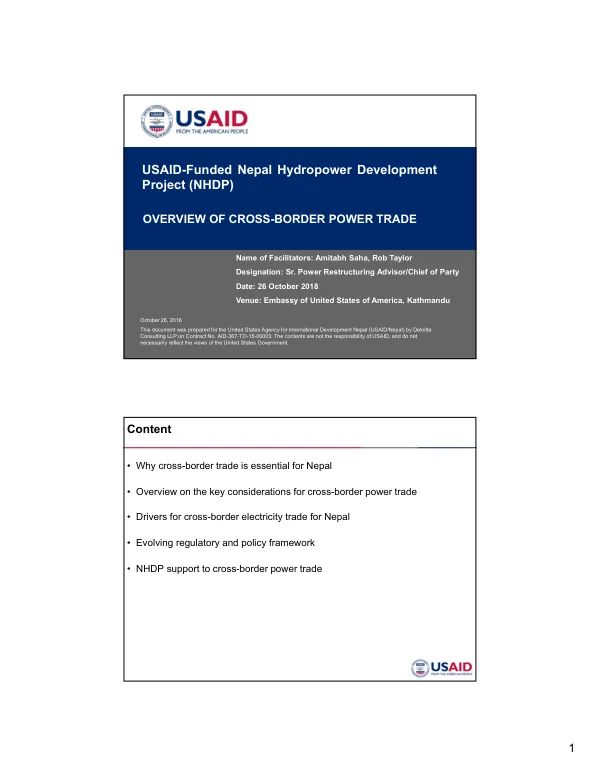
The project seeks to address the challenges faced by Nepal in meeting its electricity demand, particularly during the dry season. The country's large hydropower potential, estimated at 42 GW, remains untapped, and the government aims to monetize free power allocated to it. Nepal's electricity demand-supply gap is significant, with a shortfall of 1415 MW in 2018 due to gas shortages. The country's power generation is largely dependent on hydropower, but the existing infrastructure is inadequate to meet the growing demand. The NHDP aims to bridge this gap by promoting cross-border trade with India, which has a surplus of electricity. The project focuses on three key areas: infrastructure development, market linkage facilitation, and capacity building. The NHDP has identified several potential hydropower projects in Nepal, including the Upper Kali Gandaki (900 MW) and the Arun 3 (900 MW) projects, which have significant free power components. The project also aims to explore alternative markets, such as Bangladesh, which has a power transfer capacity of 1000 MW with India. The NHDP has been working closely with the Government of India to develop a regulatory framework for cross-border power trade. The Ministry of Power (MoP) has issued guidelines for cross-border trade of electricity, which include the establishment of a designated authority to oversee the process. The guidelines also provide for the development of a common regional trade agency to facilitate trade between India and its neighboring countries. The NHDP has identified several key drivers for cross-border power trade, including the need to bridge the demand-supply gap, optimize resource utilization, and promote regional integration. The project also aims to reduce greenhouse gas emissions by promoting the use of renewable energy sources. The project has made significant progress in developing a regulatory framework for cross-border power trade. The NHDP has worked closely with the Government of India to develop guidelines for cross-border trade of electricity, which include the establishment of a designated authority to oversee the process. The guidelines also provide for the development of a common regional trade agency to facilitate trade between India and its neighboring countries. The NHDP has also identified several key technical-commercial considerations for cross-border power trade, including the need for a common regional trade agency, open access to transmission, and commercial mechanisms to settle imbalances. The project has developed a framework for transmission planning and scheduling, which includes the development of a common regional trade agency to facilitate trade between India and its neighboring countries. The NHDP has also identified several key institutional considerations for cross-border power trade, including the need for a designated authority to oversee the process, a common regional trade agency to facilitate trade between India and its neighboring countries, and a regulatory framework to govern the trade. The project has worked closely with the Government of India to develop guidelines for cross-border trade of electricity, which include the establishment of a designated authority to oversee the process.
Related documents