USAID DEC
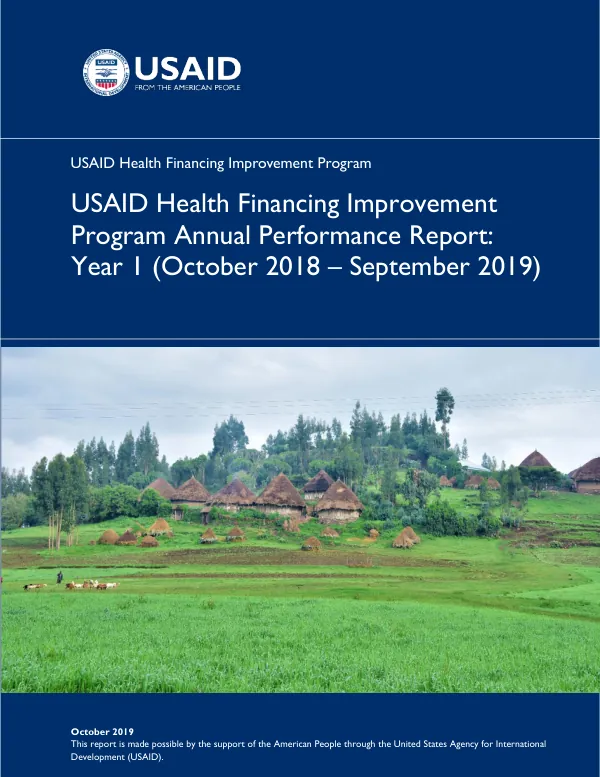
USAID Health Financing Improvement Program Annual Performance Report: Year 1 (October 2018 – September 2019)
Sign inABT ASSOCIATES
USAID Health Financing Improvement Program Annual Performance Report: Year 1 (October 2018 – September 2019)
The USAID Health Financing Improvement Program supports the Ethiopian government in its efforts to strengthen and institutionalize health care financing reforms and initiatives.
2019 · 50 pages
Sign in to readA free account is required to download.
Abstract
The program aims to provide accessible, high-quality primary health care services for all Ethiopian citizens with reduced financial barriers. Led by Abt Associates, the program is implemented in collaboration with core partners Breakthrough International Consultancy, Dimagi, the Institute for Healthcare Improvement, and Results for Development, and resource partner Harvard School of Public Health. The program focuses on four key intermediate results: increasing domestic resource mobilization for enhanced provision of quality primary health care services, streamlined risk-pooling mechanisms for wider access to primary health care services with reduced financial barriers, improved arrangements for strategic purchasing of health services from public and private providers, and strengthened governance, management, and evidence generation for health financing reforms and health facilities. Key activities and achievements in year one include the implementation of community-based health insurance (CBHI) in the four agrarian regions and Addis Ababa, with a total of 1.3 million households enrolled in the program. The program also achieved significant progress in domestic resource mobilization, with a total of 1.4 billion birr mobilized from CBHI paying members and targeted subsidy in the four agrarian regions and Addis Ababa. Additionally, the program supported the establishment of functional facility governing boards (FGBs) in 85% of health facilities, and provided in-service training on health care financing and CBHI to over 1,000 health workers. The program's monitoring, evaluation, and learning (MEL) system was also established, with regular reporting and data analysis to track progress and identify areas for improvement. The program's success story highlights the achievements of the Jida woreda in the Oromia region, which recently enrolled the highest percentage of CBHI eligible households in the region. The program's MEL accomplishments include the development of a theory of change, a results framework, and a monitoring and evaluation plan, as well as the establishment of a data management system and a reporting framework. The program's management and operations were also established in year one, with the recruitment and onboarding of staff, the operationalizing of central and regional offices, and the major procurements and dispositioning of program resources. The program's challenges and constraints included the need for further capacity building of health facilities and the need for increased community engagement and awareness about CBHI. The program's lessons learned include the importance of strong partnerships and collaboration, the need for flexible and adaptive programming, and the importance of monitoring and evaluation to track progress and identify areas for improvement. The program's prospects for year two performance include the continued implementation of CBHI in additional regions, the expansion of domestic resource mobilization, and the strengthening of governance, management, and evidence generation for health financing reforms and health facilities. The program's expenditure and accrual report for year one shows a total expenditure of 1.5 billion birr, with a balance of 200 million birr carried over to year two. The program's annexes include a list of deliverables, international short-term technical assistance, indicator reporting, and a simplified cost analysis tool.