DELOITTE INC.
USAID MTAPS FISCAL YEAR 2020, QUARTER 2 REPORT
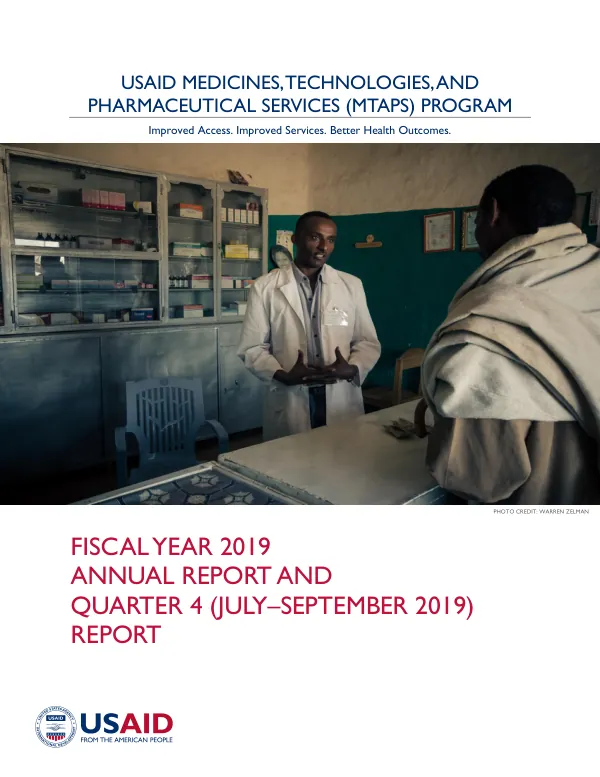
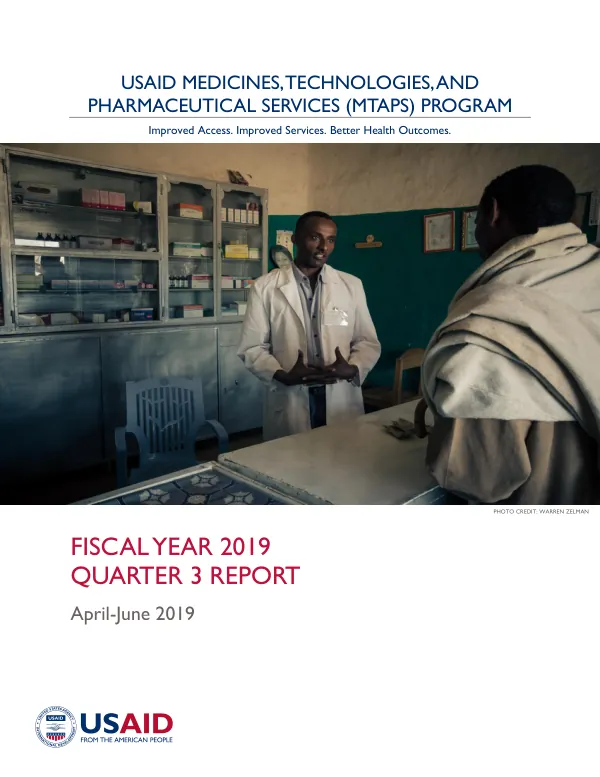
The USAID Medicines, Technologies, and Pharmaceutical Services (MTaPS) Program aims to strengthen pharmaceutical systems in low- and middle-income countries to ensure sustainable access to and appropriate use of safe, effective, quality-assured, and affordable essential medicines, vaccines, and other health technologies.
2020 · 132 pages
Sign in to readA free account is required to download.
Abstract
The program is implemented by a team led by Management Sciences for Health (MSH) and is funded by the US Agency for International Development (USAID). The goal of the MTaPS Program is to help low- and middle-income countries strengthen their pharmaceutical systems to ensure sustainable access to and appropriate use of safe, effective, quality-assured, and affordable essential medicines, vaccines, and other health technologies. The program's approach to strengthening pharmaceutical systems is based on USAID's Vision for Pharmaceutical Systems Strengthening, which posits that five functions of health systems must be strengthened to achieve sustained and equitable access to high-quality services: human resources, health finance, health governance, health information, and medical products/vaccines/technologies. The MTaPS Program has a comprehensive approach to strengthening pharmaceutical systems, which includes five main objectives: (1) strengthening pharmaceutical governance, (2) increasing institutional and human resource capacity for pharmaceutical management and services, (3) increasing the availability and use of pharmaceutical information for decision-making, (4) optimizing pharmaceutical sector financing, including resource allocation and use, and (5) improving pharmaceutical services to achieve better health outcomes. The program has made significant progress in achieving its objectives, with notable achievements including the strengthening of pharmaceutical governance in several countries, the increase in institutional and human resource capacity for pharmaceutical management and services, and the improvement in the availability and use of pharmaceutical information for decision-making. The program has also made progress in optimizing pharmaceutical sector financing and improving pharmaceutical services to achieve better health outcomes. The MTaPS Program has a strong focus on gender equality and women's empowerment, with a goal of increasing the participation of women in the pharmaceutical sector. The program has also made significant progress in improving access to essential medicines and health products, particularly for vulnerable populations. The program has a robust monitoring and evaluation system in place, with regular reporting and tracking of progress towards its objectives. The program's progress is reported quarterly to USAID, with a comprehensive report submitted at the end of each fiscal year. The MTaPS Program has a strong partnership with various stakeholders, including governments, civil society organizations, and the private sector. The program has also established partnerships with international organizations, including the World Health Organization (WHO) and the United Nations (UN). The program's success is attributed to its comprehensive approach, strong partnerships, and commitment to gender equality and women's empowerment. The program's achievements have contributed significantly to the improvement of health outcomes in low- and middle-income countries. The MTaPS Program has a strong focus on sustainability, with a goal of ensuring that the strengthened pharmaceutical systems are sustainable and self-sustaining. The program has established a robust capacity-building program to build the capacity of local institutions and individuals to manage and maintain the strengthened pharmaceutical systems. The program's success has also been attributed to its strong leadership and management, with a clear vision and strategy in place. The program's leadership has been effective in mobilizing resources and building partnerships to achieve the program's objectives. The program's success has contributed significantly to the improvement of health outcomes in low- and middle-income countries, with a focus on sustainable access to and appropriate use of safe, effective, quality-assured, and affordable essential medicines, vaccines, and other health technologies.
Related documents
Documents in this collection
 2020
2020USAID DEC
USAID Medicines, Technologies, and Pharmaceutical Services (MTaPS) Program: Quarterly Report Fiscal Year 2020, Quarter 1 (October–December 2019)
Open record 2020
2020USAID DEC