USAID DEC
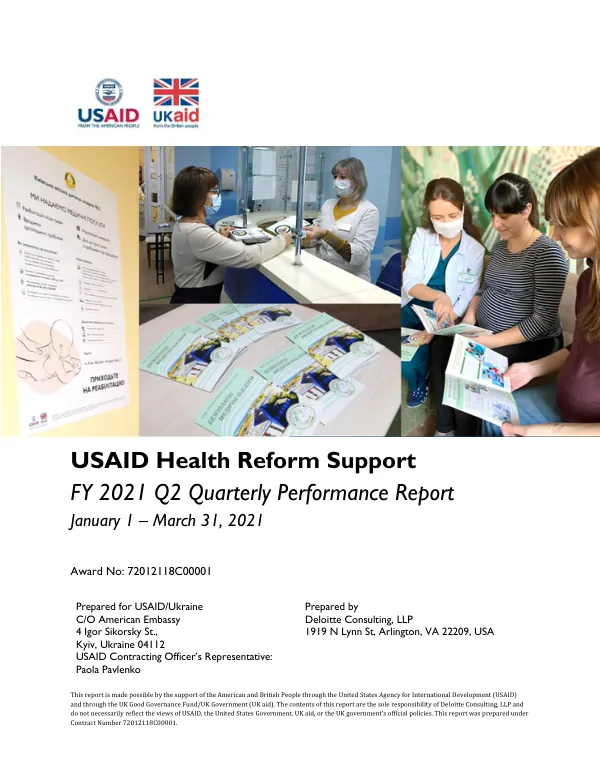
USAID Health Reform Support Quarterly Performance Report for Project Year (PY) 6 / Fiscal Year (FY) 2024 Quarter 2 (Q2): January 1, 2024 – March 31, 2024
Sign inDELOITTE CONSULTING, LLP
USAID Health Reform Support Quarterly Performance Report for Project Year (PY) 6 / Fiscal Year (FY) 2024 Quarter 2 (Q2): January 1, 2024 – March 31, 2024
The USAID Health Reform Support (HRS) project in Ukraine continued to pursue its dual goals of restoring and reforming the country's health system in Quarter 2 (Q2) of Project Year (PY) 6/Fiscal Year (FY) 2024.
2024 · 20 pages
Sign in to readA free account is required to download.
Abstract
To meet its objectives, HRS activities addressed sixteen key problem areas, which aligned with five strategic priorities. Capacity building of health care facilities (HCFs) and the Government of Ukraine (GOU) to reconnect people to care was a notable area of progress. HRS supported the "Harantovano!" Program of Medical Guarantees (PMG) awareness-raising campaign, which reached 7.3 million contacts and aimed to result in 10 million contacts in PY6/FY24. A pilot project was also completed to establish communication standards and increase patient awareness of free healthcare services in 10 HCFs, which will be scaled up to 100 HCFs by the end of PY6/FY24. HRS also issued three reconnecting people to care (RPC) grants to improve access to health services for 1.3 million patients across 60 communities in Dnipropetrovsk, Chernihiv, and Kharkiv oblasts. Additionally, eHealth data on palliative care needs was analyzed, and a local grantee was selected to improve palliative care at 40 primary healthcare (PHC) facilities in three target oblasts. Infrastructure and equipment repairs were also a focus area. Three HCF-level grants were completed for cosmetic repairs or equipment procurement under the Open Grant Application Program (OGAP), which will enable an estimated 2,145,000 patients to access restored health services in PY6/FY24. Furthermore, HRS assisted three HCF grantees in Kyiv and Chernihiv oblasts with improving their financial and non-financial employee incentives to better retain and attract health workers. The GOU's capacity to direct limited, multi-source resources during wartime was also addressed. HRS supported the Health Recovery Project Office (RPO) in coordinating healthcare sector recovery and restoration activities, including collecting and analyzing data on health infrastructure needs. The RPC Indicator Dashboard was launched to support analysis of restoration needs using data provided by eight USAID Office of Health implementing partners (IPs). Other notable progress included distributing Partner Activity Dashboards to the Ministry of Health (MOH), USAID OH, and the Sectoral Working Group, and sharing 12 Oblast Analytical Briefs with USAID OH and the RPO to improve coordination and data-driven decision-making. Additionally, the English language skills of 49 senior MOH staff were enhanced by an average rate of 28% to improve MOH communications with donors and partners. A demographic model was also programmed and triangulated core input data, which will be used to forecast future healthcare needs under different scenarios of population movement. In terms of cybersecurity, a campaign was conducted to raise awareness among medical professionals, receiving 239,138 views since the start of PY6/FY24 and exceeding the annual target by almost 90,000. The cybersecurity of 57 MOH critical information infrastructure objects (CIIOs) was also strengthened through three staff trainings.
Related documents