USAID DEC
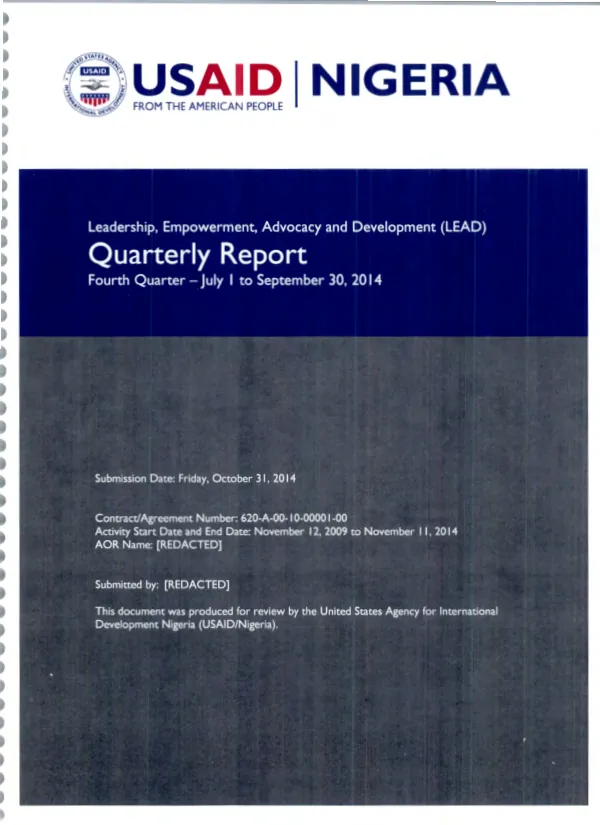
USAID I Nigeria Quarterly Report Nigeria Leadership, Empowerment, Advocacy and Development (LEAD), Fourth Quarter (July-September 2014)
Sign inRTI INTERNATIONAL
USAID I Nigeria Quarterly Report Nigeria Leadership, Empowerment, Advocacy and Development (LEAD), Fourth Quarter (July-September 2014)
The Leadership, Empowerment, Advocacy and Development (LEAD) program in Nigeria began in November 2009 and concluded in November 2014.
2014 · 44 pages
Sign in to readA free account is required to download.
Abstract
The program aimed to strengthen local government capacity, increase transparency in local government operations, and improve service delivery. LEAD's implementation principles emphasized collaboration, sustainability, and community engagement. The program focused on four objectives: strengthening local government capacity, increasing transparency in local government operations, increasing capacity of local organizations, and improving service delivery. Progress was made in all four areas, with notable achievements including the establishment of a water maintenance program in Sokoto State and the implementation of a service improvement plan in Bauchi State. Implementation challenges were encountered, particularly in achieving transparency in local government operations and increasing capacity of local organizations. The program's monitoring and evaluation plan was updated to address these challenges and ensure that progress was measured and reported accurately. The LEAD program also integrated cross-cutting issues, including gender equality, sustainability, environmental compliance, and youth development. The program's stakeholders participated in various activities, including a two-day CSO networking and education governance summit and a pre-2015 budget consultative meeting in Bauchi State. Key results from the program include a 27% increase in household income among program participants in Bauchi State and improved food security indicators across all target communities. The program also established a database for internally generated revenue in Bauchi State and conducted a basic education budget consultative workshop in Sokoto State. The LEAD program's achievements and challenges are summarized in the annexes, which provide detailed information on progress, implementation challenges, and lessons learned. The program's planned activities for the next quarter include the continuation of service improvement plans and the implementation of new initiatives to address emerging challenges. The program's overall goal was to improve the lives of Nigerians by strengthening local government capacity, increasing transparency, and improving service delivery. The LEAD program's achievements and lessons learned will inform future development initiatives in Nigeria.