USAID
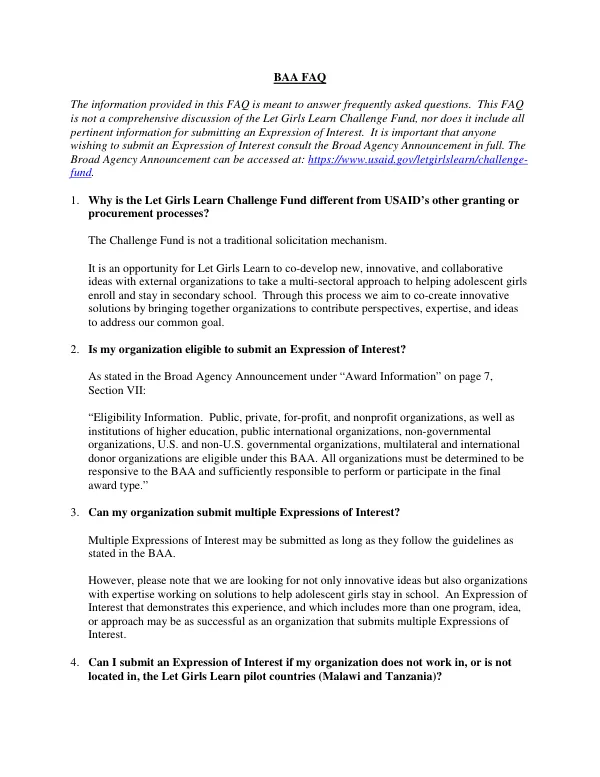
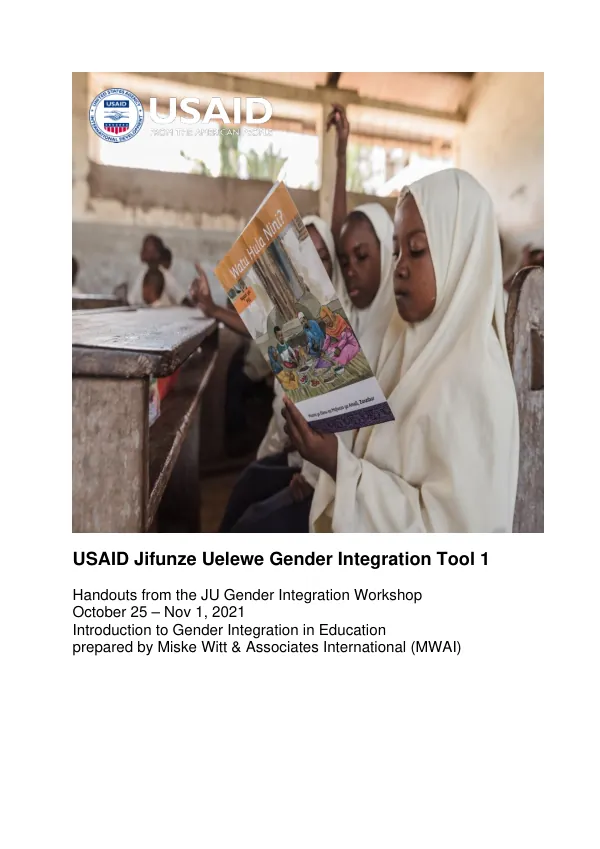
USAID Jifunze Uelewe Gender Integration Tool 1
Gender integration involves weaving an understanding of gender and what it means to move toward gender equality into all of our programming.
2021 · 16 pages
Sign in to readA free account is required to download.
Abstract
Gender integration involves identifying, and then addressing, gender inequalities during strategy and project design, implementation, and monitoring and evaluation. The roles and power relations between men and women affect how an activity is implemented, and it is essential that project managers address these issues on an ongoing basis. In Tanzania, and in Jifunze Uelewe, gender integration is essential for achieving gender equality. This is because gender equality is a human right, and a quality education that is gender equitable is the right of every girl and boy. Gender integration aims to make the world safer, more respectful, and more gender equitable for ourselves and for our daughters and sons. It also aims to build a world where every girl and boy can use her or his talents, intellect, skills, and skills without being told that they cannot do certain things because they are a girl or a boy, a woman or a man. Gender integration is a cross-cutting strategy for Jifunze Uelewe, and it is also an anticipated outcome of the project. The project is funded by USAID, and USAID is committed to gender equitable education and gender equality throughout all its programming. Gender integration is essential for achieving Sustainable Development Goal #4 – Quality Education, and Goal #5 – Gender Equality. To achieve gender integration in all components of the Jifunze Uelewe project, we will work together and with our partners to: integrate gender into our workplace and activities related to the three components; develop gender-responsive management; and develop gender-responsive Monitoring, Evaluation, and Learning (ME&L). Gender refers to the social definitions of roles, rights, entitlements, and responsibilities of girls and women, and of boys and men. Social definitions of what it means to be girls and women, or boys and men, vary among cultures and over time. Examples of gender include: most nurses are female; most daladala drivers are male; and Maasai women build houses. Sex refers to the biological characteristics that define humans as female or male. Examples of sex include: men can get prostate cancer; women can get breast cancer; and women can breastfeed babies. Gender equality is a condition that gives the same opportunities and supports for both males and females. Gender equality aims for more freedoms and improved quality of life for both males and females without sacrificing for either. Gender equity means fairness and justice in the distribution of benefits and burdens between women and men. To ensure fairness, temporary positive measures must be put in place to compensate for the historical and social disadvantages that prevent women and men from operating on a level playing field. Gender bias is the tendency to assume one gender as preferable over another for a specific role, responsibility, or privilege. Gender integration involves identifying and addressing gender inequalities during strategy and project design, implementation, and monitoring and evaluation. Since the roles and power relations between men and women affect how an activity is implemented, it is essential that project managers address these issues on an ongoing basis. Gender parity refers to the equivalent percentages of males and females in an education system. Parity is essential but not solely sufficient for achieving gender equality. Gender parity is achieved when 95% of boys and 95% of girls are enrolled in a nation's schools. Gender parity is also achieved when 50% of men and 50% of women hold leadership roles in an organization. Gender responsiveness refers to a program or report that fulfills two basic criteria: a) gender norms, roles, and relations are considered; and b) measures are taken to reduce the harmful effects of gender norms, roles, and relations, including gender inequality. Gender responsiveness is achieved when a program or report considers the needs and interests of both men and women, and when measures are taken to reduce the harmful effects of gender norms, roles, and relations. The Seven Principles of Gender Integration are a set of guidelines for achieving gender integration in all sectors, including education. The Seven Principles include: applying a gender lens; recognizing needs and interests as different and equal; rebalancing power and control over resources and decision-making; and involving managers and leaders from the top, as well as all staff involved in program implementation. The Seven Principles of Gender Integration are essential for achieving gender equality and gender equality in all sectors, including education. By applying a gender lens, recognizing needs and interests as different and equal, and rebalancing power and control over resources and decision-making, we can achieve gender equality and gender equality in all sectors, including education.
Related documents