INDONESIAN MINISTRY OF RESEARCH, TECHNOLOGY, AND HIGHER EDUCATION
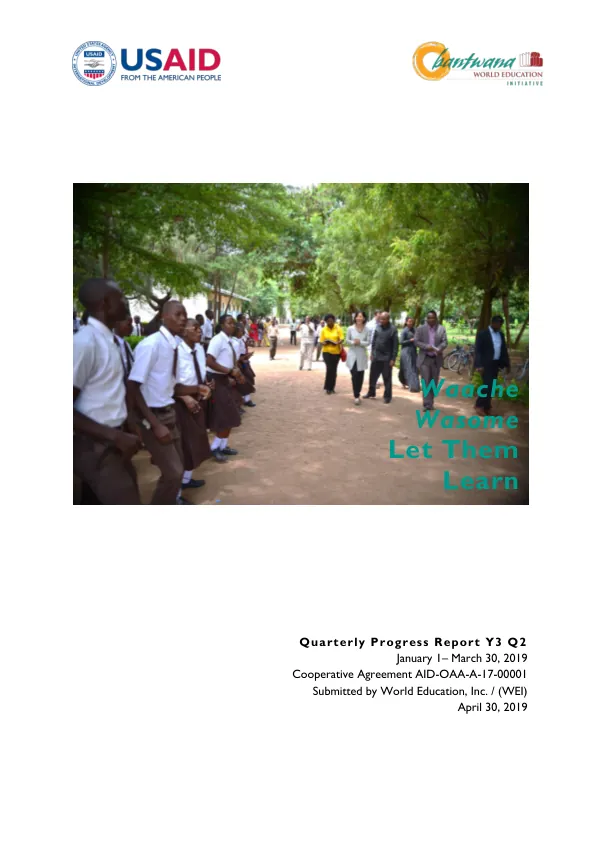
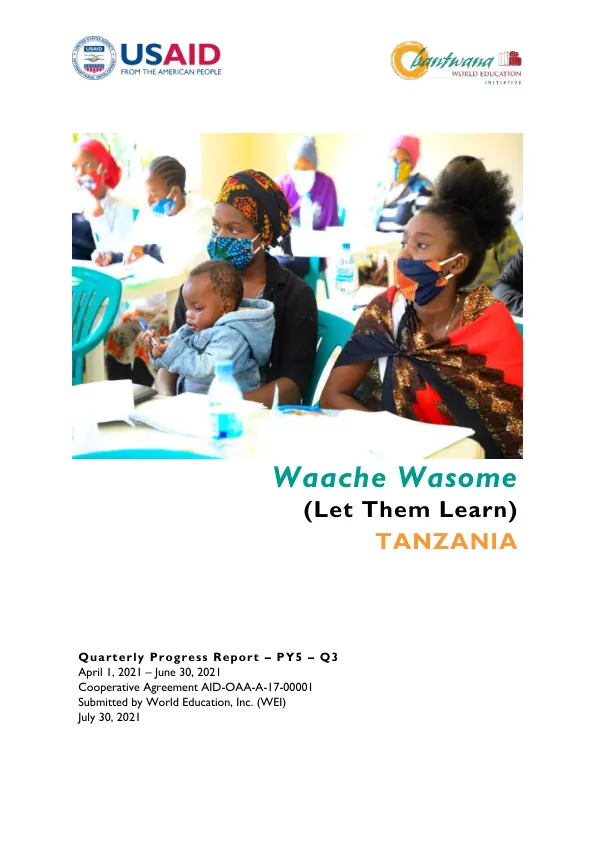
Waache Wasome Let Them Learn Tanzania | Y2 Q2 Progress Report
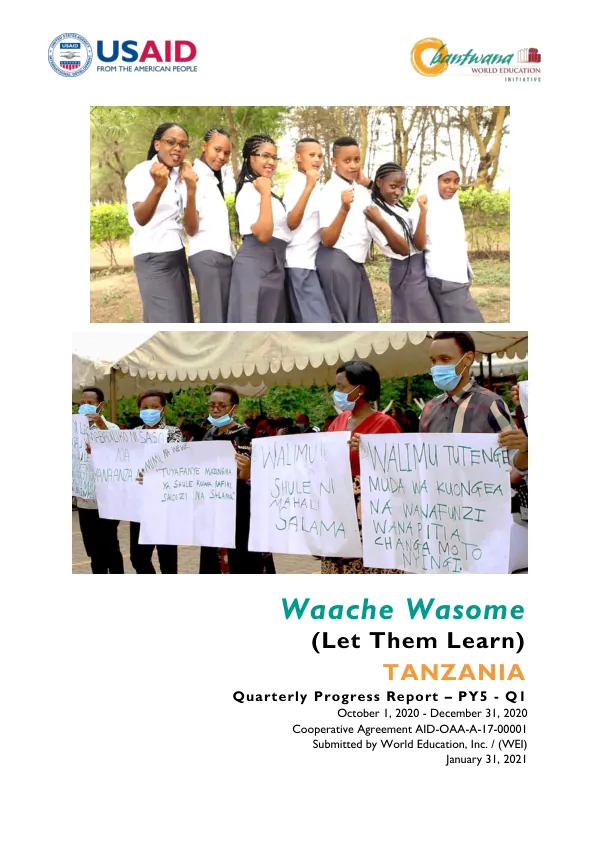
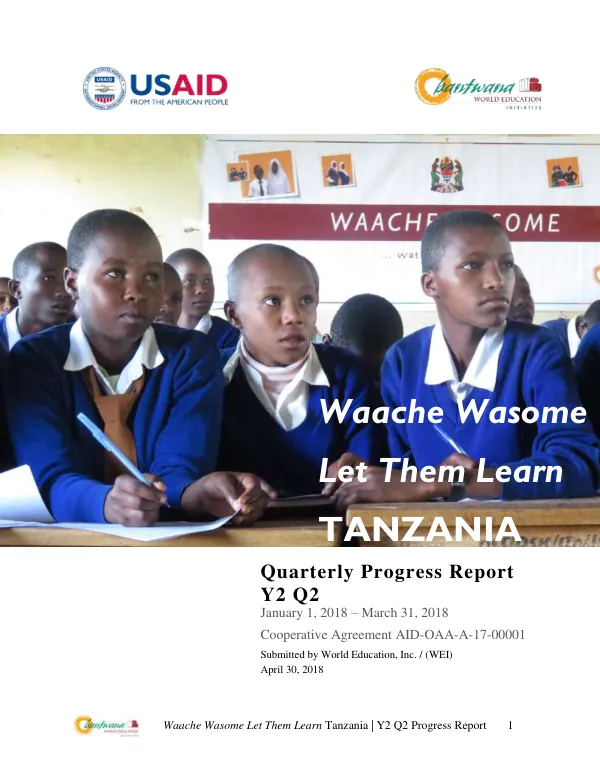
Waache Wasome Let Them Learn Tanzania is a five-year project funded by USAID, implemented by World Education, Inc.'s Bantwana Initiative (WEI/Bantwana), aimed at increasing adolescent girls' enrollment and retention in both formal secondary school and alternative education pathways.
2018 · 36 pages
Sign in to readA free account is required to download.
Abstract
The project takes a 'whole-of-girl' approach, rooted in the principles of human-centered design and addressing harmful gender norms. This model empowers adolescent girls to create and achieve goals for their future, while addressing the intersectional social norms and economic barriers that constrain their ability to remain and excel in school. The project kicked off Phase I in 30 additional schools in the four target districts of Karatu DC, Tarime DC, Musoma MC, and Musoma DC. WEI/Bantwana established 130 new Protect Our Youth (POY) Clubs in the 36 total project schools, with 5,025 students enrolled, of which 60% are girls. The project also helped the newly enrolled POY members to select 260 peer educators (130 girls) and 72 matron/patrons (36 female) to run Club activities at their respective schools. WEI/Bantwana trained the 34 matron/patrons and 121 peer educators (60 girls) selected by the 17 Karatu DC schools with support from Karatu LGAs. These trainings will continue in the other project districts in Q3. POY Club materials were updated to reflect lessons learned in the pilot phase and underwent an LGA technical review to make further improvements to the content. This quarter, 36 LGA (10 female) representatives in Phase I project districts were oriented to the POY Club model. A total of 618 members (87% women) from 24 Livelihood Improvement for Mothers and Caregivers of Adolescents (LIMCA) groups continued their savings and lending activities this quarter, issuing a total of 271 micro-loans (value of TZS 23,978,300) and bringing their total cumulative savings to TZS 72,491,000 ($32,434). Supportive supervision visits were conducted with each LIMCA group to continue capacity development of group leaders. The LIMCA model was introduced to LGAs and heads of school from the 36 project schools where implementation is rolling out in Phase I. WEI/Bantwana also collaborated with teachers at each of the 36 project schools to administer a survey to Form I students that will help target households for LIMCA participation and to identify potential Economic Empowerment Volunteers. During this quarter, WEI/Bantwana facilitated School-Related Gender-Based Violence Training Workshop Segment I for 44 teachers (11 female) and the heads of school for the four project schools in Tarime DC. Rollout of SRGBV training will be directly implemented by District Master Trainers (DMT) for subsequent districts. WEI/Bantwana identified eight DMT candidates in Karatu DC this quarter, these DMTs will complete a ToT along with the other district DMTs to be identified next quarter. WEI/Bantwana also organized a technical review of the SRGBV teacher training materials with 31 LGA representatives to solicit feedback and help ensure the content is well aligned to the Tanzanian context. During this quarter, feedback was gathered from project schools on their experience with Subject Clubs to help inform revitalization efforts moving forward. Subject Club activities were focused in five Karatu DC schools this quarter where WEI/Bantwana enrolled 783 (416 girls) Form II and Form IV student participants. This quarter WEI/Bantwana was also heavily involved in identifying and selecting sub-grantee partner organizations that will support direct implementation of Waache Wasome starting in Q3. WEI/Bantwana also established a collaborative relationship with a local SRH champion, Human Cherish, which was involved in facilitating SRH training sessions for POY peer educators. The project's interventions are in line with the priorities of the Government of Tanzania, including the Law of the Child Act of 2009 and the National Plan of Action to End Violence Against Women and Children (NPA-VAWC). Waache Wasome's strong links to the goals, objectives, and priority activities laid out in the NPA-VAWC are clear in the POY Club, SRGBV teacher training, LIMCA, and parenting skills models. Activities under Objective 3 include seeking to equip teachers and school administrators with the knowledge and skills to uphold the Law of the Child Act (2009), to prevent and respond to violence in schools, and to promote a safe and supportive learning environment for all students. The project's focus on empowering adolescent girls to create and achieve goals for their future, while addressing the intersectional social norms and economic barriers that constrain their ability to remain and excel in school, is a critical component of the project's overall strategy. By taking a 'whole-of-girl' approach, the project aims to ensure meaningful engagement of adolescents throughout the
Related documents