USAID DEC
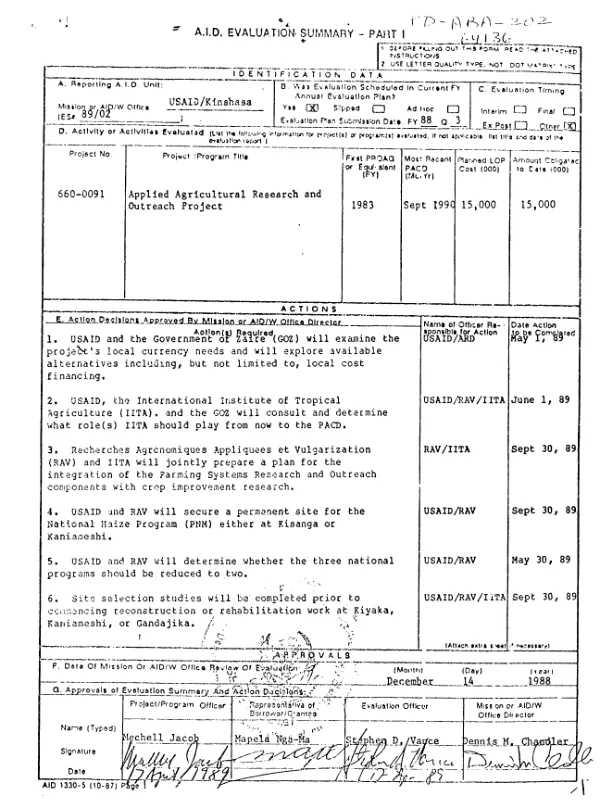
USAID/Kinshasa, Zaire, applied agricultural research and outreach project, 660-0091 : threshold decision evaluation
Sign inCHEMONICS INTERNATIONAL, INC.
USAID/Kinshasa, Zaire, applied agricultural research and outreach project, 660-0091 : threshold decision evaluation
Evaluation of a project to increase the capability of Zaire's Department of Agriculture to conduct farming systems research (FSR) and crop improvement research and to provide extension services.
Wedeman, Miles G.|Tollens, Eric F. · 1988
Sign in to readA free account is required to download.
Abstract
External evaluation covers the period 9/83-12/88. Crop research has made excellent progress. Several improved varieties have been distributed, including more than 10,000 kg of maize seed and an average of 245,000 m of cassava cuttings each year from 1986 to 1988. A national food crops research institution for cassava, maize, and grain legumes is in place and functioning. Training of Zairian personnel will be completed by the PACD and the concept and quality of the training program are good; synchronization of training and TA has not occurred, however. FSR and outreach are underway, although these components have not been integrated with crop improvement research and accomplishments have been disappointing. TA provided by the International Institute of Tropical Agriculture (IITA) has been uneven, of poor quality, and adversely affected by IITA's weak leadership. The project's major handicap is the lack of vehicles, equipment, and supplies. Lack of transport for on-farm trials, village-level studies, etc. seriously hampers FSR, outreach, and crop research. The project also suffers from a shortage of local currency resources and is totally dependent on USAID/Z for local costs. No prospect exists for the program to become self-sustaining in the next five years. It is thus recommended that the three national research programs be reduced to two - cassava and maize - and that relocation of major research facilities be considered. Also, the maize program is threatened by its shaky hold on its facilities at Kisanga. It is important that the program be assured a secure footing at that location. Several lessons were learned. (1) Project objectives should be internally consistent. This project suffers from having three distinct objectives. (2) USAID should avoid detailed involvement in project management and administration. (3) International agricultural research centers - in this project, IITA, which possesses no comparative advantage in management and outreach - should be retained only with a clear and precise understanding of what they are best qualified to do. (4) Integration of FSR and outreach with crop improvement research requires agreement on what FSR is and an extended learning process.
Related documents