USAID DEC
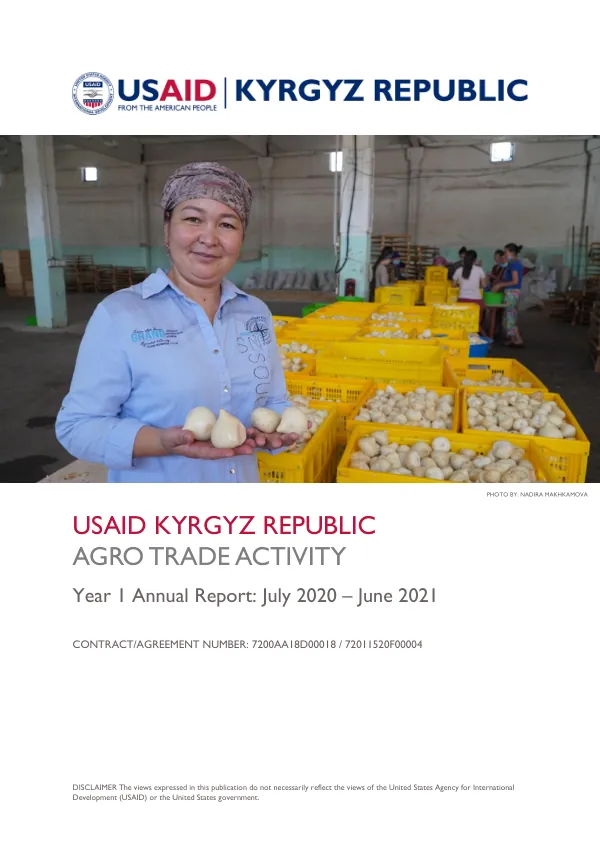
USAID Kyrgyz Republic Agro Trade Activity Year 1 Annual Report: July 2020 – June 2021
Sign inCHEMONICS
USAID Kyrgyz Republic Agro Trade Activity Year 1 Annual Report: July 2020 – June 2021
The USAID Kyrgyz Republic Agro Trade Activity (ATA) is a new project that aims to strengthen the capacity of market systems actors in the agribusiness sector to improve production, increase sales, and create jobs.
2021 · 30 pages
Sign in to readA free account is required to download.
Abstract
The project focuses on the southern part of the country, where it works with local businesses, farmers, and government entities to achieve its objectives. The project's first year of implementation, from July 2020 to June 2021, was marked by several important advances and challenges. One of the key accomplishments of the project was the creation of jobs for 244 people in the three target oblasts, equivalent to 26.17 full-time employment jobs. The project also worked with companies to sponsor training for farmer suppliers, which will build a base for further jobs, output, and export in coming years. Of the 244 people, 40 are employed formally, and the remaining 204 people are farmers who supply raw material to processors. The project also assisted farmers by working with a small business, Janylai Kaparova, a woman entrepreneur in Bazar-Korgon district, Jalal-Abad. The project provided training and technical assistance to Kaparova, facilitating connections to interested farmers to increase production, and later awarded her an in-kind grant to start the application process. Kaparova's small business processes and exports wild garlic (Allium ursinum) to Uzbekistan. The project trained 185 farmers, mostly in remote and isolated areas, to produce wild garlic, resulting in an increase in yield and income generation for the farmers. Another key accomplishment of the project was the creation of businesses and jobs by training local residents to fill an identified business niche. The project assisted Bai Diykan Ala Buka cooperative in Ala-Buka district of Jalal-Abad to help interested cooperative members fill a market need for tree care services. After completing ATA-sponsored trainings, 22 cooperative members began providing paid pruning and spraying services to 413 farmers with 220,250 trees on 629.40 ha, generating additional revenue of 2.37 million KGS in March-June 2021. The project also worked with local government to create business-to-business sales. In June 2021, the project supported the Jalal-Abad oblast government to host a Jalal-Abad – Namangan Business Forum, attended by 120 businesspeople from the Namangan region of Uzbekistan and Kyrgyz businesses. The project contributed to the development of the agenda, hosted business-to-business meetings during the forum, and provided logistical and informational support to the forum. Five contracts to supply meat, animal feed, fruits, and vegetables, with an overall value of around $3 million US dollars, were signed during the forum. The project also expanded opportunities for women and got the Kyrgyz government involved. The project and the Women Entrepreneurship Development Fund (WEDF) hosted a three-day training, coaching, and networking event in Osh city from June 18 to 21, 2021, focused on business acceleration to explore new ideas and business opportunities, as well as learn new skills and expand women's entrepreneurial networks. High-level Kyrgyz government officials attended the event, and the women participants were able to develop their business models, including a needs assessment, using strategic planning tools. The project also used grants to initiate economic improvement. On October 18, 2020, the project released its first grants annual program statement (APS-001) for the application period of October 18, 2020, through September 30, 2021. The project provided grants to support the development of small and medium-sized enterprises (SMEs) in the agribusiness sector, with a focus on women-led businesses. The grants were used to support the development of business plans, marketing strategies, and other activities that will help SMEs to grow and become more competitive in the market. Overall, the project's first year of implementation was marked by several important advances and challenges. The project created jobs, assisted farmers, created businesses and jobs, worked with local government to create business-to-business sales, expanded opportunities for women, and used grants to initiate economic improvement. The project's accomplishments demonstrate its commitment to strengthening the capacity of market systems actors in the agribusiness sector to improve production, increase sales, and create jobs in the southern part of the country.