USAID DEC
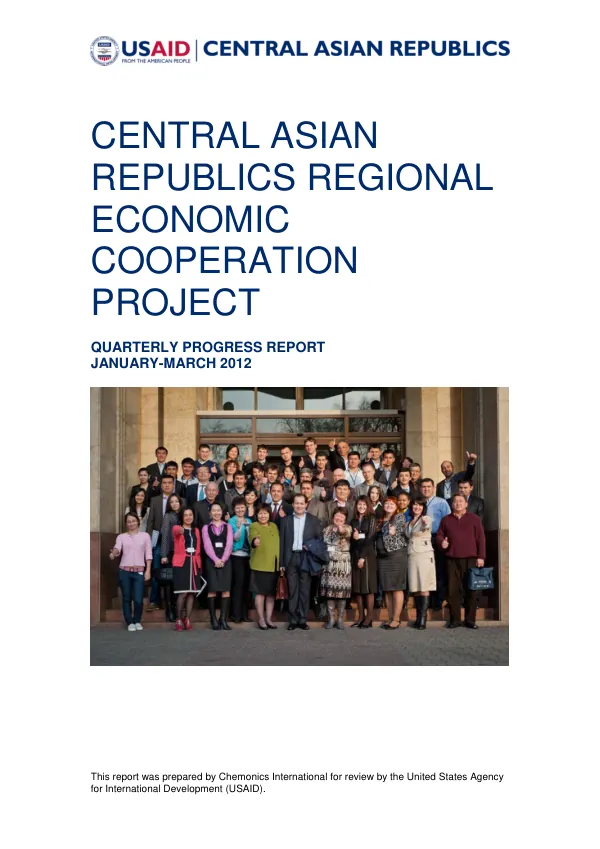
Central Asian Republics Regional Economic Cooperation Project Quarterly Progress Report January-March 2012
Sign inCHEMONICS
Central Asian Republics Regional Economic Cooperation Project Quarterly Progress Report January-March 2012
The Central Asian Republics Regional Economic Cooperation Project began operating on September 29, 2011.
2012 · 23 pages
Sign in to readA free account is required to download.
Abstract
This is the second quarterly report of the Project. During the first three months, the team focused on creating the project's foundation and organizing its operations. Multiple activities were implemented per component, and the following achievements were made: Organized two focus groups with the Organic and Textiles Export Partnerships Groups (EPG) respectively; designed EPGs action plans and received USAID approval for their implementation; organized and successfully conducted an Export Partnerships Initiative (EPI) training in Almaty with the participation of nearly 60 selected export companies, representing Kazakhstan, Uzbekistan, Kyrgyzstan, and Tajikistan; cooperated with the European Bank for Reconstruction and Development (EBRD) and Germany Agency for International Cooperation (GIZ) by providing them a slot to present their programs at the first EPI training; maintained exporters' database of more than 500 Central Asian companies; planned upcoming technical assistance for KazNexInvest; made a presentation at the meeting of Defense Logistics Agency (DLA) contractors, KazBuild exhibition; represented the REC project at a meeting with the DLA leadership in Washington, DC; prepared draft outlines and started discussing the content of the Kazak and Uzbek manuals on "How to Export to the Department of Defense (DOD)", through the Northern Distribution Network (NDN); enhanced cooperation with DLA, prime vendors (PV)s, and DOD suppliers, generating first survey results on processes, procedures, barriers on doing business with DOD; identified several candidate companies to supply to DOD, and started to organize technical assistance. The Project continued to strengthen its presence and operations in Uzbekistan. The Project hired two Center for Economic Development (CED) experts, who began contributing to the implementation of project activities in Uzbekistan: assisted in organizing a survey with DOD suppliers, started to select potential DOD suppliers, and participated in other Project operational matters. However, there are still barriers to work with the main Uzbek governmental counterparts, including the lack of approval from the Uzbek Cabinet of Ministries to organize the meeting of export promotion agencies or the third session of Export Partnership Initiative (EPI) training in Tashkent. From the administrative perspective, the Project hired a new Communications and Grants Manager, who will be finalizing the Project's web site and implementing the Branding and Marking Plan; and received approval to hire a Component 1 Coordinator to support the activities under the Export Partnerships Initiatives. Component 1: Export Partnership Initiative (EPI) During the reporting period January to March 2012, Component 1 activities were focused on launching the Export Partnership Initiative (EPI) program. The Project supported the existing Export Partnership Groups (EPG), selected participants for the EPI program, and prepared the EPI Training program in partnership with the Central Asian Tax Research Center (CATRC) of Kazakhstan Institute of Management, Economics and Strategic Research (KIMEP). The Project organized meetings, focus groups, and interviews with the above-mentioned counterparts. EPI Training The Project drafted, and USAID approved the EPI training plan. In January, the Project announced the launch of the EPI program, and distributed an on-line recruitment survey among non-governmental organizations (NGO), exporters, businesses, and industry associations, among others. In order to attract participants to the Component 1 training, the Project published advertisements in local mass media in Kyrgyzstan, Kazakhstan, and Tajikistan. To attract participants from Uzbekistan, the Project contracted UBI Consulting LLC to identify Uzbek companies and assist them in completing online application forms. The Component 1 Leader provided consultations for the applicants on the training by e-mail and phone. In February, 193 suppliers were selected from the application pool, based on likelihood of generating new exports, likelihood of receiving long-term benefits, overall readiness to export, and demonstrated commitment to participate in the program. In March, the final list of participants for EPI program was identified. The Component 1 Leader worked closely with CATRC of KIMEP in preparing a comprehensive agenda for the 1st session of the EPI Training. 57 selected participants attended the 1st session of the EPI Training, held at the "Ala Tau" sanatorium from February 29-31. Support of the existing Export Partnership Groups (EPG) Two existing Export Partnership Groups (in Organic Farming and Textiles) were invited to Almaty for a focus group discussion aimed at updating their current status, identifying challenges and capacity building needs, which would be addressed within the framework of the REC Project. The Organic farming focus group discussion took place from January 27-28, and the Textiles focus group took place from February 8-9 respectively. After two days of intensive discussions, two action plans were drafted. These included a description of activities, establishment of a timeline, and definition of roles and responsibilities. The Component 2 leader supported these activities and will support the implementation at least two market surveys for the existing