FEDERATION MINISTRY OF ENERGY, MINING AND INDUSTRY
USAID/Lebanon Community Support Program Task Order No. 5 Work Plan, FY2021
The Lebanon Community Support Program (CSP) Task Order No.
2021 · 27 pages
Sign in to readA free account is required to download.
Abstract
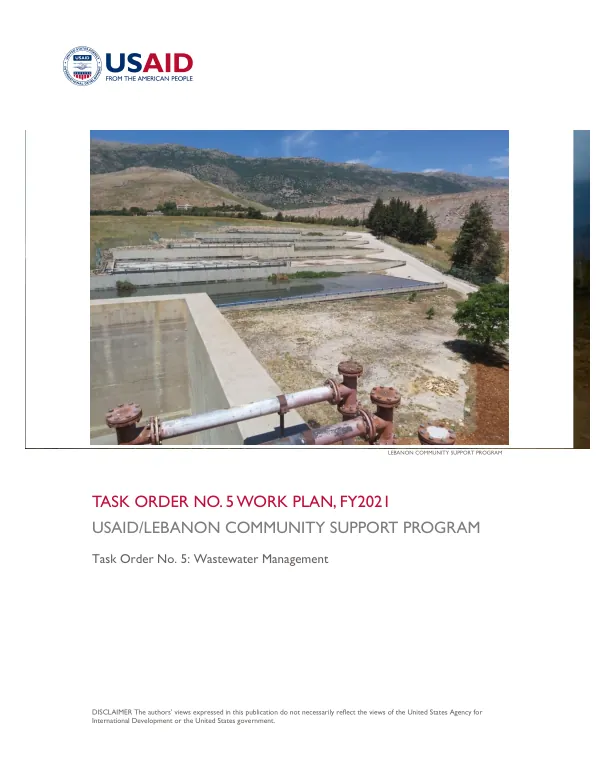
5 Work Plan for FY2021 aims to improve wastewater management in Lebanon. The country is facing significant economic and social challenges, including a devastating explosion in Beirut, a surge in COVID-19 cases, and a severe economic crisis. The regional water establishments (RWEs) are struggling to provide adequate water services and marginal wastewater services due to a dwindling tariff collection rate, electrical power outages, and a lack of government funding. The RWEs face numerous challenges, including a shortage of staffing, limited institutional and technical capacities, and uncoordinated decision making among stakeholders. The wastewater sector in Lebanon has historically been neglected, with only recent efforts to implement wastewater infrastructure to reduce untreated or insufficiently treated industrial and domestic wastewater discharge into the country's waterways. The CSP Task Order No. 5 aims to address this shortfall in infrastructure and alleviate tensions in regions where pollution poses a threat to human health, the environment, and the economy. The program will implement sustainable interventions to improve wastewater management, partnering with the Ministry of Energy and Water, RWEs, the Litani River Authority, and other stakeholders. The CSP program has three components: Community Stabilization Support, Community Development Support, and Technical Assistance Support for Essential Services. Task Order No. 5 falls under the Community Development Support component, which provides medium to long-term support to address priority development needs and fill gaps in access to resources. The program's objectives are to improve lives and reduce tensions that may contribute to conflict and violence in Lebanon's North, South, and Beqaa regions. The CSP uses a flexible and locally driven approach to address each community's unique dynamics, partnering with local governments, civil society organizations, and the private sector. The wastewater management activity under Task Order No. 5 aims to achieve the following minimum results: improve wastewater collection and treatment infrastructure, enhance wastewater treatment capacity, and increase public awareness and education on wastewater management practices. The program will also provide technical assistance and capacity building to local partners and workforce development and job placement for underserved youth. The implementation of Task Order No. 5 will involve several key activities, including feasibility studies and cost-benefit analysis, environmental assessment, engineering design and construction specifications, tendering and awarding of construction contracts, construction implementation, and verification of performance and administering rebates. The program will also provide capacity building to enhance sustainability and infrastructure interventions. The program will focus on the North, South, and Beqaa Valley regions, where the RWEs are struggling to provide adequate water services and marginal wastewater services. The program will also address the challenges faced by the RWEs, including a shortage of staffing, limited institutional and technical capacities, and uncoordinated decision making among stakeholders. The implementation of Task Order No. 5 will be carried out in partnership with local governments, civil society organizations, and the private sector, using a flexible and locally driven approach to address each community's unique dynamics. The program will also provide technical assistance and capacity building to local partners and workforce development and job placement for underserved youth. The program's success will be measured by the achievement of the following indicators: improved wastewater collection and treatment infrastructure, enhanced wastewater treatment capacity, increased public awareness and education on wastewater management practices, and increased employment opportunities for underserved youth.