USAID
USAID-Livestock Market Development Second Quarter Report (Oct.-Dec. 2014)
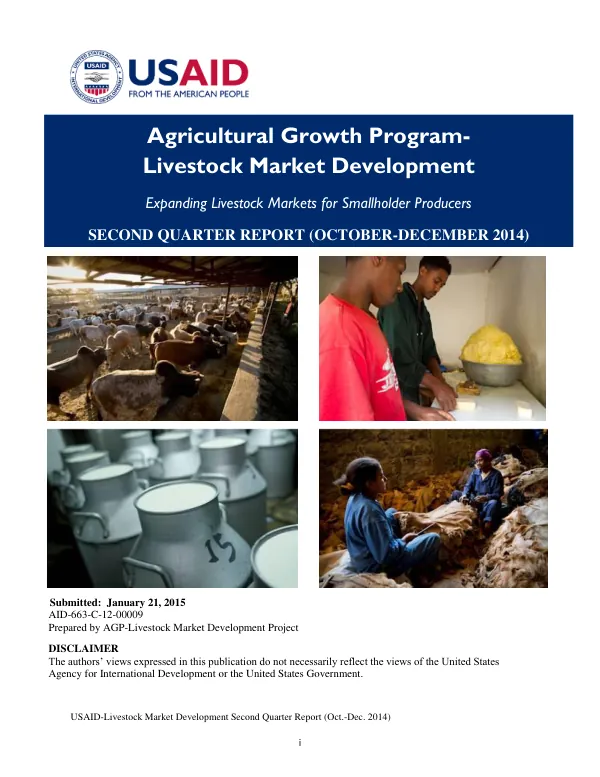
The Agricultural Growth Program-Livestock Market Development (AGP-LMD) project is a USAID-funded initiative aimed at expanding livestock markets for smallholder producers in Ethiopia.
2015 · 93 pages
Sign in to readA free account is required to download.
Abstract
The project's primary objective is to improve the productivity and competitiveness of livestock value chains, ultimately enhancing the nutritional status of rural households. During the second quarter of 2014 (October-December), the project focused on implementing activities related to grants, catalytic and innovative support to the private sector, and engagement with government institutions. The project's performance indicators showed significant progress in various areas, including the establishment of a livestock market information system, the development of a business plan for a dairy cooperative, and the provision of training to farmers on improved livestock management practices. Component 1 of the project, "Moving from Analytics to Strategy to Learning," focused on developing a comprehensive understanding of the livestock value chain in Ethiopia. This component involved the collection and analysis of data on the livestock sector, as well as the development of a strategy for improving the productivity and competitiveness of the value chain. Component 2, "Improve the Productivity and Competitiveness of Livestock Value Chains," involved the implementation of several strategies aimed at improving the productivity and competitiveness of the value chain. These strategies included linking value chain actors to input and service providers, establishing and strengthening input suppliers and service providers, improving livestock management, and improving post-production relationships, efficiencies, and quality. Component 3, "Spur Investment and Innovation," focused on stimulating investments and access to finance throughout the value chain. This component involved the use of innovation grant funds to strengthen value chain businesses and stimulate investments in the sector. Component 4, "Improve the Enabling Environment of Livestock Value Chains," involved the facilitation and empowerment of stakeholders for policy reform and advocacy. This component also included capacity building for public and private stakeholders, institutional coordination among stakeholders, and applied research for development. Component 5, "Enhance the Nutritional Status of Rural Households," focused on improving the quality and diversity of household diets through the intake of livestock products. This component involved behavioral change and communication, as well as the improvement of availability of livestock-based foods. The project's progress was monitored and evaluated through various indicators, including the number of farmers trained, the number of livestock market information system users, and the number of value chain businesses strengthened. The project's performance was also evaluated through the use of a results framework, which tracked progress against specific indicators and targets. Overall, the AGP-LMD project made significant progress during the second quarter of 2014, with notable achievements in the areas of grants, catalytic and innovative support to the private sector, and engagement with government institutions. The project's focus on improving the productivity and competitiveness of livestock value chains, as well as enhancing the nutritional status of rural households, is expected to have a positive impact on the livelihoods of smallholder farmers and rural communities in Ethiopia.
Related documents