USAID DEC
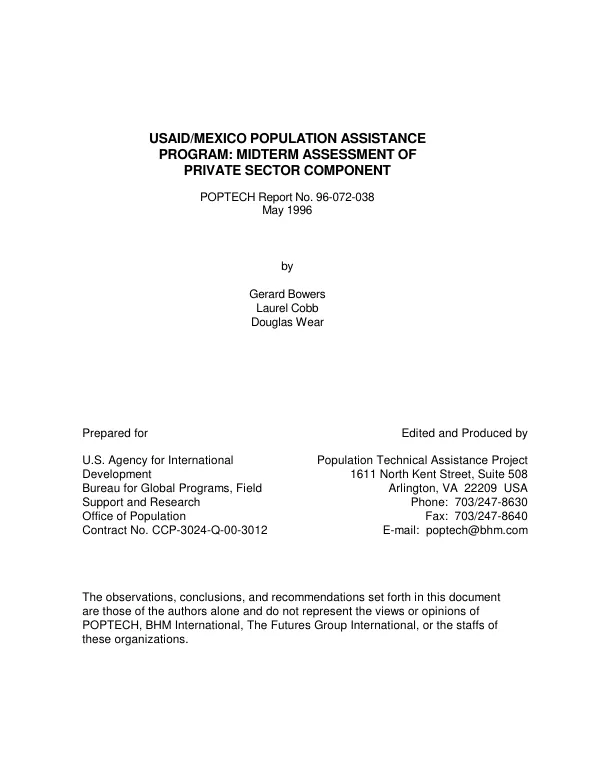
USAID/Mexico population assistance program : midterm assessment of private sector component
Sign inBASIC HEALTH MANAGEMENT INTERNATIONAL (BHM)
USAID/Mexico population assistance program : midterm assessment of private sector component
Evaluates progress made by two private Mexican family planning (FP) organizations -- MEXFAM (an affiliate of the International Planned Parenthood Foundation or IPPF) and FEMAP (the Mexican Federation of Private Associations for Health and Community Development) in achieving financial self-sustainability.
Bowers, Gerard; Cobb, Laurel +1 more · 1996
Sign in to readA free account is required to download.
Abstract
The evaluation covers the period 1992-2/96. USAID"s assistance to MEXFAM and FEMAP has been channeled primarily through IPPF"s Transition Project, but also through other centrally funded projects. Shortly before the evaluation, a significant reduction in USAID"s population assistance budget, along with other efforts to streamline Agency programming, strengthened USAID/Washington"s resolve to conclude population assistance activities in Mexico in the near future. USAID/Mexico and MEXFAM, however, had expected a longer relationship and are concerned that an early phase-out will disrupt MEXFAM"s program. MEXFAM and FEMAP have played significant and valuable roles in promoting the reproductive health of Mexico"s poorest citizens. Both organizations have strong, dedicated managers and staff, and have developed innovative ways to deliver FP information and services to "hard-to-reach" and marginalized groups. USAID staff, in both Washington and Mexico, attach a very high value to their long-standing partnership with MEXFAM and FEMAP. The two organizations have approached the challenges of an assistance phase-out in very different ways. MEXFAM, having assumed that USAID support would continue for several more years, has used USAID resources to (1) continue most elements of its service and information delivery program, with emphasis on poor rural and peri-urban populations (the "social program"); and (2) launch a series of medical clinics (the CSMs), designed to serve middle-class clients and generate enough eventually to replace USAID funds currently used to support MEXFAM"s social program. According to this evaluation, however, the CSMs will not achieve their projected earnings, although many of them may break even or realize modest profits if given enough time to develop a client base. Absent this expected income, major elements of the social program are vulnerable to significant and unanticipated cutbacks. It is recommended that MEXFAM make some overdue adjustments now to the social program -- including the near elimination of the low-impact, high-cost Industry program (PIN) and commodity transfer activities such as the Program of Technical Cooperation (PCT) -- and begin a rigorous strategic planning process to identify and develop a new role for the organization. Given MEXFAM"s late start in getting this process underway, the team recommends a 1-year extension of support. USAID should continue contraceptive assistance to MEXFAM during this period, though at lower levels than in the past, and should assist MEXFAM in obtaining more cooperation from commercial vendors on contraceptive pricing and product registration. FEMAP, as a decentralized network of largely autonomous and self-supporting organizations, is less vulnerable to reductions in USAID funding than is MEXFAM. FEMAP was therefore able to use USAID funds and TA to strengthen its technical and management capacity, and to help transfer these skills to some 18 of its 44 affiliates. Indeed, FEMAP"s leadership is not greatly concerned about a phase-out of USAID assistance -- except regarding their need to secure favorable commercial prices for oral contraceptives currently donated by USAID. USAID should extend its assistance relationship with FEMAP for an additional year so that both parties can address this contraceptive supply issue. Finally, USAID, MEXFAM, and FEMAP should begin to develop the framework for a continuing collaborative relationship. That framework could include, for example, identifying a joint agenda for operations research; trials/demonstrations of innovative ways to reach young adults, men, or other hard-to-recruit groups; and utilization of MEXFAM and FEMAP as regional training centers, as sources of TA for developing country programs, and as partners with USAID, other U.S. Government agencies, and U.S. NGOs in developing responsible reproductive health policies and priorities and presenting them at donor and international fora. (Author abstract, modified)