USAID
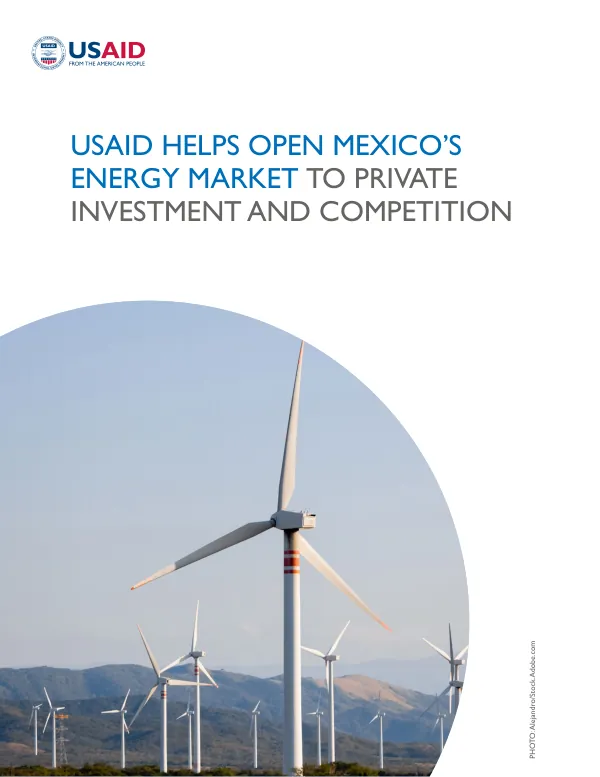
USAID Opening Mexico’s Energy Market to Private Investment and Competition
Mexico's energy market has been characterized by high costs due to inefficient government monopolies in electricity, oil, and gas.
2021 · 7 pages
Sign in to readA free account is required to download.
Abstract
Petróleos Mexicanos (PEMEX) and the Comisión Federal de Electricidad (CFE), national oil and electricity companies, were restricted from working with private and international companies, limiting the country's ability to take advantage of rapidly evolving renewable energy technologies. As a result, consumers and businesses faced high electricity costs. In 2013, Mexico implemented a constitutional reform that ushered in free enterprise, competition, and direct private investment in the energy sector. Policymakers aimed to reduce energy costs, increase national energy security, attract investment to modernize the energy sector, and power economic growth. The country also sought to cut greenhouse gas emissions, particularly in the energy sector, and pledged to increase the share of energy coming from renewable energy sources from 18 percent to 35 percent by 2024. To achieve these goals, Mexico held three renewable energy auctions between 2016 and 2017, with the help of the U.S. Agency for International Development (USAID). The auctions resulted in renewable energy projects that diversified Mexico's energy mix and increased private investment in the energy sector. Total investment in the three auctions was roughly $9 billion, with investors from 12 countries, and more than $1 billion in energy projects awarded to U.S. firms. The auctions achieved progressively lower prices, with the average price decreasing from $47.78 in the first auction to $20.57 in the third auction. The auctions also resulted in the allocation of clean energy certificates to clean energy generation and managed compliance with clean energy obligations. By 2021, eight gigawatts of affordable renewable energy will be available to power homes and businesses. The auctions were a success due to the transparent and competitive tender process, which was facilitated by an online auction platform developed by USAID. The platform ensured that the bidding process was electronic and transparent, and independent evaluators certified the bids. The auctions also addressed common risks associated with participating in such auctions, such as foreign exchange risk, by allowing bidders to index their offers in either U.S. dollars or Mexican pesos. The success of Mexico's renewable energy auctions has caught the attention of other countries in Latin America, with Argentina, Brazil, Chile, Peru, and Colombia holding auctions in recent years. Auctions have become the gold standard for procuring energy in Latin America and around the world.