RTI INTERNATIONAL
USAID/PEPAM—Manuel Technique d’Assainissement des Partenaires d’USAID/PEPAM
The Doubles Latrines Ventilées (DLV) initiative in Senegal was launched by USAID/PEPAM to improve access to sanitation services in rural areas.
2012 · 50 pages
Sign in to readA free account is required to download.
Abstract
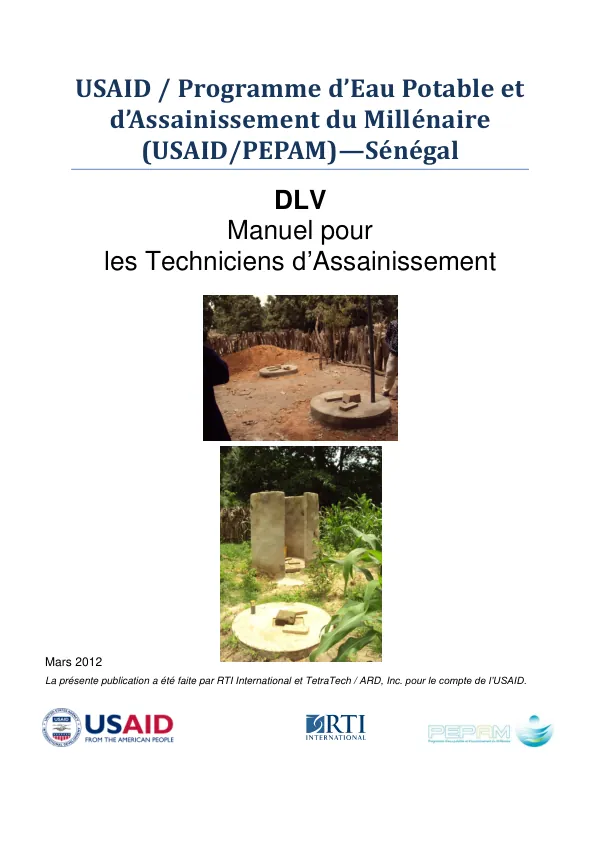
The program aimed to achieve a 59% access rate to sanitation services by 2015, in line with the Millennium Development Goals (OMD). To achieve this goal, USAID/PEPAM introduced various low-cost technologies, including the DLV, SanPlat, VIP, and TCM latrines. The DLV consists of two simple ventilated latrines built in the same concession, with a minimum distance of 2 meters between them. The two latrines function in alternation, with the latrine in service being filled up in approximately 18 to 24 months. The filled latrine is then taken out of use, and the second latrine is used. After about two years, the contents of the closed latrine are digested and transformed into a rich organic humus that can be used as compost after proper hygiene. The DLV has several advantages, including a barrier against vectors, ease of implementation, and low costs. One skilled mason can construct four DLV units per day, and the technology allows for the use of local materials. The DLV is also easily replicable and can be adapted to different contexts. The manual for technicians is designed to accompany organizations non-governmental (ONG) in following up on masons engaged in the construction of family sanitation infrastructure. The USAID/PEPAM program has capitalized on its previous experiences to develop a strategy for improving access to improved sanitation. The manual covers various aspects of the DLV, including its description, construction steps, and procedures for following up on construction sites. The DLV is one of the models of latrines proposed by USAID/PEPAM, along with the SanPlat, VIP, and TCM latrines. The DLV has several benefits, including a barrier against vectors, ease of implementation, and low costs. The technology allows for the use of local materials and is easily replicable. The DLV is also suitable for rural areas, where the availability of water is limited. The manual provides detailed information on the construction of the DLV, including the materials required, the construction steps, and the procedures for following up on construction sites. The manual also includes annexes with additional information on the DLV, such as the price list, planning charts, and technical specifications. The DLV is a low-cost technology that can be easily implemented in rural areas. The manual provides a comprehensive guide for technicians and masons engaged in the construction of family sanitation infrastructure. The DLV is a suitable option for improving access to sanitation services in rural areas, where the availability of water is limited. The manual is designed to accompany organizations non-governmental (ONG) in following up on masons engaged in the construction of family sanitation infrastructure. The USAID/PEPAM program has capitalized on its previous experiences to develop a strategy for improving access to improved sanitation. The manual covers various aspects of the DLV, including its description, construction steps, and procedures for following up on construction sites.
Related documents