USAID DEC
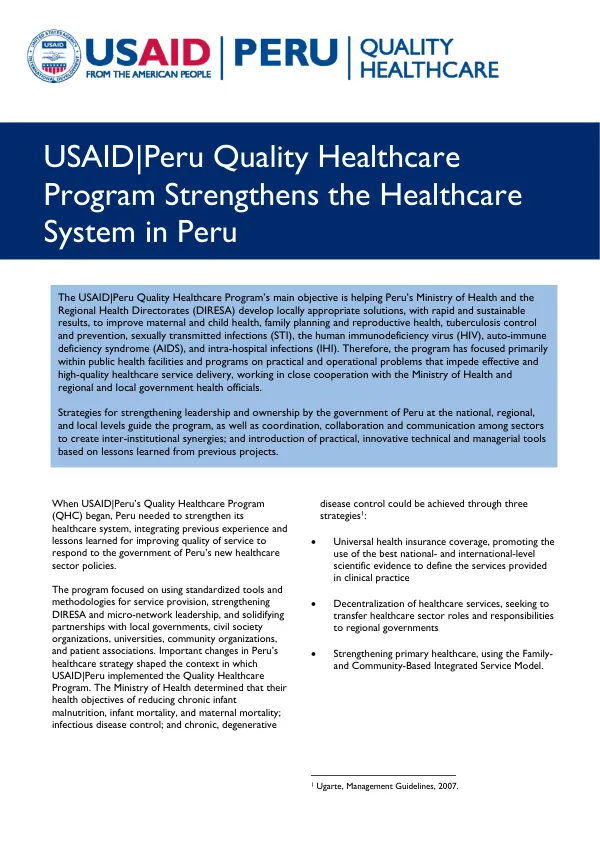
USAID|Peru — 21 Years Supporting Efforts to Improve the Quality of Healthcare Delivery
Sign inMINISTRY OF HEALTH
USAID|Peru — 21 Years Supporting Efforts to Improve the Quality of Healthcare Delivery
The movement to improve the quality of healthcare in Peru began in the early 1990s, when the healthcare sector was in a state of disorganization.
2013 · 9 pages
Sign in to readA free account is required to download.
Abstract
Annual health sector spending declined by 87 percent per capita, facilities lacked basic supplies, and surgical services were reduced. The leadership of the Ministry of Health was weak, and there was no clear direction or long-term vision for improving healthcare quality. In 1996, the Hospital Accreditation System was adopted, based on management standards for institutions providing health services. This marked the beginning of the standardization process, which aimed to introduce the use of scientific evidence as the basis for effective healthcare delivery. Important progress was made in developing technical standards of care, highlighting those relevant to family planning, immunizations, and child health. However, these standards lacked complementary instruments to facilitate daily use by health workers. A new generation of public health professionals began to display growing leadership in the ministry, and ten new projects were implemented to restore the capacity to provide basic services and introduce health services focused on meeting the needs and expectations of users. Quality improvement committees were formed at the health facility level, and early versions of performance standards were developed to translate care standards into practical guidelines for everyday use by healthcare providers. The projects introduced a new culture of accountability and recognition, implemented through the practice of self-evaluation and ranking of "model facilities." Local management processes to improve the quality of reproductive health programs were also strengthened, including the use of monitoring and evaluation systems, employee recognition systems, training of local facilitators, client feedback mechanisms, teamwork, and the inclusion of stakeholders beyond the confines of the health sector. The standardization years, which spanned the first five years of the new millennium, were marked by the beginning of a transition to a decentralized system of government that was more open to communities, local governments, and civil society. Decentralization in the health sector required strong and explicit structuring of government sector functions and the transfer of some of those functions from the national to the regional level. During this period, development of local and regional initiatives continued to improve the quality of reproductive and maternal health services, giving priority to the development of policy and managerial support to allow for sectoral management of quality improvement processes that were comprehensive, effective, and sustainable. The main achievement during these years was strengthened leadership skills within the health system and improved management skills for the design and implementation of health strategies that addressed the needs and demands of health equity, effectiveness, efficiency, and quality in the context of decentralization. The years of integration, which began in 2008, were marked by the implementation of universal health insurance and the relaunch of Primary Healthcare globally. The technical design of the policy considered three elements that shifted attention from management systems to processes of care: prioritization based on the burden of disease, use of standardized instruments of care, and inclusion of explicit quality guarantees, defined as the use of the best national and international scientific evidence in clinical practice management. As a result of these efforts, the Ministry of Health began to develop a comprehensive proposal that was sustainable and viable in a decentralized governance environment. The proposal aimed to continue the progress and achievements of the previous stages, ensuring the implementation of best practices for healthcare, engaging the policy and quality management elements, strengthening state decentralization, incorporating various regional civil society and community actors, and ensuring institutionalization and sustainability. Key policy and management recommendations were identified to ensure the success and sustainability of quality improvement. These recommendations included favoring locally appropriate and sustainable solutions within a decentralized context, incorporating quality improvement into healthcare planning systems and healthcare financing, and continuing the institutionalization process and retaining the elements developed in the previous stages.