FHI 360
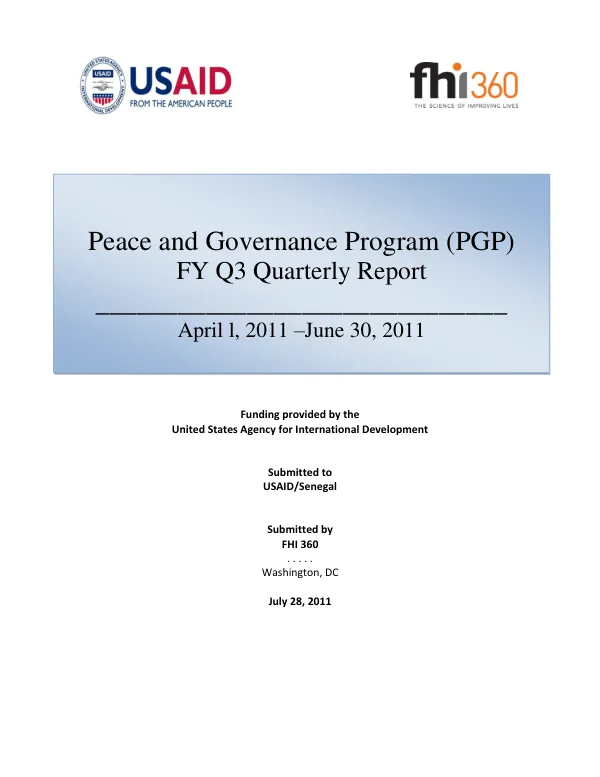
USAID/PGP-Senegal Peace and Governance Program FY Q3 Quarterly Report
The Peace and Governance Program (PGP) in Senegal is a USAID-funded initiative aimed at strengthening democracy, good governance, and national reconciliation in the country.
2011 · 12 pages
Sign in to readA free account is required to download.
Abstract
The program has four main components: Transparency and Accountability, Fiscal Decentralization and Local Governance, Citizen Participation in the Electoral Process, and Dialogue for Social Stability in Casamance. PGP works with government bodies, oversight and regulatory institutions, and civil society organizations at the national level, as well as with local councils and civil society groups in the regions of Dakar Banlieue, Thiès, Casamance, and Kédougou. During the period from April 1 to June 30, 2011, PGP achieved several key milestones. The annual work plan for the program was amended at the request of USAID, and a review of the Scopes of Work of international partners was conducted. A Strategic Action Planning Workshop (APAS) was held with the Office of the Inspector General (IGE), and a PGP and USAID intervention approach was developed to secure Senegal's accession to the Extractive Industries Transparency Initiative (EITI). PGP also conducted an information day in Dakar for the ten Mayors and Rural Council Presidents of the first cycle of Collectivites Locales (CLs), and governance performance evaluation commenced in five new partner Collectivites Locales. A public awareness campaign was held to register young people on the electoral rolls, and a training program was developed for Magistrates and for the youth and women of political party coalitions. In addition, USAID representation was maintained at meetings of the Oversight Committee and the donors' Election Group, and forums were held with partner CSOs and other partners in the three regions of Casamance to develop regional action plans and a general plan for the Dialogue for Social Stability in Casamance. Regional Development Committee meetings were held in the three regions of Casamance to introduce the program to local players and initiate the grants program. The program also issued three requests for grant proposals for components 1 and 4 at the national (Dakar) and local levels (Ziguinchor, Sédhiou, and Kolda), and developed sub-contracts for the three local partners (ACA, ANAFA, and Collectif des OSC). Orientation sessions were held in the Dakar, Ziguinchor, and Kédougou offices on the Office Policy and Procedures Manual, the Grants Manual, and the adoption of the program's per diem policy. The situation in Casamance during this quarter was characterized as "neither peace nor war," with two hot spots persisting: the border area with Gambia and the area located in the South between national route 6 and the border with Guinea-Bissau. Some clashes and armed attacks were noted in these areas, and the factions of MFDC combatants who had agreed to accept the State's outreach were still waiting for the State to keep its promises. The amendment to the annual work plan was made in response to unexpected constraints faced by PGP during the first year, which affected the implementation of certain activities and the performance of the project, especially components 3 and 4. The activities of components 3 and 4 were reformulated while keeping the objectives of the Cooperative Agreement and the approved Work Plan. The principal changes made in the work plan included reformulating component titles to better correspond to the activities conducted and to improve communications with Senegalese Government partners.