USAID DEC
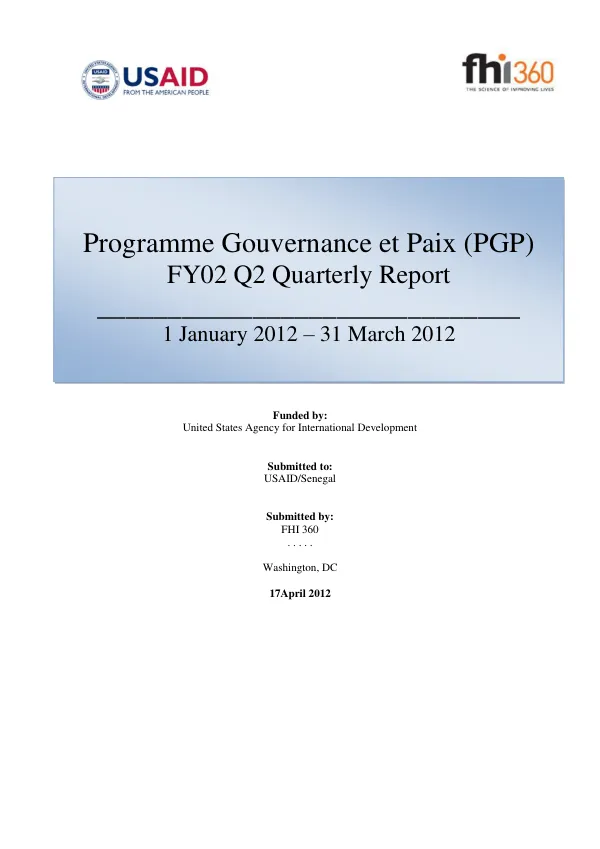
Quarterly Performance Report FY 2012 Q2: Programme Gouvernance et Paix (PGP)—Senegal
Sign inFHI 360
Quarterly Performance Report FY 2012 Q2: Programme Gouvernance et Paix (PGP)—Senegal
The presidential election in Senegal was conducted on 26 February 2012 amidst controversy over the constitutional validity of a third term for the incumbent president Abdoulaye Wade.
2012 · 159 pages
Sign in to readA free account is required to download.
Abstract
His candidacy was the subject of widespread controversy that resulted in protests and violence. The 2012 presidential election certainly led to the most violent electoral campaign Senegal has ever experienced, claiming dozens of lives. During this electoral period, there were positive developments on the political front as the religious leaders repeatedly called for a peaceful election. Another positive development was the Women's Platform for Peace in Casamance comprising of women from the southern regions of Kolda, Sedhiou and Ziguinchor in Senegal wrote a memorandum for peace in Casamance, which they asked the 14 candidates standing in the election to sign. Unfortunately, in the Casamance the situation deteriorated during the electoral period with repeated attacks on the army camps on the border with the Gambia which also resulted in the kidnapping of soldiers. Due to the attacks in this area, the election was not conducted in 10 villages of Bignona department which is located next to the border with the Gambia. In the presidential election no candidate received more than 50 percent of the votes so a runoff was conducted on 25 March. In the first round of elections President Wade won 34% of the vote followed by Macky Sall, the President's former Prime Minister, who received 23% of the vote. For the second round, all the twelve other candidates and the citizens' movements supported Macky Sall who won the election with 66% of the vote. Most importantly the election was conducted without violence and they were deemed credible and free and fair. The electoral cycle proved to be a critical test in Senegal's progress in consolidating democracy. The Parliament elections are currently scheduled for June 2012 but all the political parties have requested that the elections be postponed. The government has just announced that the elections will be postponed to July 1st. The Programme Gouvernance et Paix (PGP) program had significant successes and challenges during this reporting period. Under the previous government, it was extremely difficult for the PGP program to work on anticorruption and to support the peace process in the Casamance. Consequently, the program was more focused on working at the grassroots level. However, with the election of the new President, the USAID "Programme Gouvernance & Paix" (PGP) comes at a critical time in Senegal's democratic development. The PGP program is well situated to focus on the new governance and peacebuilding opportunities in this remarkable democratic transition. The goal of the project is to support Democracy, Good Governance and National Reconciliation and the objectives are the following: i) Greater transparency and accountability; ii) Strengthened fiscal decentralization; iii) Fair and credible 2012 elections; and iv) the Casamance peace process. During this quarter under Component 1 Greater Transparency and Accountability, some activities were delayed due to the elections. However, even under these constraints, the project was able to achieve some positive results such as the remarkable achievement of the government's decision to join the EITI initiative. The adherence to the EITI initiative will greatly improve the transparency and accountability of Senegal's extractive industries. PGP has also worked closely with the CNLCC to build its capacity and credibility as a capable government agency. During this quarter, PGP continued to support the CNLCC efforts in advocating for anti-corruption legal reforms in five key areas which were prioritized during the national anti-corruption workshop in the previous quarter. PGP also worked with the oversight agencies to build their capacity and to develop their role in supporting the national anticorruption plan. PGP has developed and built strong, collaborative relationships with the national oversight agencies such as, DREAT, IGE, CNLCC, and Cour des Comptes. In addition, PGP also attended at least one meeting with each national agency partner where they planned the support to priority activities that were identified in December 2011. In coordination with PGP's work of supporting and improving the national policy of fiscal decentralization, PGP supported its CL partners to improve local governance and the implementation of the fiscal decentralization policy by supporting the CLs' action plans and the implementation of the fiscal decentralization policies at the local level. Finally under this component, PGP significantly contributed to the capacity of the CSOs and the Media to ensure their involvement in anti-corruption activities and the Extractive Industries Transparency policy reforms. During this quarter under component 2, Strengthened Fiscal Decentralization, PGP continued to support the improvement of Senegal's decentralization policy through the development of the new Sectorial Policy Letter on Decentralization and Local Government (LPSD). This letter updates Senegal's national decentralization and local development policy under the coordination of the Local Development Agency (Agence de Développement Local—ADL). The national workshop supported by PGP
Related documents