CHEMONICS
USAID Regional Economic Cooperation Project Quarterly Report January – March 2016
The Regional Economic Cooperation Project (REC) facilitates trade among Central Asian countries, Afghanistan, and large trading partners of these countries.
2016 · 17 pages
Sign in to readA free account is required to download.
Abstract
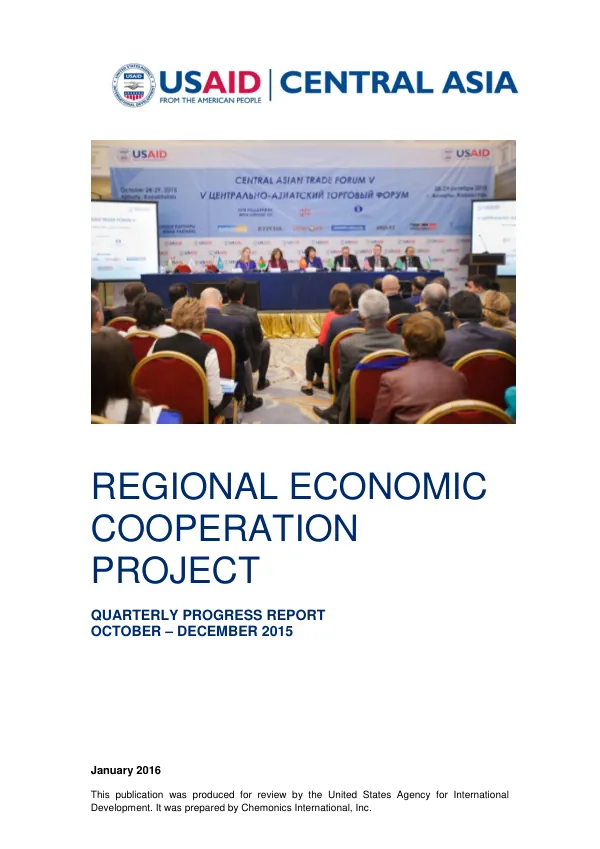
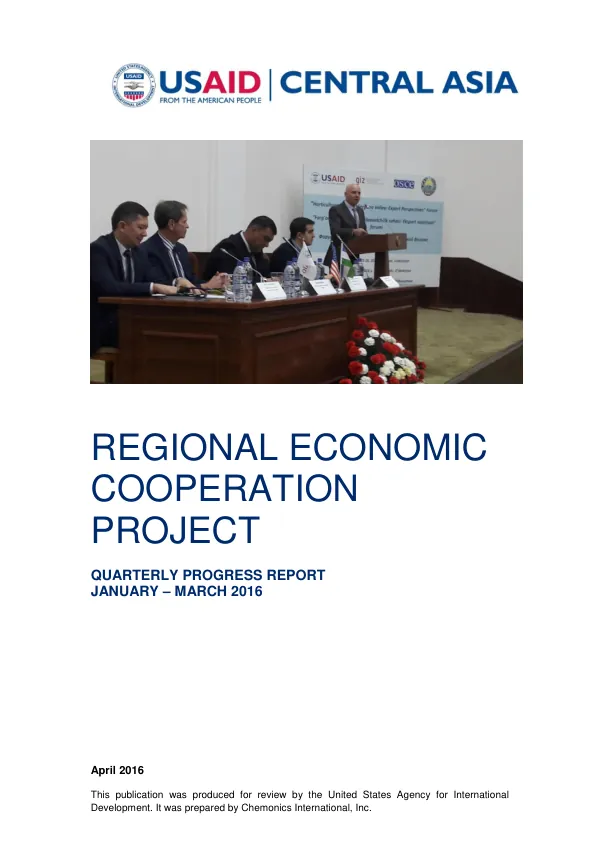
The project aims to develop export potential of firms in the region through fostering business network connections and partnerships. REC supports increased sales and exports of several industries, including textiles, organic farming, horticulture, fruits and vegetables, packaging, and transport and logistics. During the reporting period from January to March 2016, REC's main accomplishments include the organization of a master class in Astana, Kazakhstan, for students and faculty from the Textile Technology and Design Department of the Kazakh University of Technology and Business. The master class, organized through USAID/REC's grantee SPINNA Circle Ltd., focused on textile product development and production processes for the international market. Two fashion design lecturers from Middlesex University in London trained students and faculty on pattern cutting methodologies, garment construction, sales channels, and international market access. Another key accomplishment was the workshop for 30 Tajik women artisans working in the textile industry, which took place in Khudjand, Tajikistan. The workshop, hosted by USAID/REC grantee SPINNA Circle, in collaboration with the Women's Development Agency, a Tajik NGO and former USAID/REC grantee, covered professional product development, international market access, and provided hands-on training. Participants designed and created modern apparel that incorporates traditional Tajik fabric and embroidery. The Transport & Logistics Partnership Group also conducted a regional meeting of customs brokers in Bishkek, Kyrgyzstan, on February 11, 2016. The meeting aimed to create a platform for information and experience exchange among customs brokers who are encountering recent changes as a result of membership in the Eurasian Economic Union (EEU). Participants from Kazakhstan, Kyrgyzstan, Tajikistan, and Uzbekistan discussed their experiences and challenges related to technology and customs clearance procedures under the EEU. The REC project, in partnership with GIZ, OSCE, the Ministry of Foreign Economic Relations, Investments and Trade of Uzbekistan, the Fergana Region Khokimiyat, and the State Committee of Uzbekistan for Privatization, De-monopolization and Development of Competition, hosted a forum on horticultural exports in Fergana, Uzbekistan, on February 25-26, 2016. The two-day event brought together more than 450 experts, farmers, entrepreneurs, buyers, and sellers representing ten countries to discuss the export capacity and potential of the horticulture sector in the Fergana Valley to increase competitiveness and spur economic growth. As a result, participants signed Memoranda of Cooperation (MOC) and Letters of Intent (LOI) to supply horticulture products from Uzbekistan to international markets valued at $150 million. The forum also resulted in $3.5 million in signed contracts between the Uzbekistan Trading House in Latvia and Uzbek horticulture exporters. In conjunction with the Fergana Valley Horticultural Exports Forum, USAID/REC, in partnership with GIZ and government partners, hosted a transport and logistics roundtable focusing on fruits and vegetables. The roundtable provided a platform for public and private transport and logistics companies to discuss future areas of cooperation. "AsstraA Forwarding," a Swiss company, signed a contract for transportation of goods with one of the biggest retail chains in Kazakhstan – "Magnum" – valued at $678,000. Representatives from Latvian and Lithuanian transport companies also officially invited their Uzbek counterparts to visit the Trading Houses in the Baltic States. The REC project has actively encouraged increasing Uzbekistan's horticultural export potential. The project conducted a horticulture forum in Fergana Valley, dedicated to increasing horticulture export capacity and increase its competitiveness in the region. The two-day forum resulted in participants signing Memoranda of Cooperation (MOC) and Letters of Intent (LOI) to supply Uzbek fruit and vegetable products to international markets, valued at $150 million. The forum brought together more than 450 participants, including exporters from the Fergana region, international trade facilitation experts, representatives of business associations, transport and logistics companies, and retail chains from Central Asia, Belarus, Germany, Latvia, Lithuania, and Russia.