BANK FOR WEST AFRICAN DEVELOPMENT
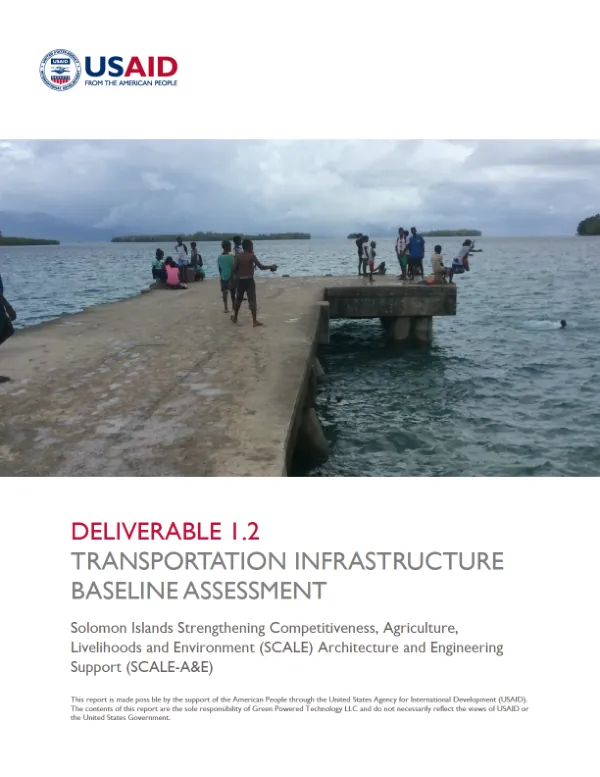
USAID Report: Transportation Infrastructure Baseline Assessment
The Solomon Islands cover approximately 28,000 square kilometers of Melanesia in the South Pacific, with around 85 percent of the population living in villages of just a few hundred people each.
2021 · 25 pages
Sign in to readA free account is required to download.
Abstract
The population resides on six main islands/island groups, as well as on more than 300 of the 900 plus small islands that constitute the archipelago. An estimated 77 percent of the rural population is within reach of a road, which connects people to the coast and the maritime transport that is the primary mode of transport for people and goods. Transport connections enable Solomon Islanders to link to markets for their goods and services, including the movement of agricultural produce, livestock, and seafood. They are also vital to people's ability to access public services in provincial centers as well as in the capital city of Honiara. Through transport connections to urban centers, the rural population can access domestic markets, and through Honiara they can connect to an aggregated onward transit point for international markets. In reverse, connections from Honiara provide imported goods and locally manufactured supplies with access throughout the country. Maritime transport is the primary mode of transport for people and goods, with interisland shipping connecting various points in the archipelago to Honiara, and local boats providing important links between villages and other island connection points. Interisland services vary in frequency, from almost daily between Honiara and Noro, to monthly for Temotu's outer islands. People in the vicinity of Noro can establish supply links with Honiara for perishable goods that would not be possible for areas with only monthly services. The nation's road network plays a critical role in linking people to maritime transport points on the coast, to nearby urban centers, and to airports. Vehicle ownership is very rare in rural areas—in contrast to ownership of boats or canoes (at 6 percent of households)—and most people walk to schools and health clinics. However, roads and vehicles are critical for the movement of freight to and from coasts. In global terms, the Solomon Islands' road network of 1,463 km is extremely small relative to the size of the land area, but it is not so small relative to the size of the population. An estimated 82 percent of the population are within reach of the road network (77 percent of the rural population, and all of Honiara). The existing network is vital for connectivity, but there are some key gaps and weaknesses. Key gaps include the limited connectivity of Honiara with large parts of Guadalcanal (terrain, cost, and land access are significant constraints) and the limited road network of Honiara itself which is now grossly inadequate for existing traffic volumes. Key weaknesses include the present poor physical quality of the road network, as well as the poor ability to effectively operate and maintain it. Only 12 percent of this road network is paved. The remaining roads are mostly of coronus material, with 56 percent in maintainable condition (about a quarter of which are not usable after heavy rains), and the rest is in poor condition or impassable. Air transport plays a fairly small role in domestic connectivity, with its cost prohibitive for most Solomon Islanders. The domestic network is centered on Honiara, which accounts for 55 percent of departing passengers (including domestic and international), with Western Province dominating the spokes—at 27 percent of departing passengers. Service frequencies vary from daily to weekly. A return fare to Honiara is often out of reach for many Solomon Islanders, limiting their access to air transport services. The Solomon Islands National Transport Plan (NTP) 2011-2030 establishes a policy framework to maintain and develop physical infrastructure, develop transport services, and improve capacities of government agencies and the private sector for delivering services in the transport sector. The key overarching strategy driving the development of the road, aviation, and maritime sub-sectors is the Sustainable Transport Infrastructure Improvement Program, which is strengthening country transport infrastructure and aligning government funding with development partner assistance through the National Transport Fund. Approximately 85 percent of projects implemented in the Solomon Islands involve some type of sovereign loan or other form of Official Development Assistance (ODA).