MANAGEMENT SCIENCES FOR HEALTH
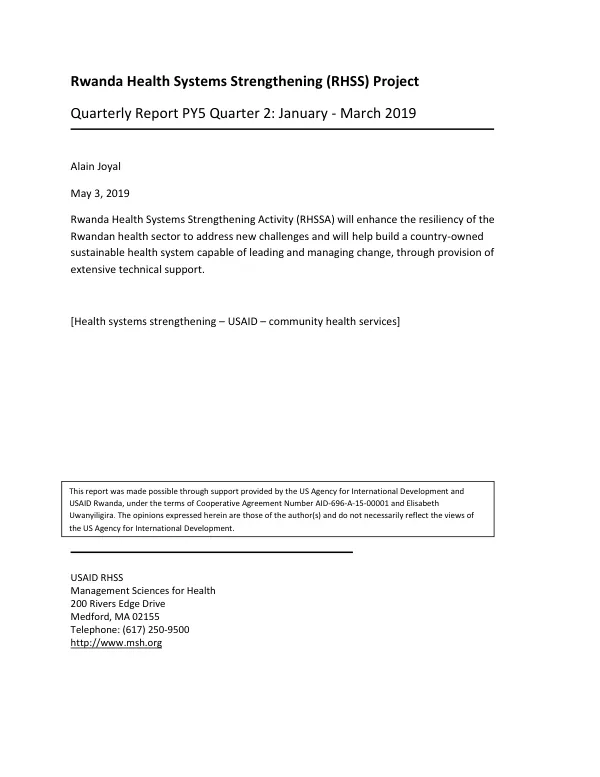
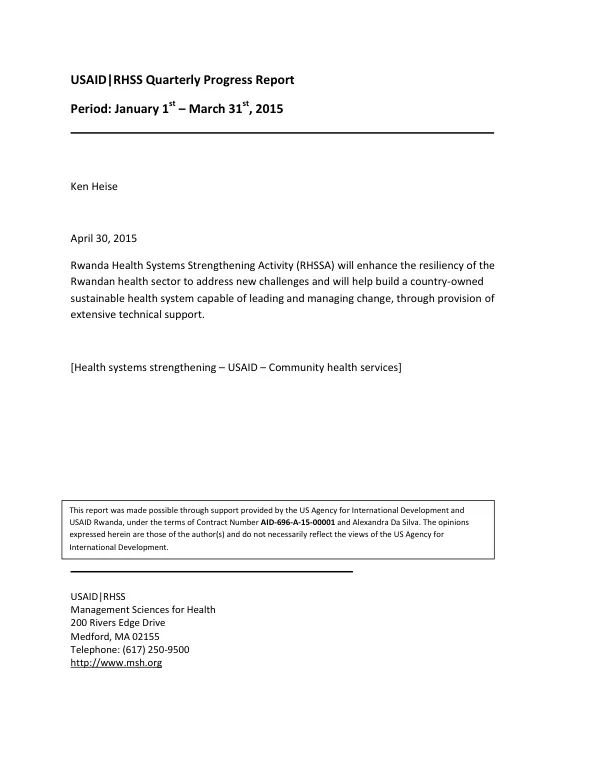
USAID|RHSS Quarterly Progress Report January 1st – March 31st, 2015
Rwanda Health Systems Strengthening Activity (RHSSA) is a USAID-funded initiative aimed at enhancing the resiliency of the Rwandan health sector.
2015 · 39 pages
Sign in to readA free account is required to download.
Abstract
The activity seeks to build a country-owned sustainable health system capable of leading and managing change through provision of extensive technical support. RHSSA is implemented by Management Sciences for Health (MSH) in partnership with the Rwandan Ministry of Health (MOH). During the first quarter of 2015, RHSSA made significant progress in various areas. In project management and administration, the activity developed its first-year work plan, established a monitoring and evaluation (M&E) plan, and launched the Rwanda Health Systems Strengthening Activity. Additionally, RHSSA recruited new staff to support its implementation. In leadership, governance, and decentralization, RHSSA conducted a baseline assessment planning exercise, provided support to the planning Technical Working Group (TWG), and reviewed technical documents. The activity also facilitated consultative meetings to enhance partnership, coordination, and implementation. Furthermore, RHSSA recruited technical advisors at the decentralized level to support the implementation of health systems strengthening interventions. RHSSA also made progress in increasing revenue mobilization by the health sector. The activity validated the Community-Based Health Insurance (CBHI) sustainability study, transitioned CBHI to the Rwanda Social Security Board (RSSB), and integrated CBHI membership and payment systems. Additionally, RHSSA strengthened the capacity of the MOH to carry out economic analyses and financial feasibility of health system interventions. In terms of improved and expanded quality health services, RHSSA strengthened the regulatory framework for continuous quality improvement of health services, assessment mechanisms to identify systems inefficiencies and performance quality gaps, and hospital progress surveys to identify performance quality gaps and standard compliance. The activity also scaled up the use of accreditation standards and supported the establishment of an independent accreditation body. RHSSA also made progress in improved M&E, culture of learning, and knowledge-based practices. The activity supported strategic and operational planning for MOH/e-health activities, fully operationalized the Rwanda health data portal, and supported the development of the 2014 statistical booklet and update of the SOPs for data management. Additionally, RHSSA established a knowledge management platform to support forums and continued support for institutionalizing existing health information platforms. Overall, RHSSA's progress during the first quarter of 2015 demonstrates its commitment to strengthening the Rwandan health sector and building a country-owned sustainable health system. The activity's achievements in various areas will contribute to improved health outcomes and increased access to quality health services for the Rwandan population. RHSSA's results framework, which outlines the activity's expected outcomes and indicators, is presented in Annex 1. The activity's implemented and planned short-term technical assistance is presented in Annex 2, and the draft performance monitoring plan is presented in Annex 3.
Related documents