USAID DEC
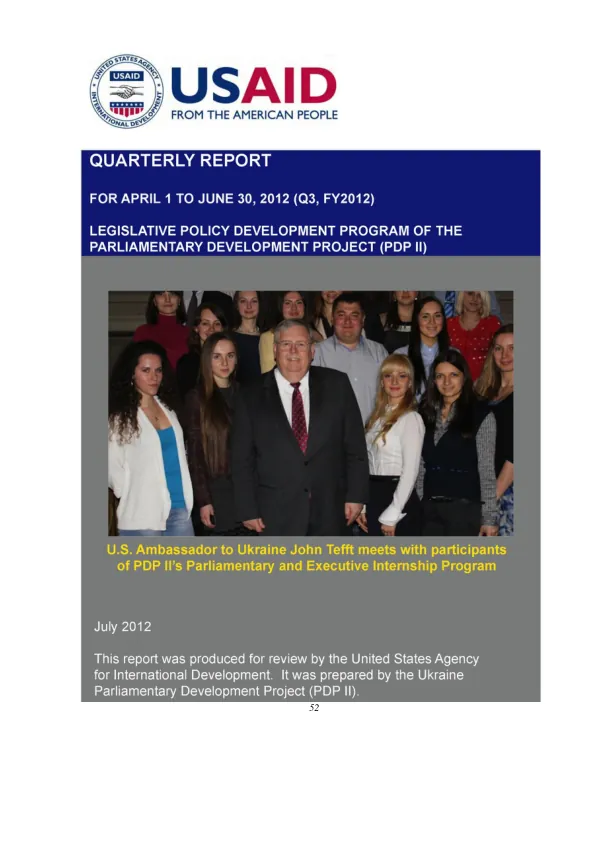
USAID's Parliamentary Development Project for Ukraine: Increasing Transparency and Access to the Policy-Making Process
Sign inOPEN UNIVERSITY
USAID's Parliamentary Development Project for Ukraine: Increasing Transparency and Access to the Policy-Making Process
The Verkhovna Rada (VRU) of Ukraine has made significant strides in increasing transparency and access to the policy-making process.
5 pages
Sign in to readA free account is required to download.
Abstract
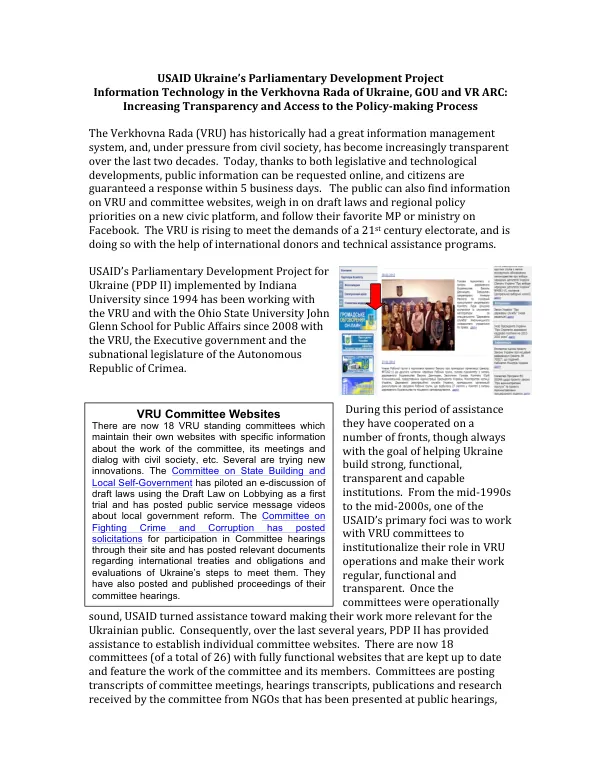
Historically, the VRU had a great information management system, and under pressure from civil society, it has become increasingly transparent over the last two decades. Today, thanks to both legislative and technological developments, public information can be requested online, and citizens are guaranteed a response within 5 business days. The public can also find information on VRU and committee websites, weigh in on draft laws and regional policy priorities on a new civic platform, and follow their favorite MP or ministry on Facebook. The VRU is rising to meet the demands of a 21st-century electorate, and it is doing so with the help of international donors and technical assistance programs. USAID's Parliamentary Development Project for Ukraine (PDP II) has been working with the VRU and the Executive government and the subnational legislature of the Autonomous Republic of Crimea since 1994. During this period of assistance, they have cooperated on a number of fronts, with the goal of helping Ukraine build strong, functional, transparent, and capable institutions. From the mid-1990s to the mid-2000s, one of USAID's primary foci was to work with VRU committees to institutionalize their role in VRU operations and make their work regular, functional, and transparent. Once the committees were operationally sound, USAID turned assistance toward making their work more relevant for the Ukrainian public. Consequently, over the last several years, PDP II has provided assistance to establish individual committee websites. There are now 18 committees (of a total of 26) with fully functional websites that are kept up to date and feature the work of the committee and its members. Committees are posting transcripts of committee meetings, hearings transcripts, publications, and research received by the committee from NGOs that has been presented at public hearings. Some committees are trying new innovations, such as the Committee on State Building and Local Self-Government, which has piloted an e-discussion of draft laws using the Draft Law on Lobbying as a first trial and has posted public service message videos about local government reform. PDP II has also been involved in a number of other IT-related initiatives with the VRU. PDP II provided assistance to the VRU's Information and Communication Technologies (ICT) Division in improving the VRU's general website, which is considered one of the best in the region. The new improvements launched for public testing in June 2012 received much higher marks than its predecessor when measured against the Inter-Parliamentary Union's guidelines for parliamentary websites. Some of its new notable features include a completely new content management system that allows for a comprehensive search mechanism, multimedia capability, and a link that allows e-filing of access to public information requests—a useful tool that gives the historic January 2011 Freedom of Information legislation more utility. In addition to the VRU's main site and the satellite sites of its committees, another new web portal is under development, offering Ukrainian citizens and civil society organizations a chance to gain an increased and direct opportunity to participate in the law-making process. USAID's PDP II is now working with the VRU and the VRU's Legislative Institute to create an interactive site for citizen dialogue around draft laws and issues of national and regional policy. Through crowdsourcing technologies, citizens will be able to log in, review draft laws, leave their comments and questions, and in this way contribute to important conversations about policies that affect their lives. The portal also offers citizens the chance to interact with each other by forming issue-based communities of experts online. The Verkhovna Rada Legislative Institute has also requested that this platform service public discussions on the Constitutional Assembly that was established by the President of Ukraine in December 2011 and the work of which is expected to continue through 2013. PDP II also worked with the VRU on the development of a new E-Parliament Strategy for 2012-2017, which passed parliament on July 5, 2012. If it is carried out successfully, the VRU will continue its evolution into an accessible, transparent 21st-century governing body. The strategy includes plans for e-chamber, e-committees, e-consultative council, and e-library and research available to all members and staff. In early 2012, the Verkhovna Rada adopted a decision to disseminate documents for first reading of legislative acts only in e-format. Already there is electronic service for national and regional press clippings, and the European Information Support Centre established in July 2011 together with the VRU and the European Union's Policy Legal Advice center is providing reference and research services in person, electronically, and through their webpage on the VRU website. Parallel to cooperation with USAID and other technical assistance programs, some Ukrainian parliamentarians and institutions have embraced the importance of constituent accessibility and have found effective ways to relay their messages to the public. Volodymyr Lytvyn, the current Speaker
Related documents
Documents in this collection
 2012
2012USAID DEC
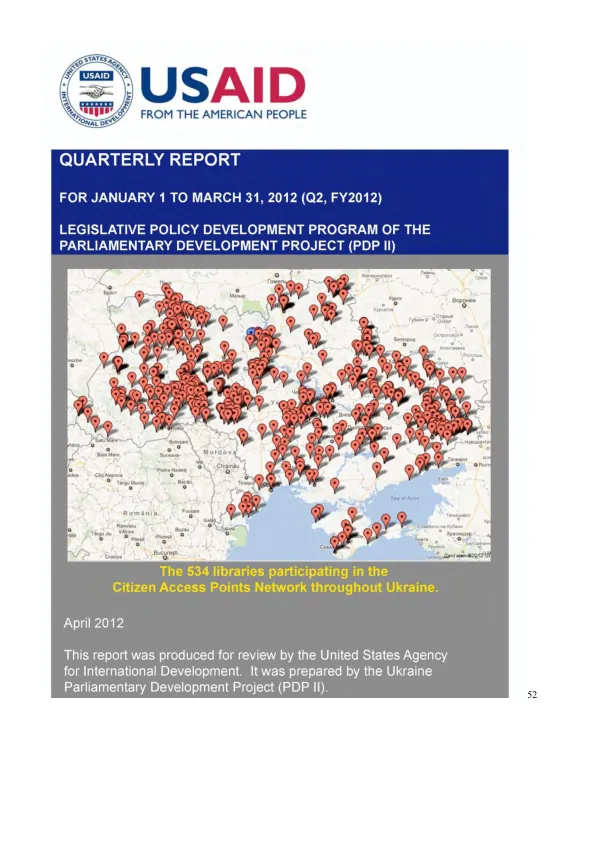
Quarterly Report for January 1 to March 31, 2012 (Q2, FY 2012): Legislative Policy Development Program of the Parliamentary Development Project (PDP II)
Open record 2012
2012USAID DEC