USAID DEC
USAID Sector Reform and Utility Commercialization (SRUC) Papua New Guinea Power Limited (PPL) Support on Data Management, Metering, and Customer Engagement Component 4: Large Customer Engagement Strategy (LCES) & Follow-On Support
Sign inDELOITTE INC.
USAID Sector Reform and Utility Commercialization (SRUC) Papua New Guinea Power Limited (PPL) Support on Data Management, Metering, and Customer Engagement Component 4: Large Customer Engagement Strategy (LCES) & Follow-On Support
The Large Customer Engagement Strategy (LCES) was a key component of the USAID Sector Reform and Utility Commercialization (SRUC) program in Papua New Guinea.
2021 · 4 pages
Sign in to readA free account is required to download.
Abstract
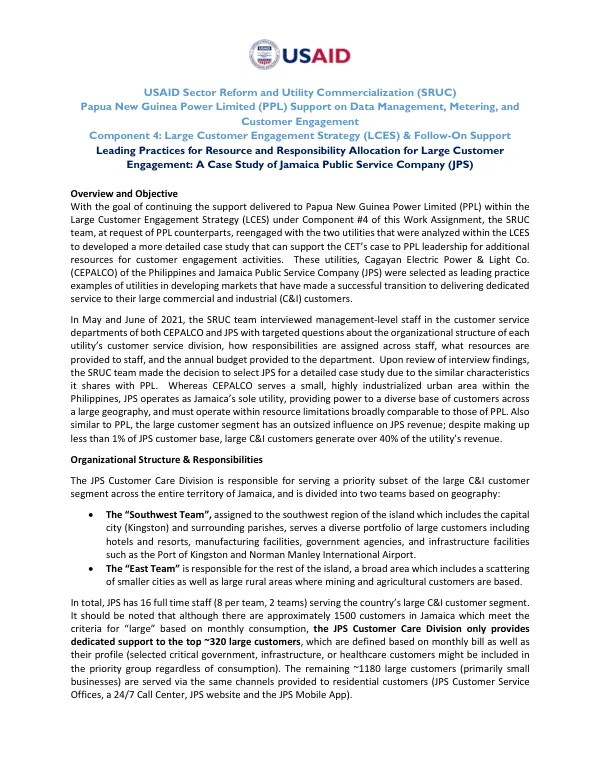
The program aimed to support Papua New Guinea Power Limited (PPL) in improving its customer engagement activities. As part of this effort, the SRUC team conducted a case study of Jamaica Public Service Company (JPS), a utility in Jamaica that had successfully transitioned to delivering dedicated service to its large commercial and industrial (C&I) customers. JPS's Customer Care Division is responsible for serving a priority subset of the large C&I customer segment across the entire territory of Jamaica. The division is divided into two teams based on geography: the Southwest Team and the East Team. Each team has an identical structure, with a Client Relations Manager, two Customer Service Representatives, and five Key Account Executives (KAEs). The KAEs are assigned approximately 25-35 priority large customers each and spend most of their time in the field on-site with their assigned customers. The JPS Customer Care Division has a total of 16 full-time staff members, who are responsible for serving the country's large C&I customer segment. The division provides dedicated support to the top ~320 large customers, which are defined based on monthly consumption and customer profile. The remaining ~1180 large customers are served via the same channels provided to residential customers. The division's staff are provided with additional resources, including company smartphones and fuel and upkeep costs for personal vehicles. The annual budget for the JPS Customer Care Division is approximately USD $960,000, covering staff salaries and additional resources. The analysis of JPS's approach to serving its large C&I customer segment provides several key findings relevant to PPL's Customer Engagement Team. These include the importance of physical mobility for providing adequate service to large C&I customers, the need for segmentation and prioritization of the large C&I segment, and the use of internal tracking systems to manage large customer requests and issues. The JPS Customer Care Division's approach to serving its large C&I customer segment is characterized by a focus on dedicated proactive customer engagement. The division's staff are responsible for managing the connection process for new customers, developing annual and monthly forecasts for load growth/decline, and conducting customer education through presentations and energy management workshops. The division also uses a trained engineer to provide technical expertise when required. The SRUC team's analysis of JPS's approach to serving its large C&I customer segment provides several recommendations for PPL's Customer Engagement Team. These include the importance of physical mobility for providing adequate service to large C&I customers, the need for segmentation and prioritization of the large C&I segment, and the use of internal tracking systems to manage large customer requests and issues. The team also recommends that PPL consider taking a similar approach to JPS, using internal Excel-based trackers and a central email box to manage large customer requests and issues.
Related documents
Documents in this collection
 2021
2021USAID DEC
USAID Sector Reform and Utility Commercialization (SRUC) Task Order Papua New Guinea Power Limited (PPL) Support on Data Management, Metering, and Customer Engagement – Component 4: Large Customer Engagement Strategy (LCES)
Open record 2021
2021USAID DEC