USAID DEC
USAID/Solomon Islands SCALE A&E Cocoa Bean Solar Drying Facility Project
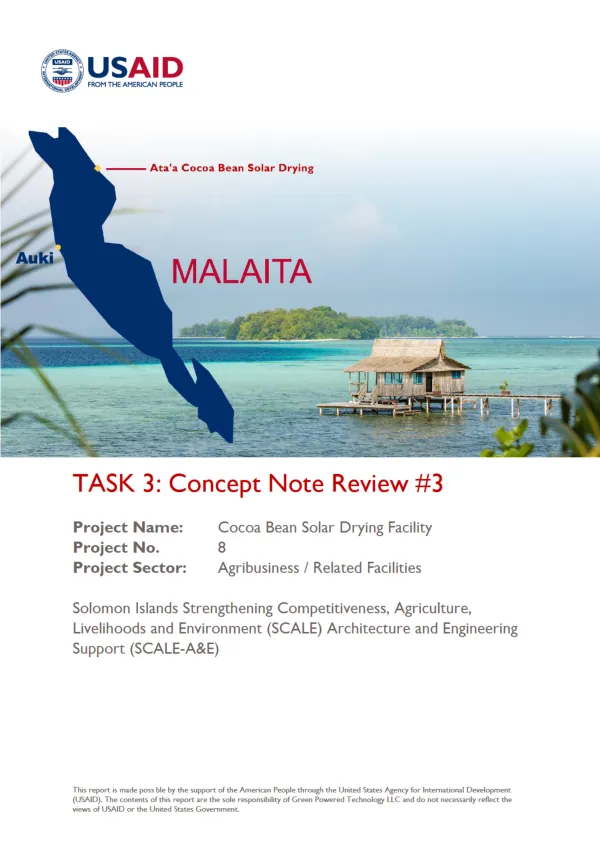
The proposed project in Malaita, Solomon Islands, aims to establish a solar drying facility for cocoa beans.
2021 · 4 pages
Sign in to readA free account is required to download.
Abstract
This facility would enable partial processing of cocoa beans prior to distribution to third-party processors, emulating the successful model established by Makira Gold in Makira-Ulwara. The facility is envisioned to strengthen market linkages between cocoa producers and downstream value chain actors. Improving the initial handling and treatment of cocoa beans is expected to enhance product quality and market value. However, fermentation, drying, roasting, crushing, and grinding are distinct and important components of the chocolate production process, requiring significant investment in modern facilities, equipment, and skilled personnel. Focus may be best placed on short-term investments in drying, with the resulting products being on-sold to other facilities for further processing into chocolate. The project's objective is to address the current practice of outsourcing cocoa processing with the export of raw product overseas. For example, it is estimated that ten tons of cocoa beans are shipped each year from the Solomon Islands to a factory on Mount Maunganui, in New Zealand. The proposed facility would regulate temperature, protect against the elements, and limit contamination from dirt, animals, and insects, thereby improving the quality of cocoa beans. The facility is planned to be located in Ata, Northeast Malaita. The implementation model may involve empowering neighboring farming associations or communities that are already well-established, with questions to be answered about facility ownership and governance. The project's estimated capital expenditure is not yet known, while operational expenditures are also unknown at this stage. A broad array of stakeholders will need to be consulted, including the Malaita Provincial Government, communities in Ata, industry associations, and farming cooperatives. These actors will have important perspectives that will influence project design and implementation approaches. Implementation risks include the need for civil society and industry buy-in and support, a clear governance system, and suitable financial structuring for the facility operation. Key data requirements for the project include information on current cocoa production in the target location, current cocoa trading linkages domestically and foreign export markets, consultation with potential partners from community organizations and farmer associations, and technical appraisals of possible facility design and equipment options. The project met the minimum threshold cutoff score in the Screening and Prioritization Assessment, with a final score of 72.0% (5.04 / 7), indicating a strong overall result that justifies further development of the facility as a pilot project.
Related documents