USAID
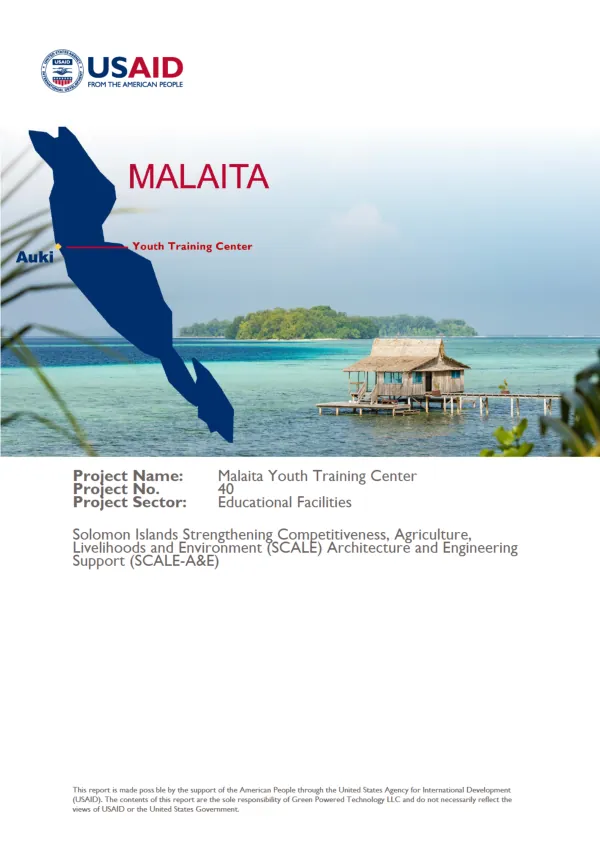
USAID/Solomon Islands SCALE A&E Project Concept Note: Malaita Youth Training Center
The Malaita Youth Training Center is a proposed facility aimed at providing young people in Malaita with training and business support services.
2021 · 4 pages
Sign in to readA free account is required to download.
Abstract
The establishment of the center is expected to have a significant impact on knowledge raising and information dissemination regarding agriculturally related livelihood opportunities. The center will support livelihood generation through the training and support provided to young job seekers, requiring careful consideration for connecting youths with potential employers and business associations. The project's objective is to foster 'invisible' market linkages between value chain actors through workforce development, community engagement, business networking, commercial partnerships, and trading relationship development. The center will act as a catalyst to host and conduct training related to agricultural livelihoods, healthy lifestyles, and youth participation in decision-making. By advancing skills required for youth to succeed financially, the project aims to contribute to resilience by improving livelihoods and reducing vulnerability to sudden environmental or economic hazards. The proposed location for the center is Auki, in the Northwest Region of Malaita. The project concept note was sourced by the SCALE A&E Project based on engagement with the Malaita Provincial Government, various national government line ministries, and local stakeholders. The project identification, screening, and prioritization process has been disseminated. The implementation model for the center is not intended to serve a commercial purpose, nor would it be run for profit. The facility could be constructed by the SCALE A&E Project, but this should be conditional on dialogue with key stakeholders from the Malaita Provincial Government, the Solomon Islands Government, industry bodies, and civil society to determine possible facility management approaches. Budgetary commitments will likely be required from government stakeholders, although there is potential for donor or concessional co-financing and technical assistance with the training program. The center will need to be managed by a formal youth engagement and support services organization, with a range of governance structures that could be established, either with a new or existing organization performing targeted roles. Partnerships should also be established with other educational and vocational facilities to promote participation by young job seekers. Individual businesses could be engaged in business mentoring initiatives, internship/job placement programs, and work experience rotations. The project met the minimum threshold cutoff score in the Screening and Prioritization Assessment conducted by the SCALE A&E Project Team, with an overall assessment result of 72% (4.39/7). However, the project received a subpar result for the prioritization assessment due to the orientation of the assessment toward infrastructure and facilities that create agribusiness livelihoods, strengthen value chain linkages, foster private investment, and facilitate access to market through infrastructure connectivity.
Related documents
Documents in this collection
 2021
2021USAID DEC
Monthly Progress Report: A-E Services to Support Infrastructure Related Programming in Solomon Islands, January 2021
Open record 2021
2021USAID DEC