MANAGEMENT SYSTEMS INTERNATIONAL
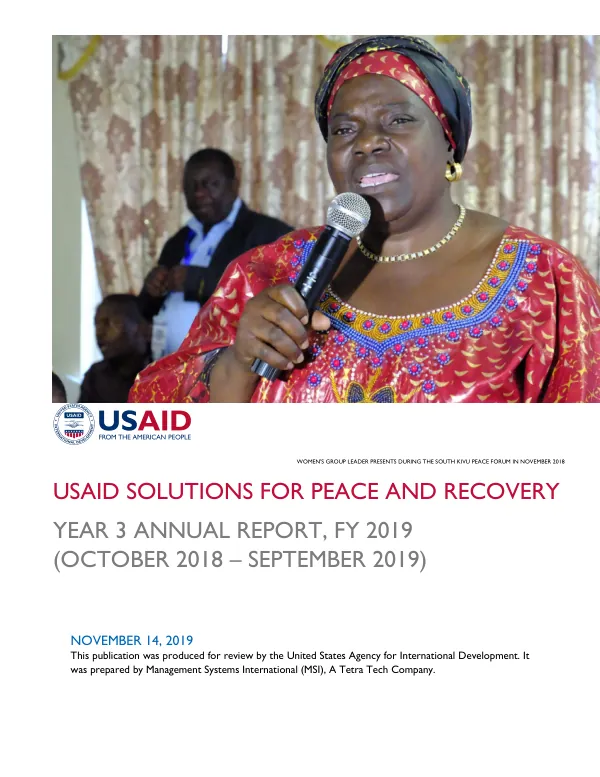
USAID Solutions for Peace and Recovery Year 3 Annual Report, FY 2019
The Solutions for Peace and Recovery project in the Democratic Republic of the Congo (DRC) aimed to address the root causes of conflict and promote peace and stability in the region.
2019 · 125 pages
Sign in to readA free account is required to download.
Abstract
The project was implemented in South Kivu Province, where conflict and insecurity have been persistent issues. The project's objectives were to identify and accept solutions to specific drivers of conflict, implement participatory solutions, and allocate resources for community development more inclusively. The project's first objective focused on community stakeholders identifying and accepting solutions to specific drivers of conflict. Accomplishments included the establishment of a community-based organization management committee, which facilitated the participation of local stakeholders in the decision-making process. Challenges arose due to the inaccessibility of target zones and staffing shortages. Solutions implemented included the provision of training and capacity-building programs for local stakeholders and the establishment of a conflict sensitivity framework. The project's second objective aimed to implement participatory solutions. Accomplishments included the development of a provincial advocacy framework, which facilitated the participation of local stakeholders in the decision-making process. Challenges arose due to partner compliance issues and the need for more inclusive resource allocation. Solutions implemented included the establishment of a grant program to support community-led initiatives and the provision of training and capacity-building programs for local stakeholders. The project's third objective focused on allocating resources for community development more inclusively. Accomplishments included the establishment of a community development plan, which prioritized the needs of local stakeholders. Challenges arose due to the inaccessibility of target zones and staffing shortages. Solutions implemented included the provision of training and capacity-building programs for local stakeholders and the establishment of a resource allocation framework that prioritized the needs of local stakeholders. Cross-cutting themes emerged throughout the project, including advocacy, inclusion and participation, integration of conflict sensitivity, monitoring, evaluation, and learning, and performance of output and outcome indicators. The project's management and operations were also critical to its success, with challenges arising due to staffing shortages and partner compliance issues. Lessons learned and opportunities for future improvement were identified, including the need for more inclusive resource allocation and the importance of conflict sensitivity in project implementation. The project's success was measured through the performance of output and outcome indicators, which showed significant improvements in community stability and peace. The project's impact was also evident in the establishment of a community-based organization management committee, which facilitated the participation of local stakeholders in the decision-making process. The project's legacy will continue to be felt in the region, with a focus on promoting peace and stability through community-led initiatives and inclusive resource allocation.
Related documents