MANAGEMENT SYSTEMS INTERNATIONAL
USAID’s Solutions for Peace and Recovery Year 3 Quarter 3 Report
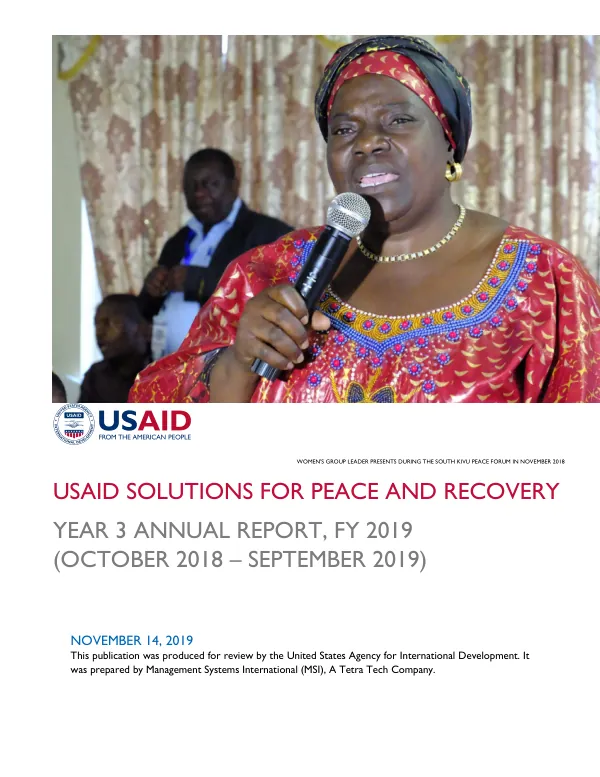
The Solutions for Peace and Recovery (SPR) project in the Democratic Republic of the Congo (DRC) aims to increase the participation of women and other marginalized groups (OMGs) in community-based approaches to conflict analysis, prevention, resolution, and recovery in the eastern DRC.
2019 · 81 pages
Sign in to readA free account is required to download.
Abstract
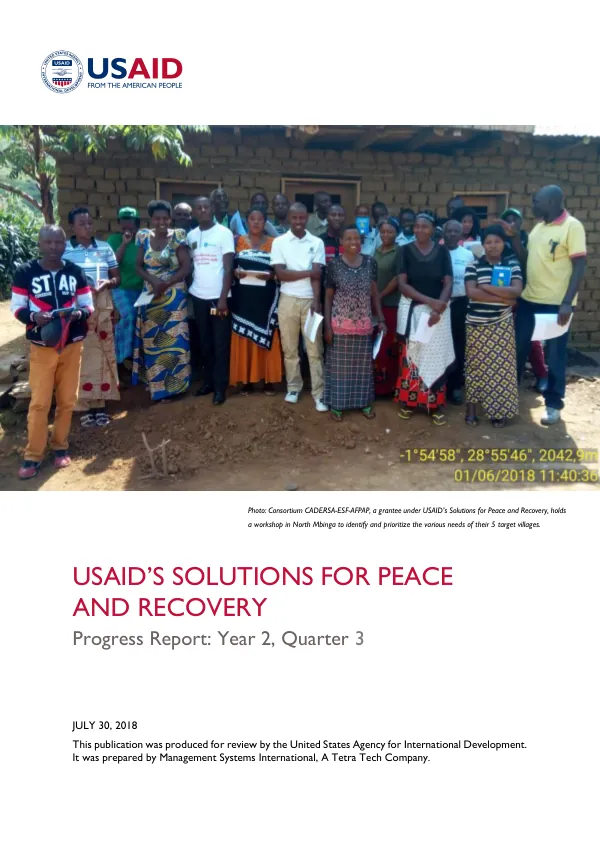
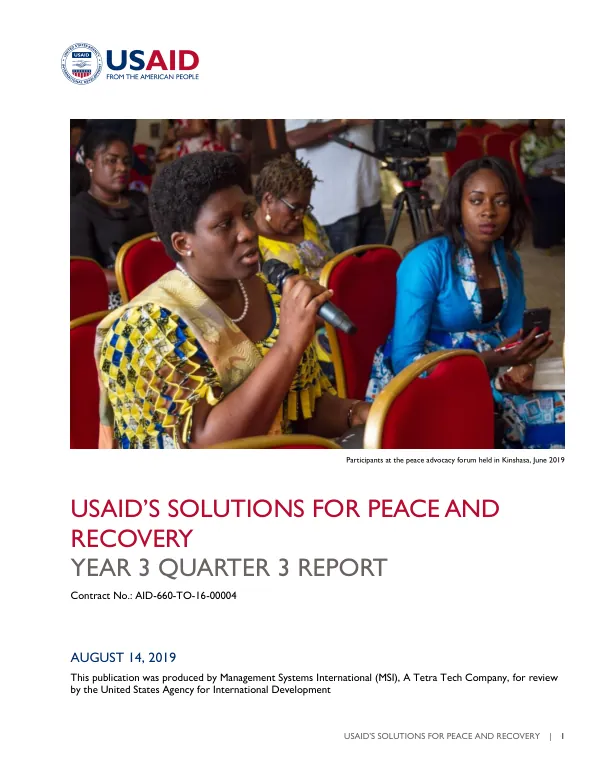
The project began on August 30, 2016, and will be implemented through August 29, 2019, with the possibility for two option years. During the reporting period, the SPR project continued to close direct and indirect field activities. The project team monitored SPR activities and collected data to document performance results. By the end of the third quarter of the reporting year, the majority of indicators have met or exceeded life of project (LoP) targets. Performance against LoP targets improved from 95 percent at the end of the second quarter to 111 percent at the end of the reporting period. Progress in achieving Objective 1 targets rose from 77 percent of LoP targets at the end of the second quarter to 114 percent at the end of this reporting period. Community validation of the findings of participatory action research (PAR) and implementation of joint action plans were key achievements of this objective. A total of 12 community validation forums, 28 mini-dialogues, eight community peace forums, and six community dialogues were organized in various groupements. A total of 2,076 people participated in these community peacebuilding and social cohesion processes. Five agreement-monitoring committees in Masisi and Walungu have been set up and trained to support compliance with the parties' commitments and to report to the community. Six meta-conflict assessment research reports consolidating 65 community participatory conflict analyses were validated, and seven local implementing partners certified increases in their capacity and knowledge in conducting participatory conflict analysis and participatory action research. Progress in achieving Objective 2 targets reached 111 percent at the end of the quarter. The project organized 129 coaching and training sessions to support transformational leadership for 664 women and OMGs from Goma, Biiri, Mbinga Nord, and Bukavu. Themes included law, protection, peacebuilding, advocacy, and communication. A short message service (SMS) text message campaign to raise awareness about women and OMGs' inclusion and participation in local governance, peace processes, and social cohesion targeted local authorities and the general population in North Kivu. Ten community forums, including one festival, brought together about 4,000 women, OMGs, and local authorities. Themes developed during the events included increasing women's economic power, discouraging early marriage, promoting family reconciliation, advocacy, peaceful cohabitation, and the role of women in peace consolidation. For Objective 3, progress in achieving the LoP targets rose from 97 percent to 108 percent. The project trained 90 service providers and user committees on good governance, including transparency, gender, and inclusion, accountability. The project organized one linkage forum connecting livelihood groups to private sector actors, particularly microfinance institutions, and 15 memoranda of understanding have been signed between the private sector and livelihood groups as a result of the process. The project continued to provide technical assistance to local implementing partners, including training and capacity building. The project also continued to monitor and evaluate its activities, collecting data to document performance results. By the end of the reporting period, the project had made significant progress in achieving its objectives, with many indicators meeting or exceeding LoP targets.
Related documents