USAID DEC
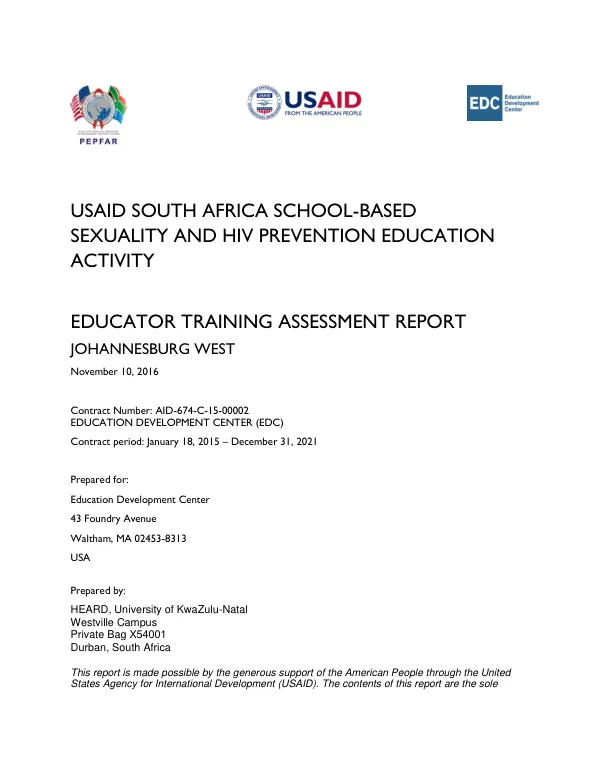
USAID SOUTH AFRICA SCHOOL-BASED SEXUALITY AND HIV PREVENTION EDUCATION ACTIVITY EDUCATOR TRAINING ASSESSMENT REPORT
Sign inCENTER FOR EDUCATIONAL DEVELOPMENT
USAID SOUTH AFRICA SCHOOL-BASED SEXUALITY AND HIV PREVENTION EDUCATION ACTIVITY EDUCATOR TRAINING ASSESSMENT REPORT
The South Africa School-Based Sexuality and HIV Prevention Education Activity is a PEPFAR-Funded USAID Activity aimed at reducing new HIV infections in learners and educators by assisting the Department of Basic Education (DBE) to implement high-quality, evidence-informed sexuality and HIV prevention education programs.
2016 · 9 pages
Sign in to readA free account is required to download.
Abstract
The project's activities are specifically designed to strengthen, link, and consolidate South African Government (SAG) efforts to link education sector initiatives and health sector initiatives that share a common purpose: a reduction in the incidence of new HIV and TB infections among young people and improved linkages to HIV care and SRH services for learners. The project's objective three focuses on improving the quality of school-based sexuality and HIV education programs, with task 3.1 aiming to implement sexuality and HIV education activity in target schools. Sensitization workshops are being conducted in the districts where the Education Development Center (EDC) is working to strengthen school governing body (SGB) members' advocacy skills for comprehensive sexuality education (CSE), including SGBV and the Integrated School Health Policy (ISHP). These workshops consist of 2-day discussions that cover information on the comprehensive sexuality education package offered in schools and aim to equip SGBs and senior management teams (SMTs) with skills to advocate for schools-based comprehensive sexuality and HIV education activity among parents in the community. A total of 45 SGB representatives took part in the sensitization workshop included in this analysis, representing the SGBs in 27 schools in the district of Johannesburg West. The participants were predominantly female (67%), with an average age of 44 years. The majority of participants (58%) had only been at the school for one or two years. The information was collected from the participants through a self-administered paper-based structured questionnaire administered pre- and post-training. The questionnaire asked participants to respond to statements of value or opinion by indicating whether they strongly agreed, agreed, were neutral, disagreed, or strongly disagreed with the statement. The section on parental involvement asked respondents to indicate whether the statements were true or false. The questionnaires were anonymous, but each participant entered their dates of birth to allow for the pre- and post-training questionnaires to be linked and tested for statistical significance. The data was entered into the SPSS statistical software (version 24) and analyzed by means of descriptive statistics and paired sample t-tests to determine the statistical significance of any change in answers between the first and second round of responses. The findings are reported in a table below, with one asterisk (*) signifying statistical significance at (p<.05) and two indicating significance at (p<.001). The results show that a large majority of respondents (92%) said that their school has an active SGB, with 84% of participants saying that the SGB in their school meets either once a month or once every quarter. A majority (52%) say that their school has strong support from the parents in the community, and 60% say that parents actively encourage learners to take their education seriously. School communication is also effective, with 84% saying that their school keeps the community informed of activities and events at the school, and the same-size majority saying that their school communicates well with the family of a learner who is not doing well in school. In terms of sexuality education and HIV and AIDS, the results show that there was a significant increase in the number of participants who strongly agreed that their school provides comprehensive sexuality education (CSE) to learners. The percentage of participants who strongly agreed increased from 22% pre-training to 42% post-training, with a statistically significant difference (p<.05). There was also a significant decrease in the number of participants who strongly disagreed that their school provides CSE to learners, with the percentage decreasing from 26% pre-training to 10% post-training. Overall, the results suggest that the sensitization workshops were effective in improving the knowledge and attitudes of SGB representatives towards comprehensive sexuality education. The workshops appear to have increased the number of participants who support CSE and decreased the number of participants who are opposed to it. However, further research is needed to determine the long-term impact of the workshops on the implementation of CSE in schools.
Related documents