USAID DEC
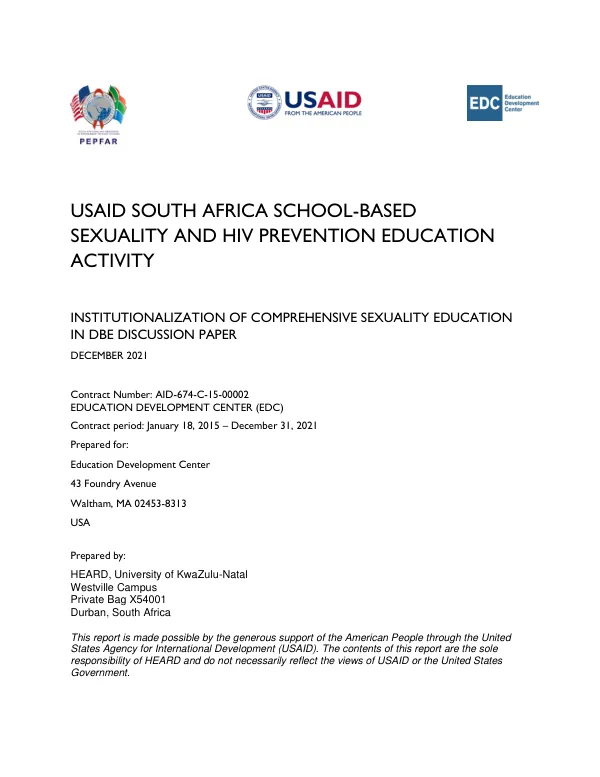
Institutionalization of Comprehensive Sexuality Education in the Department of Basic Education
Sign inCENTER FOR EDUCATIONAL DEVELOPMENT
Institutionalization of Comprehensive Sexuality Education in the Department of Basic Education
The South African School-Based Sexuality and HIV Prevention Education Activity is a USAID-funded initiative that aims to contribute to reducing new HIV infections, accelerate and sustain HIV epidemic control in South Africa.
2021 · 34 pages
Sign in to readA free account is required to download.
Abstract
The Education Development Center (EDC), an implementing partner, was mandated to support the Department of Basic Education (DBE) through strengthening existing systems to enhance both delivery and effectiveness of Comprehensive Sexuality Education (CSE). The activities undertaken by EDC are expected to be institutionalized by the DBE to ensure sustainability. The initiative is aligned with the National Strategic Plan (NSP) 2017-2022 goals and the "95-95-95" targets. The EDC led activities aim to support the DBE in institutionalizing CSE, which is essential for the effective delivery of CSE in schools. The institutionalization of CSE involves the integration of CSE into the school curriculum, educator training, and the development of a comprehensive CSE policy. The DBE has been supportive of integrating partner-led activities into government functions. However, several challenges to institutionalization remain, including gaining buy-in and key stakeholder support, obtaining financial resources, and developing official transition plans. The DBE will need to consider several issues as program close-out approaches, including budget planning, educator training modalities, strengthening links with the Department of Health, and the role of learner support agents (LSAs). The Transition Preparedness Assessment (TPA) Framework was applied to this activity, using a qualitative research approach, where key stakeholders from the DBE and EDC were engaged to identify the requirements for the institutionalization of CSE activities from supporting partners and funders to government-led. Three broad areas were identified as important in the transition process: program service delivery, governance, and budget considerations. The results of the study indicate that the DBE has made progress in institutionalizing CSE, but several challenges remain. The study highlights the importance of developing official transition plans at the inception of an externally funded program for both program institutionalization and sustainability. These plans must be developed by the implementing partners and DBE, and should be clear, specific, and timebound. The study also emphasizes the need for the DBE to consider several issues as program close-out approaches, including budget planning, educator training modalities, strengthening links with the Department of Health, and the role of learner support agents (LSAs). The study concludes that the DBE will need to develop a comprehensive transition plan that addresses these challenges and ensures the sustainability of CSE activities in schools. The study's findings have implications for the institutionalization of CSE in South Africa. The study highlights the importance of developing a comprehensive transition plan that addresses the challenges of institutionalization and ensures the sustainability of CSE activities in schools. The study also emphasizes the need for the DBE to consider several issues as program close-out approaches, including budget planning, educator training modalities, strengthening links with the Department of Health, and the role of learner support agents (LSAs). The study's recommendations include the development of a comprehensive transition plan that addresses the challenges of institutionalization and ensures the sustainability of CSE activities in schools. The plan should be developed by the implementing partners and DBE, and should be clear, specific, and timebound. The plan should also address the need for budget planning, educator training modalities, strengthening links with the Department of Health, and the role of learner support agents (LSAs). The study's conclusions highlight the importance of institutionalizing CSE in South Africa. The study emphasizes the need for the DBE to develop a comprehensive transition plan that addresses the challenges of institutionalization and ensures the sustainability of CSE activities in schools. The study also highlights the importance of developing a comprehensive transition plan that addresses the need for budget planning, educator training modalities, strengthening links with the Department of Health, and the role of learner support agents (LSAs).