USAID DEC
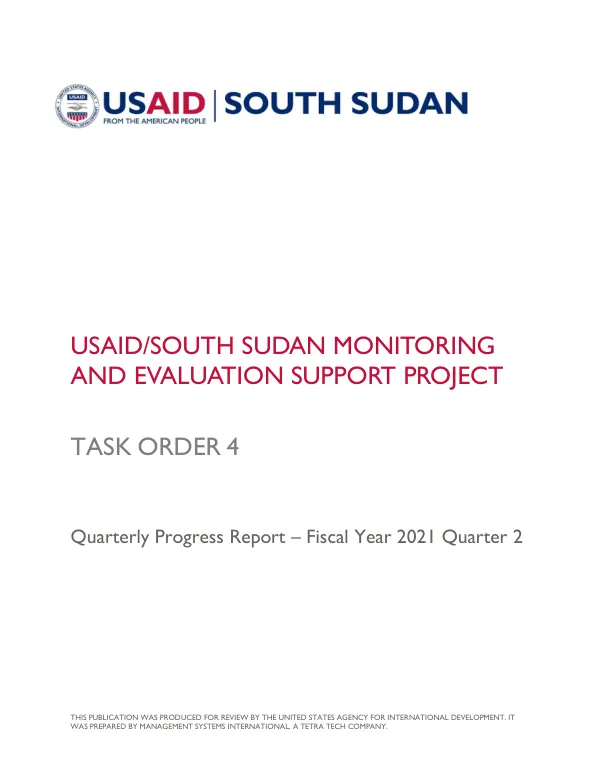
USAID/South Sudan Monitoring and Evaluation Support Project FY 2021 Quarter 2 Performance Report
Sign inMANAGEMENT SYSTEMS INTERNATIONAL
USAID/South Sudan Monitoring and Evaluation Support Project FY 2021 Quarter 2 Performance Report
The USAID/South Sudan Monitoring and Evaluation Support Project (MESP) is a project aimed at providing technical support to the Mission in monitoring and evaluating USAID/South Sudan activities.
2021 · 21 pages
Sign in to readA free account is required to download.
Abstract
The project is contracted under Task Order 4, with a scope that was revised in the second quarter of fiscal year 2021 to focus on implementation of the baseline household survey, GIS mapping support, and remote third-party monitoring of USAID/South Sudan activities. In the period under review, MESP provided technical support to the Mission in the development of its Performance Monitoring Plan (PMP) for the new Strategic Framework (2020-2024). The Mission approved the PMP, and the development of the Performance Indicator Tracking Table (PITT) is slated to begin in the third quarter. MESP will provide all the necessary technical support in the design of the PITT as requested by the Mission. Geographic maps are an essential resource for the Mission to understand the spatial distribution of activities implemented by USAID and other donors. In the second quarter, MESP updated maps of the thirteen target counties for the USAID/IP meeting. The maps depict population densities in the counties, administrative boundaries for bomas and payams, and relevant topographic features. MESP submitted the tools for verifying beneficiaries and monitoring utilization of solar radios distributed under the Integrated Essential Emergency Education Services (IEEES) activity to support distance learning following school closure due to COVID-19. However, schools remain closed, and the MESP Field Monitors are not permitted to travel out of Juba. In view of this, MESP held a meeting with the Education Office and Program Office to discuss how the tool should be implemented. In response to the Bureau of Humanitarian Assistance's (BHA) request to assess the efficacy of beneficiary feedback mechanisms, MESP revised the Outpatient Therapeutic Program (OTP) and Targeted Supplementary Feeding Program (TSFP) tools by introducing a module that captures the availability and functionality of beneficiary feedback mechanisms, including how the Implementing Partners respond to beneficiary complaints and whether beneficiaries have a voice in how the system works. Expansion of Third Party Monitoring (TPM) for BHA was put on hold during the reporting period pending approval of the contract modification. In the second quarter, MESP monitored 64 activities for BHA in five counties and delivered debrief presentations for Pibor and Tonj South counties. The remaining debriefs for Kajo Keji, Aweil South, and Yei counties are scheduled for early April 2021. MESP commenced implementation of the baseline household survey in six "flood-prone" counties: Akobo, Duk, Uror, Pibor (Jonglei), Budi (Eastern Equatoria), and Leer (Unity). The purpose of the household survey is to obtain baseline data in the target areas for the indicators included in the Mission's PMP and the Community Roadmap, in support of USAID/South Sudan's Strategic Framework (2020-2024). Activities implemented during the reporting quarter are discussed below. MESP translated the tool into eight local languages: classical Arabic, Anyuak, Didinga, Dinka, Jie, Juba Arabic, Murle, and Nuer. MESP recruited twelve highly qualified supervisors to field-test the instrument and data collection procedures in 20-25 households and to train and supervise the enumerators during the survey roll-out. However, two additional "supervisors" were needed to conduct the pilot test of the tool in the Anyuak and Jie languages in Pibor county. The project faced several challenges during the reporting period, including field trips for TPM that could not be conducted due to the current global COVID-19 pandemic and SOW restriction. Staff coordination was also challenging at times as staff are still working from home, affecting the preparation of deliverables. Poor phone network coverage and high telephone costs also affected data collection during RTPM.