USAID DEC
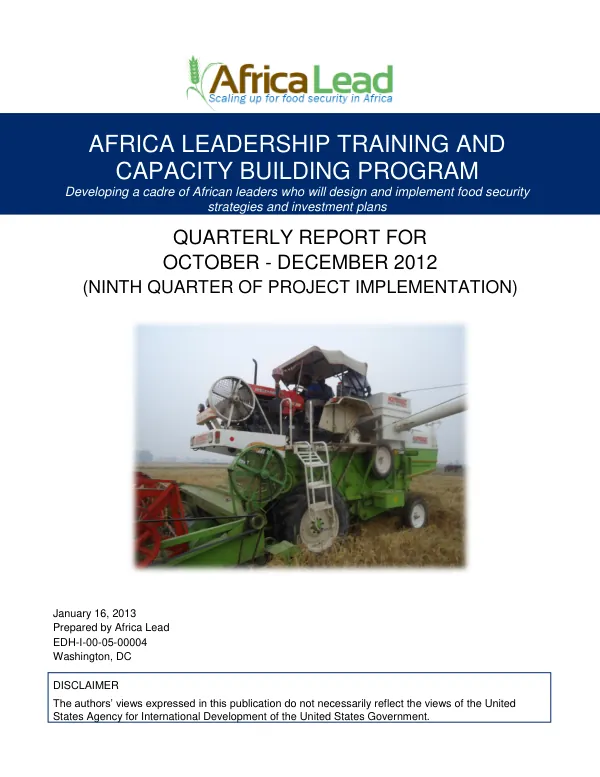
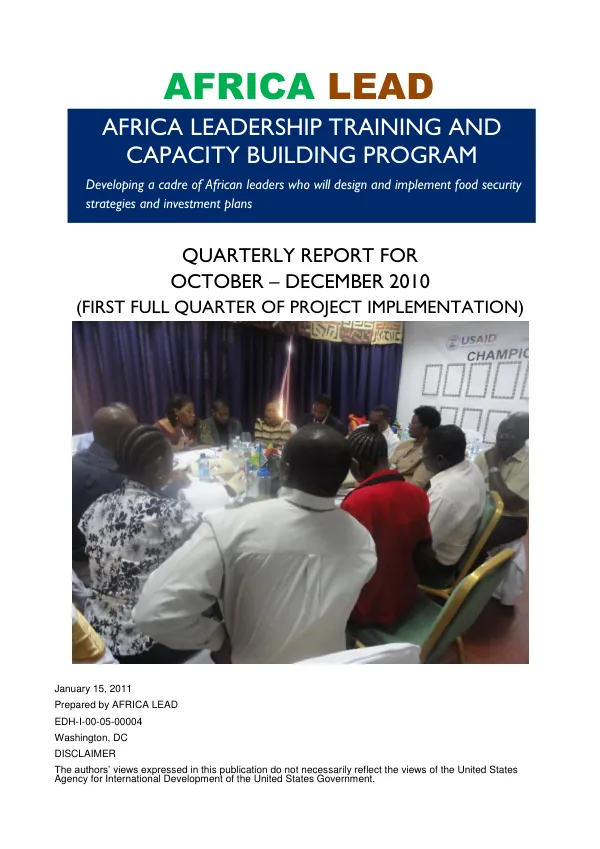
AFRICA LEADERSHIP TRAINING AND CAPACITY BUILDING PROGRAM QUARTERLY REPORT FOR OCTOBER – DECEMBER 2010
Sign inDAI
AFRICA LEADERSHIP TRAINING AND CAPACITY BUILDING PROGRAM QUARTERLY REPORT FOR OCTOBER – DECEMBER 2010
The Africa Leadership Training and Capacity Building Program, also known as AFRICA LEAD, is a two-year task order under the RAISE Plus Indefinite Quantity Contract (IQC) mechanism.
2011 · 14 pages
Sign in to readA free account is required to download.
Abstract
The program runs from September 20, 2010, to September 30, 2012, with a budget ceiling of $21,332,381. AFRICA LEAD is implemented through three regional offices in Accra, Nairobi, and Pretoria, each run by a Regional Deputy Chief of Party (RDCOP), and a Bethesda-based office headed by the program Chief of Party (COP). The purpose of the program is to support the capacity building program of the US Government's Feed the Future (FTF) Initiative, which aligns US Government assistance with Africa-owned agriculture development plans that are aligned with the African Union's Comprehensive Africa Agriculture Development Program (CAADP). CAADP seeks to ensure that governments throughout the continent apply 10% of their public budgets to agriculture in an effort to achieve the 6% annual growth in agricultural productivity needed to achieve sustainable food security throughout the continent. AFRICA LEAD provides leadership training, capacity assessments, logistical support for training, and innovative short courses and internships/twinning arrangements prioritized in consultation with missions and partner countries and institutions. The program's Results Framework, preliminary indicators, and all data collection instruments for Module 1 have been completed and vetted. During the first quarter of implementation, AFRICA LEAD made substantial progress in setting up a Bethesda office and three regional offices, designing the curriculum for Module 1 of the Leadership Training Workshop Series, and mobilizing Regional DCOPs. The Regional DCOPs have been in touch with their Mission Points of Contact (POCs), CAADP Teams, and Agriculture Working Groups supporting CAADP implementation. Module 1 of the Task 1 Leadership Training has been developed, approved, and tested, with trainers identified, contracted, and trained in the material through Training of Trainers (TOT) workshops. Participants have been selected after consulting with USAID regional and bilateral missions and marketing the program to stakeholders in all focus countries. Substantial logistical preparations have been made for the launch of Module 1 5-day leadership trainings at the beginning of the second quarter. The project's institutional assessment process is now under development, with consultations continuing with DCOPs, NEPAD/NPCA, and USAID to define the needs assessment system and methodological process. Individual institutional capacity assessments are set to begin. A few issues pose challenges to the program, including a restrictive geographic code and lengthy process of getting rates approvals, which are causing a backlog of unapproved personnel and delaying implementation. The program has made significant progress in developing the curriculum for Module 1, with the involvement of four curriculum development experts. The Master Trainers produced a participant training manual and trainer's guide, as well as additional supporting materials. Trainers have been identified, selected, and hired in both East and West Africa, with two ToTs held during the first quarter. Minor revisions are expected after the first participant trainings during the second quarter. The program is expected to complete several activities in the coming quarter, including finalizing the Module 1 curriculum design, translating the curriculum into French and Portuguese, officially launching the project in all three regions, selecting and training a team of French-speaking trainers, and training 400 participants in Module 1 in East Africa.
Related documents
Documents in this collection
 2015
2015USAID DEC
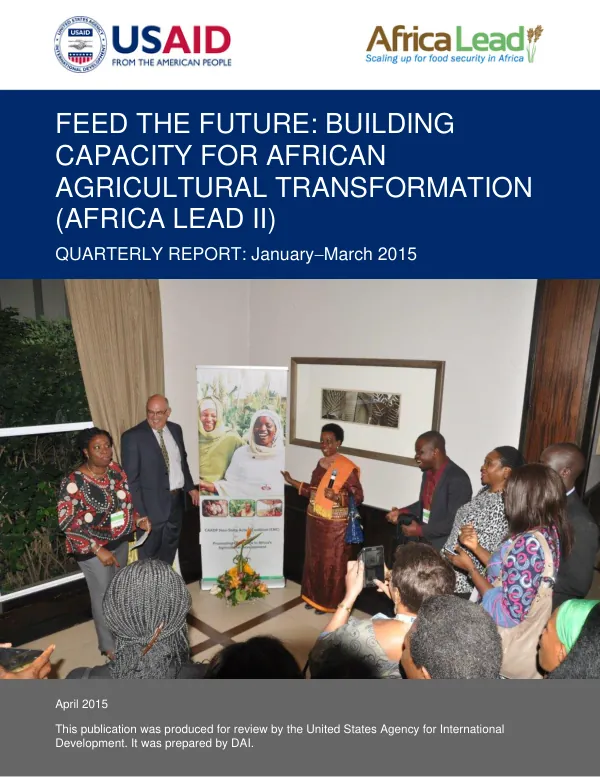
Feed the Future: Building Capacity for African Agricultural Transformation (Africa Lead II) Quarterly Report: January–March 2015
Open record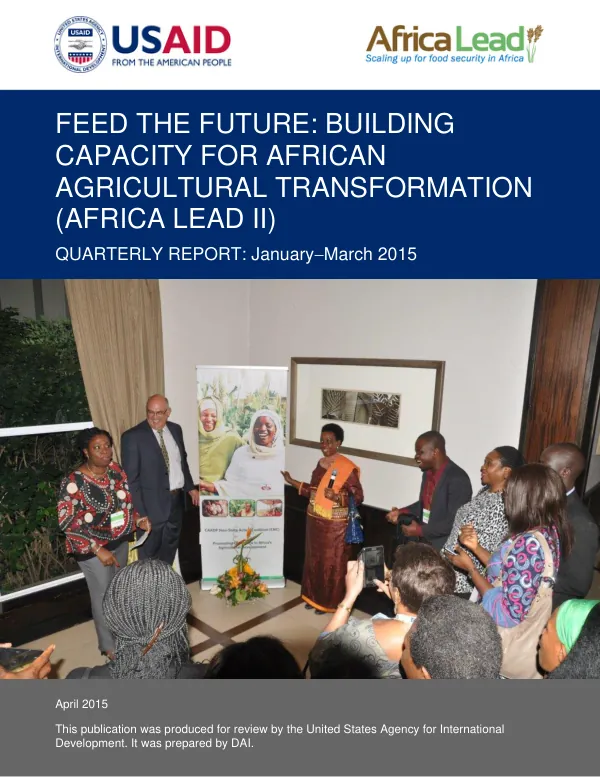 2015
2015USAID DEC