LIFELINE/CHILDLINE NAMIBIA
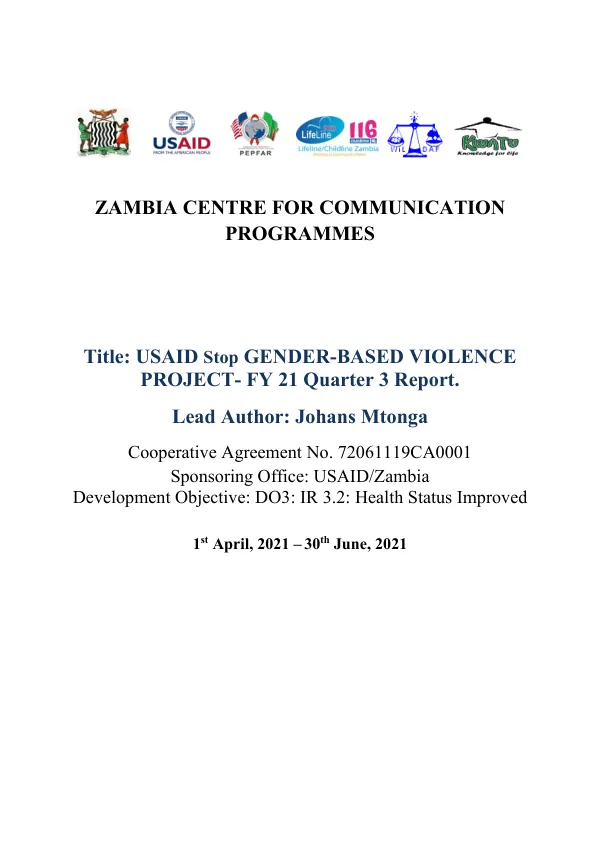
USAID Stop Gender-Based Violence Project - FY 21 Quarter 3 Report
The USAID Stop Gender-Based Violence (GBV) project is a five-year initiative implemented by the Zambia Centre for Communication Programmes (ZCCP) in partnership with three organizations: Women in Law and Development in Africa (WiLDAF), Lifeline/ChildLine Zambia, and Lusitu Chambers.
2021 · 26 pages
Sign in to readA free account is required to download.
Abstract
The project aims to strengthen the environment for girls, women, boys, and men, as well as members of key populations (KP) and priority populations (PP), to live lives free of GBV and enjoy healthy, supportive, and gender-equitable relationships. The project is being implemented in 16 selected districts of Zambia and has a project duration of five years, from November 15, 2018, to November 14, 2023. The project's objectives are being met through various interventions, including GBV/HIV prevention and awareness, capacity building and quality improvement of One Stop Centres (OSCs), and engagement of boys and men through Coaching Boys Into Men (CBIM). During the reporting period of 1st October 2020 to 30th June 2021, the project achieved significant milestones. The project overachieved on several indicators, including PP_PREV, GEND_NORMS, OVC_SERV (Prevention), GEND_GBV (DSD & TA), and Physical GBV (DSD & TA). However, challenges were faced during implementation, including the COVID-19 pandemic, which slowed down activity implementation and affected some components of the project. The project also faced challenges related to late reporting of Sexual Gender-Based Violence (SGBV) cases to the OSC due to distance and cultural issues, as well as low PEP coverage due to cases being reported late. Despite these challenges, the project adopted strategies from the ZNPHI Community Engagement Guidelines, which helped to increase community engagement indicators. The project also learned the importance of adapting new strategies during a crisis to continue with project implementation. A community activist adapted a strategy being used for political campaigns to sensitize people on GBV, COVID-19, and HIV, which helped to pick cases and provide escorted referrals to the OSC and perpetrators. The project's achievements during the reporting period include: * Overachievement on PP_PREV and GEND_NORMS indicators * Achievement of 105% and 92% respectively * Overachievement on OVC_SERV (Prevention) indicator, achieving 68% * Overachievement on GEND_GBV (DSD & TA) indicator, achieving 124% * Achievement of 91% on Sexual GBV (DSD & TA) indicator * Overachievement on Physical GBV (DSD & TA) indicator, achieving 135% * Achievement of 34% on PEP (Coverage) (DSD & TA) indicator * Overachievement on GEND_GBV indicator, achieving 98% * Achievement of 69% on Sexual GBV indicator * Overachievement on Physical GBV indicator, achieving 107% * Achievement of 49% on PEP (Coverage) indicator The project's challenges during the reporting period include: * COVID-19 pandemic, which slowed down activity implementation and affected some components of the project * Late reporting of SGBV cases to the OSC due to distance and cultural issues * Low PEP coverage due to cases being reported late The project's lessons learned during the reporting period include: * Enhanced collaboration with government, civil society organizations, and other partners from sites of implementation made activity implementation effective amidst the COVID-19 pandemic * Engagement of community gatekeepers with local leadership helped in making the project achieve the desired results * Mobile outreach activities are key in taking services closer to the community as well as raising awareness on post GBV care services in the communities * Adapting new strategies during a crisis helps to continue with project implementation.