MINISTRY OF HEALTH
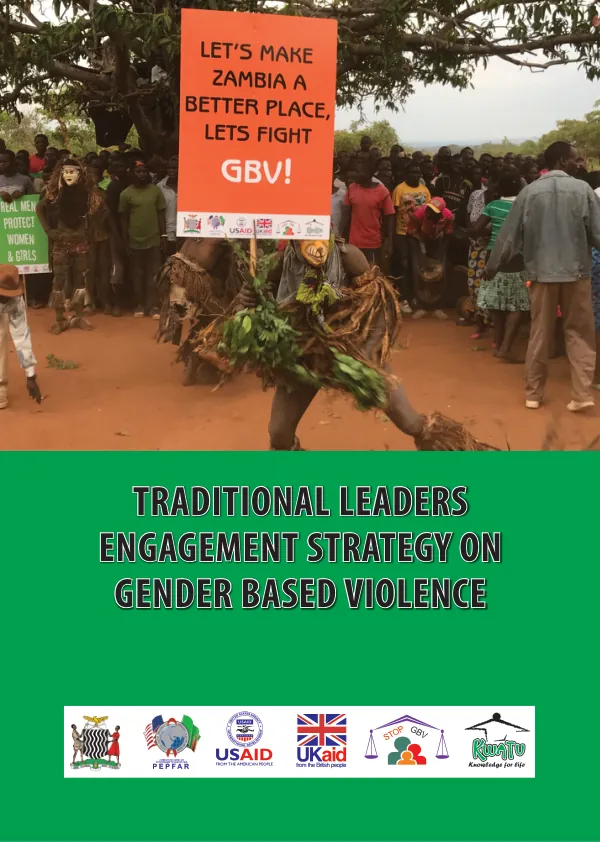
Traditional Leaders Engagement Strategy on Gender Based Violence
The traditional leadership structure in Zambia plays a crucial role in addressing Gender-Based Violence (GBV).
2018 · 40 pages
Sign in to readA free account is required to download.
Abstract
The country's context is characterized by a high prevalence of GBV, with 43% of women aged 15-49 experiencing physical violence and 17% experiencing sexual violence since the age of 15. The 2013/2014 ZDHS survey found that 9% of Zambian women who had experienced violence had never sought help and never told anyone about the violence. Child marriage, a form of GBV and a violation of human rights, threatens children's well-being. The Anti-GBV Act No. 1 of 2011 defines GBV as any physical, mental, social, or economic abuse against a person because of that person's gender. GBV affects both men and women, boys and girls, and can cause physical, emotional, and psychological harm. The traditional leaders in Zambia have been given powers to oversee their subjects using by-laws, making them key influencers in changing social and gender norms in rural communities. The Zambia Center for Communication Programmes has developed a Traditional Leaders Engagement Strategy on GBV to motivate traditional leaders to become gender activists and change agents. The strategy aims to address the root causes of GBV, including negative social and gender norms, and to promote a multidisciplinary approach to ending child marriage and GBV. The document was developed with the support of the American people through President's Emergency Plan for AIDS Relief (PEPFAR) and the United States Agency for International Development (USAID), as well as funds from the United Kingdom Agency for International Development (UKAID) from the British government through the STOP GBV Project. The strategy involves the establishment of a Chiefdom GBV Secretariat, which will be responsible for coordinating GBV-related activities at the chiefdom level. The secretariat will be composed of representatives from various stakeholders, including traditional leaders, government officials, and community members. The strategy also emphasizes the importance of aligning with government structures and legal frameworks, including the National legal frameworks on GBV, CM, Teenage Pregnancies, and HIV. The theoretical basis of the strategy is rooted in the Theory of Change, which posits that traditional leaders can influence change in their communities by promoting positive social and gender norms. The strategy also recognizes the importance of monitoring and evaluation in ensuring the effectiveness of the interventions. The Zambia Center for Communication Programmes has provided expertise and technical support in writing the document, and community activists have contributed valuable information from various communities. The strategy has been developed as a national document to provide guidance on how stakeholders and chiefs can work together to address issues of GBV, HIV, and Child Marriages. The document has been validated by various stakeholders, including traditional leaders, government officials, and community members. The strategy is expected to contribute to the reduction of GBV in Zambia by promoting positive social and gender norms and by empowering traditional leaders to become change agents in their communities. The strategy has been developed with the support of various stakeholders, including the Ministry of Chiefs and Traditional Affairs, the Ministry of Gender, the Ministry of Health, and the Ministry of Home Affairs. The document has been written in a way that is accessible to traditional leaders and other stakeholders, and it provides guidance on how to implement the strategy at the chiefdom level. The strategy is expected to contribute to the reduction of GBV in Zambia by promoting positive social and gender norms and by empowering traditional leaders to become change agents in their communities. The Zambia Center for Communication Programmes has provided expertise and technical support in writing the document, and community activists have contributed valuable information from various communities. The document has been validated by various stakeholders, including traditional leaders, government officials, and community members. The strategy is expected to contribute to the reduction of GBV in Zambia by promoting positive social and gender norms and by empowering traditional leaders to become change agents in their communities.
Related documents