USAID DEC
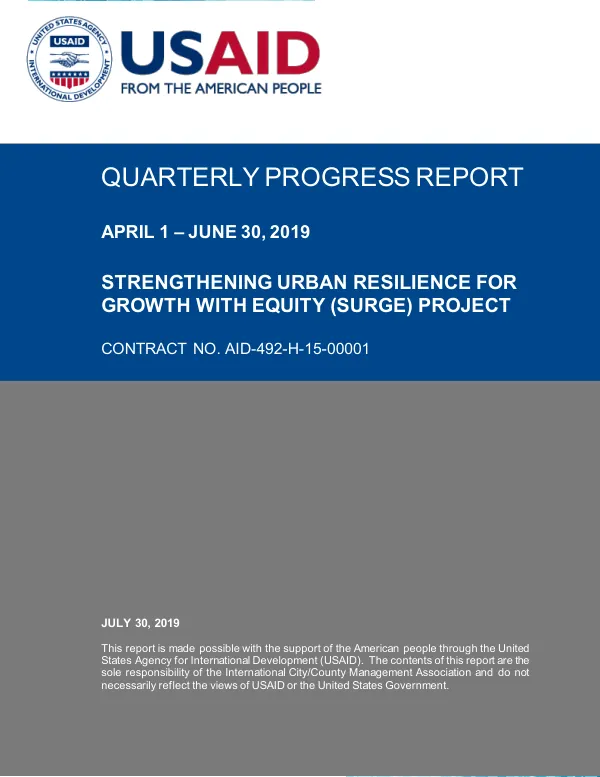
Third Quarter Progress Report, April – June 2019: Strengthening Urban Resilience for Growth with Equity (SURGE) Project
Sign inINTERNATIONAL CITY AND COUNTY MANAGEMENT ASSOCIATION
Third Quarter Progress Report, April – June 2019: Strengthening Urban Resilience for Growth with Equity (SURGE) Project
The SURGE Project, funded by USAID, aims to strengthen urban resilience for growth with equity in eight Cities Development Initiative (CDI) cities in the Philippines.
2019 · 73 pages
Sign in to readA free account is required to download.
Abstract
The project focuses on improving local capacity in inclusive and resilient development, promoting low-emission local economic development strategies, and expanding economic connectivity and access between urban and rural areas. Improving Local Capacity in Inclusive and Resilient Development is a key component of the SURGE Project. In the third quarter of 2019, the project made progress in climate change adaptation initiatives by facilitating the various stages of CDI cities' greenhouse gas management in both entity and community levels. Climate change adaptation and disaster risk reduction were also mainstreamed in the development plans of Batangas and General Santos City. The project also started the curriculum resource mapping with Holy Name University of Tagbilaran City, University of Science and Technology of Southern Philippines in Cagayan de Oro City, and University of the Philippines Visayas in Iloilo City for the establishment of an executive course on urban development. The SURGE Project continued to conduct water safety planning activities with Rural Water and Sanitation Associations (RWSAs) of Batangas and General Santos, and with the water district of Legazpi City. Diagnostic assessments were conducted to improve water service delivery of seven RWSAs in Batangas City. The project also facilitated the formalization and implementation of septage management programs in General Santos, Tagbilaran, Legazpi City, and Tabaco City in Albay, accompanied by social marketing campaigns to increase public awareness and acceptance of the cities' sanitation activities. Promoting Low-emission Local Economic Development Strategies is another key component of the SURGE Project. Through the project's assistance, the cities of General Santos and Puerto Princesa were able to enhance their confirmations of asset inventories, resulting in reconciled data on real property assets and addressed inter-agency discrepancies on land classification. The project provided technical support in public financial management, with a focus on strategic planning, internal audit, risk assessment, and business planning. To promote ease of doing business, the cities made progress in the construction of their one-stop-shops, which will contribute to the streamlining of their processes on construction and business permit issuance. Expanding Economic Connectivity and Access between Urban and Rural Areas is also a key component of the SURGE Project. For this quarter, the project engaged and consulted local stakeholders to draw recommendations for the formulation of the proposed aviation and logistics hub at the General Santos City Airport. The project supported the facilitation of economic linkages, including air connectivity between SOCCSKSARGEN (South Cotabato, Cotabato, Sultan Kudarat, Sarangani, and General Santos City) and Central Luzon. Building on the previous quarter's technical assistance in building up seaweed, cassava, and high-value vegetables as market-based investment environments, the project provided support in forging market linkages for seaweed growers and farmers. The SURGE Project also supported the facilitation of economic linkages, including air connectivity between SOCCSKSARGEN and Central Luzon. The project provided support in forging market linkages for seaweed growers and farmers. The project's efforts aim to promote economic growth and development in the CDI cities and surrounding areas, while also addressing climate change and disaster risk reduction concerns. In the third quarter of 2019, the SURGE Project made significant progress in its various components, including improving local capacity in inclusive and resilient development, promoting low-emission local economic development strategies, and expanding economic connectivity and access between urban and rural areas. The project's efforts aim to contribute to the sustainable development of the CDI cities and surrounding areas, while also addressing climate change and disaster risk reduction concerns.
Related documents