UNIVERSITY OF PRETORIA
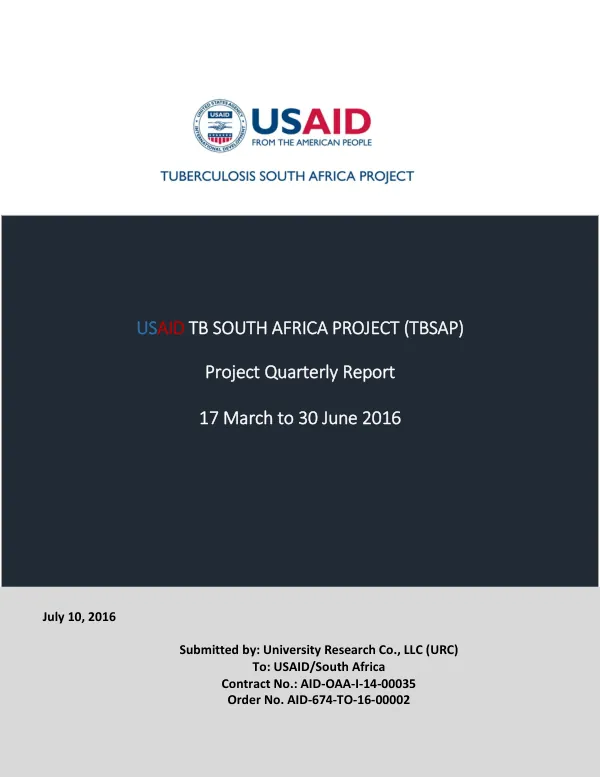
USAID | TBSAP Quarterly Report (March 17 – June 30, 2016)
The United States Agency for International Development's (USAID) Tuberculosis South Africa Project (TBSAP) aims to reduce the burden of tuberculosis (TB) in South Africa.
2016 · 26 pages
Sign in to readA free account is required to download.
Abstract
The project was awarded to University Research Co., LLC (URC) on March 17, 2016, with the primary objective of providing technical assistance to the Government of South Africa (GoSA) to reduce TB infections. The project builds on the activities of the TB Program South Africa (2009-2014) and TB Care II (2014-2015). The project's objectives are to reduce TB infections, increase sustainability of effective TB response systems, and improve care and treatment of vulnerable populations. To achieve these objectives, the project will promote the End TB strategy, a paradigm shift to a global plan to end TB, and strengthen health systems to improve the quality of TB care in South Africa. The project will also expand patient-centered care as guided by the ICSM model of care. Key achievements during the reporting period include the development of a 90-day work plan to guide initial implementation of the project. TBSAP successfully staffed all key positions identified in the project proposal, with the exception of the Chief of Party (COP), who is currently being vetted. Non-key positions have been advertised, and nine out of 18 positions have been filled to date. The project has also developed strategic documents and technical strategies, including a work plan, performance monitoring plan, evaluation and learning plan, environmental mitigation and monitoring plan (EMMP), capacity building plan, advocacy, communication, and social mobilization (ACSM) strategy, TB in the mining sector strategy, MDR-TB strategy, and ICSM model of care strategy. Implementation of the project's strategies aims to assist the National Department of Health (NDOH) in achieving the following targets: 85% treatment success rate for drug-sensitive (DS) TB cases, 70% treatment success rate for MDR-TB, 100% initiation of confirmed DR-TB cases on appropriate treatment, and 90% ART coverage for TB/HIV co-infected patients. These targets will also be aligned to the 90/90/90 targets for TB and HIV, and project activities will be aligned to district-level implementation plans. The project's quarterly report outlines key achievements and activities undertaken by the TBSAP project from project inception (March 17, 2016) through June 30, 2016. The report highlights the project's progress in staffing, development of strategic documents and technical strategies, and implementation of project activities aimed at reducing TB infections and improving care and treatment of vulnerable populations. The project's results framework outlines the objectives, indicators, and targets for the project. The framework includes the following objectives: reduce TB infections, increase sustainability of effective TB response systems, and improve care and treatment of vulnerable populations. The indicators and targets for each objective are also outlined in the framework. The project's implementation plan outlines the activities and strategies to be implemented to achieve the project's objectives. The plan includes the development of a 90-day work plan, staffing of key positions, development of strategic documents and technical strategies, and implementation of project activities aimed at reducing TB infections and improving care and treatment of vulnerable populations. The project's monitoring and evaluation plan outlines the methods and tools to be used to monitor and evaluate the project's progress. The plan includes the development of performance monitoring, evaluation, and learning plans, as well as the use of data collection tools and methods to track progress towards the project's objectives. The project's advocacy, communication, and social mobilization (ACSM) strategy outlines the approaches and activities to be used to promote the project's objectives and engage stakeholders. The strategy includes the development of public service announcements, social media campaigns, and other communication materials to promote the project's objectives and engage stakeholders. The project's TB in the mining sector strategy outlines the approaches and activities to be used to address TB in the mining sector. The strategy includes the development of a TB control program for the mining sector, as well as the provision of training and technical assistance to mining companies to improve TB control practices. The project's MDR-TB strategy outlines the approaches and activities to be used to address MDR-TB. The strategy includes the development of a MDR-TB control program, as well as the provision of training and technical assistance to health facilities to improve MDR-TB control practices. The project's ICSM model of care strategy outlines the approaches and activities to be used to implement patient-centered care as guided by the ICSM model of care. The strategy includes the development of a patient-centered care program, as well as the provision of training and technical assistance to health facilities to improve patient-centered care practices. The project's quarterly report highlights the progress made towards the project's objectives and targets. The report includes the following key achievements: development of a 90-day work plan, staffing of key positions, development of strategic documents and technical strategies, and implementation of project activities aimed at reducing TB infections