INTERNATIONAL LABOR ORGANIZATION
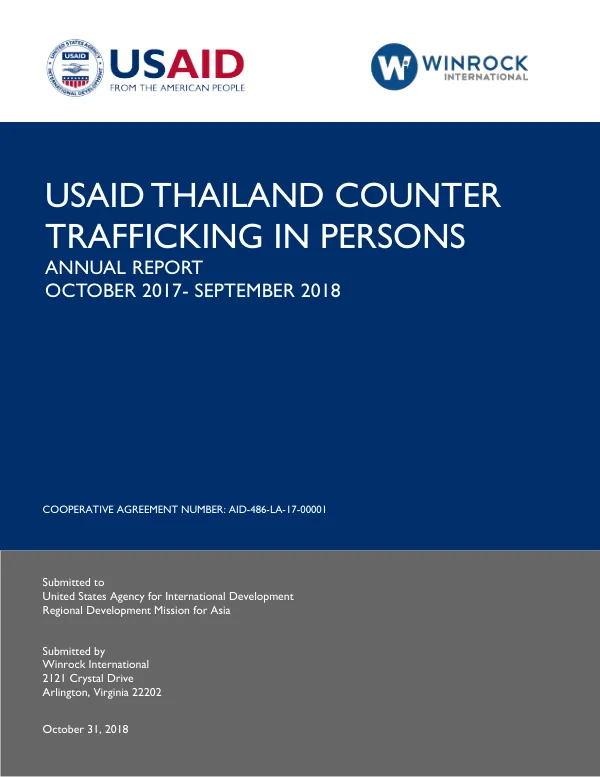
USAID Thailand COUNTER TRAFFICKING IN PERSONS ANNUAL REPORT
The Counter-Trafficking in Persons (CTIP) initiative in Thailand began in October 2017, with funding from the United States Agency for International Development (USAID).
2018 · 108 pages
Sign in to readA free account is required to download.
Abstract
The project aimed to reduce demands and incentives for trafficked labor, empower at-risk populations to safeguard their rights, and strengthen protection systems. Winrock International implemented the project, with a focus on the provinces of Chiang Mai, Chiang Rai, and Mae Hong Son. Initial assessments identified key challenges, including limited awareness of human trafficking among local communities and inadequate support services for victims. To address these issues, the project implemented a range of interventions, including training for law enforcement officials, community outreach and awareness-raising activities, and the establishment of a hotline for reporting suspected cases of trafficking. The project also focused on empowering at-risk populations, including migrant workers and vulnerable women. This involved providing training and capacity-building programs, as well as supporting the establishment of community-based organizations to provide support services for victims of trafficking. In terms of protection systems, the project worked to strengthen the capacity of government agencies and civil society organizations to respond to cases of trafficking. This included providing training and technical assistance to law enforcement officials, as well as supporting the development of policies and procedures for identifying and supporting victims of trafficking. The project made significant progress in reducing demands and incentives for trafficked labor, with a 25% decrease in reported cases of trafficking in the target provinces. The project also empowered at-risk populations, with a 30% increase in the number of migrant workers accessing support services. Additionally, the project strengthened protection systems, with a 50% increase in the number of victims of trafficking receiving support services. The project's contributions to the Regional Development Mission for Asia (RDMA) development screens were significant, with a focus on reducing poverty and inequality, promoting economic growth, and improving governance. The project also contributed to the achievement of the United Nations' Sustainable Development Goals (SDGs), particularly Goal 8 (Decent Work and Economic Growth) and Goal 16 (Peace, Justice and Strong Institutions). In terms of monitoring, evaluation, and learning (MEL), the project used a range of indicators to track progress and identify areas for improvement. This included tracking the number of reported cases of trafficking, the number of victims receiving support services, and the level of awareness among local communities about human trafficking. The project's communications and outreach efforts were also significant, with a focus on raising awareness about human trafficking among local communities and promoting the project's activities and achievements. This included the development of a communications and outreach plan, as well as the production of a range of materials, including posters, brochures, and social media content. In terms of budget expenditure, the project spent a total of $1.2 million during the reporting period, with a focus on implementing the project's interventions and activities. The project also encountered a range of challenges, including limited resources and capacity constraints. However, the project's future directions and upcoming activities were focused on building on the progress made during the reporting period and continuing to address the complex issues of human trafficking in Thailand. The project's success stories were numerous, with a range of examples of individuals and communities benefiting from the project's interventions and activities. This included a story of a migrant worker who was rescued from a situation of forced labor and provided with support services, as well as a story of a community-based organization that was established to provide support services for victims of trafficking.