FHI 360
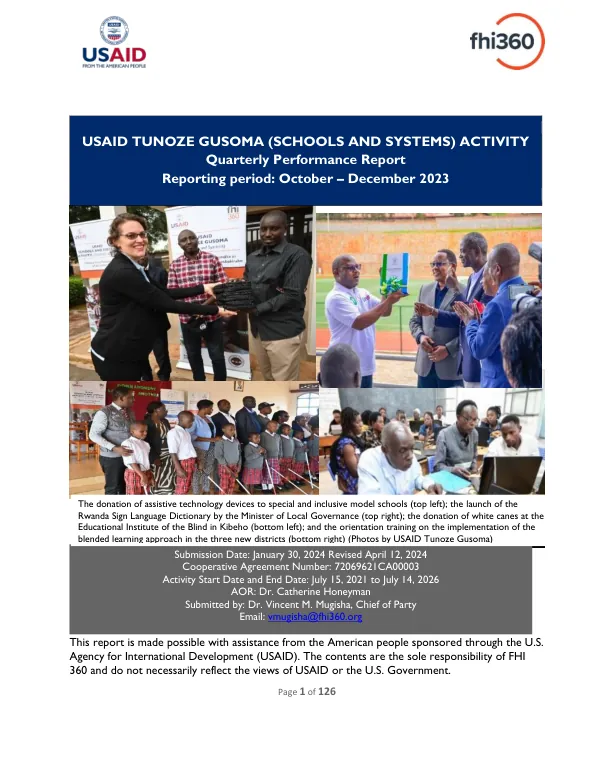
USAID Tunoze Gusoma (Schools and Systems) Activity Quarterly Performance Report
The USAID Tunoze Gusoma (Schools and Systems) Activity aims to strengthen the Government of Rwanda's education system to ensure that pre-primary and lower primary school and classroom environments are of high quality, inclusive, and focused on the learning of foundational literacy skills.
2024 · 126 pages
Sign in to readA free account is required to download.
Abstract
The activity falls under CDCS Development Objective 2: Improved Learning Outcomes, and the overall LEARN project purpose is to improve literacy outcomes for all Rwandan children by the end of P3. Capacity building for pre-primary teachers was a key achievement in this reporting period. A three-day intensive training on emergent literacy was conducted for 2,748 Early Childhood Education (ECE) pre-primary ECE mentors, including 2,268 female and 604 male. The training emphasized the pillars of emergent literacy, integrating Social-Emotional Learning (SEL) in Kinyarwanda lessons, and crafting holistic lesson plans for read-aloud sessions, corner play, and Kinyarwanda language and literacy. The trained ECE mentors will continue to provide continuous professional development to pre-primary teachers through school-level communities of practice (CoPs). The rollout of the blended learning continuous professional development (CPD) approach in three more districts (Ruhango, Rubavu, and Bugesera) was another key achievement. The roll-out of the blended learning program kicked off with a two-day orientation training for 2,669 education actors in the three new districts to implement the blended learning CPD approach. Participants acquired essential ICT skills to register themselves and navigate the REB e-learning platform, blended learning structures and expectations, and the use of Content Access Point (CAP) as an alternative solution to access the eLearning courses for schools with limited access to internet connectivity. Strengthened collaboration and synergy between the project and decentralized education actors through Fidelity of Implementation (FOI) monitoring was also a key achievement. A refresher training was provided to district and sector education officials on the revised Fidelity of Implementation (FOI) monitoring tools between November 9 and 15, 2023. This training aimed to enhance the capacity of education officials to monitor and evaluate the implementation of the blended learning CPD approach. The activity has made significant progress in strengthening the education system in Rwanda. The capacity building for pre-primary teachers, the rollout of the blended learning CPD approach, and the strengthened collaboration and synergy between the project and decentralized education actors are key achievements that will contribute to improved literacy outcomes for all Rwandan children by the end of P3. The activity has made significant progress in implementing the blended learning CPD approach in Rwanda. The roll-out of the blended learning program has kicked off with a two-day orientation training for 2,669 education actors in the three new districts. Participants acquired essential ICT skills to register themselves and navigate the REB e-learning platform, blended learning structures and expectations, and the use of Content Access Point (CAP) as an alternative solution to access the eLearning courses for schools with limited access to internet connectivity.