INTERNATIONAL MONETARY FUND
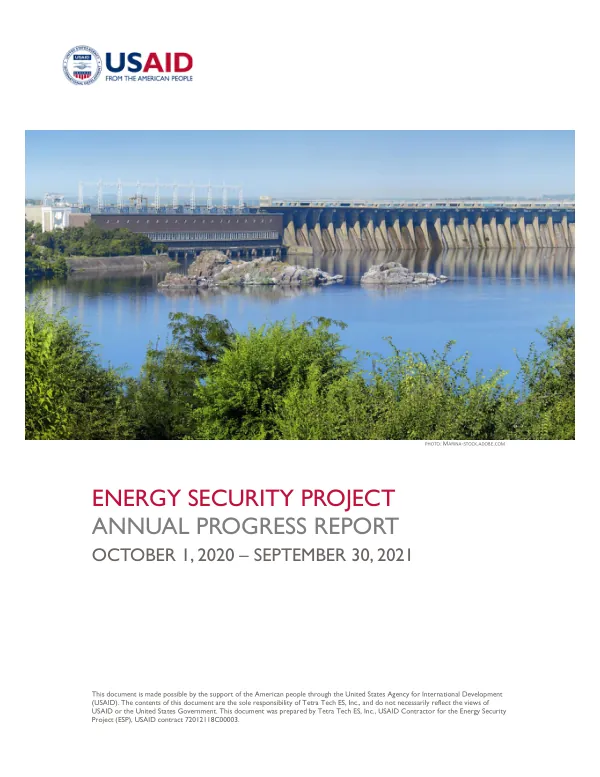
USAID/UKRAINE ESP FY 2021 ANNUAL REPORT
The U.S.
2021 · 33 pages
Sign in to readA free account is required to download.
Abstract
Agency for International Development (USAID)/Ukraine Energy Security Project (ESP) is a five-year initiative (2018-2023) to enhance Ukraine's energy security by improving the energy policy, legal and regulatory environment, and increasing energy supply to achieve broad-based, resilient economic development as a means to sustain Ukrainian democracy. The project aims to strengthen cooperation with counterparts and other development partners, expand the number of stakeholders with whom the project regularly engages, and support the development of a competitive energy market. During the third year of the project, ESP continued to progress despite the ongoing pandemic, which led to more complicated working conditions. The project demonstrated resilience by adding several new major workstreams and reinstituting efforts elsewhere in Ukraine that had been on hold due to the pandemic. ESP successfully strengthened cooperation with counterparts and other development partners, including the Verkhovna Rada, the Ministry of Territories and Communities Development, the Anti-Monopoly Committee of Ukraine, and some state enterprises, such as EnergoAtom. One of the major highlights of the third year was the signing of the loan agreement between the European Bank for Reconstruction and Development (EBRD) and Kyiv City Council to provide a €140 million loan for upgrading the infrastructure of the Kyivteploenergo (KTE) utility. ESP also provided technical support for Ukrhydroenergo to gain financing of $21 million from the World Bank and Clean Technology to support an integrated battery energy storage system at several of their generating plants. Between these two projects, ESP supported investment attraction of about $380 million during the third year of the project. The project continued to make progress on European energy market integration through ENTSO-E, with nearly completing unit testing and certification as required by the ENTSO-E PG. ESP also continued with several studies in support of the so-called 'island mode' to model how the Ukraine Integrated Power System (IPS) will function when separated from the Russian system. The project supported Ukrenergo and the Ministry of Energy on this high priority of successful ENTSO-E integration. ESP led the donor community in providing support for the Wholesale Electricity Market (WEM), advising throughout the year on market monitoring and designing additional reform steps such as changes to market rules. The ancillary services market (ASM) was strengthened through unit testing and certification of generating plant to participate in the ASM. However, problems still persist with non-payment in key market segments and the need for development of the competitive bilateral segment of the market, a target for the remaining two years of ESP. Significant training and advocacy efforts dominated the project's third year, leading to progress on the EU Regulation for Wholesale Energy Market Integrity and Transparency (REMIT) in Ukraine, including draft law (#5322) and progress at the National Energy Utilities and Regulatory Commission (NEURC) on the internal and organizational capacity development to support REMIT. ESP also completed a comprehensive review of the sector's performance, identified the root causes of the financial performance problems being seen, and identified a set of measures to address each. This sector financial recovery plan (FRAP) is now being advocated among counterparts and development partners. During the third year, ESP restarted its municipally focused effort, now supported 11 municipal district heating utilities with improved planning and operations. Major workstreams continued at the national level, such as on heating sector policy, promotion of individual heating substations, regulation of the heating sector, assessing the impact and mitigating the risks associated with the removal of the Public Service Obligation that had capped the gas price charged to DH utilities, and the changing method of calculating the gas price.
Related documents