EUROPEAN UNION
USAID V-LEEP’s Support to Vietnam’s Solar Market Development
Vietnam's solar market development received significant support from V-LEEP, particularly in collaboration with the Ministry of Industry and Trade (MOIT) to establish the national Rooftop Solar (RTS) program.
2021 · 2 pages
Sign in to readA free account is required to download.
Abstract
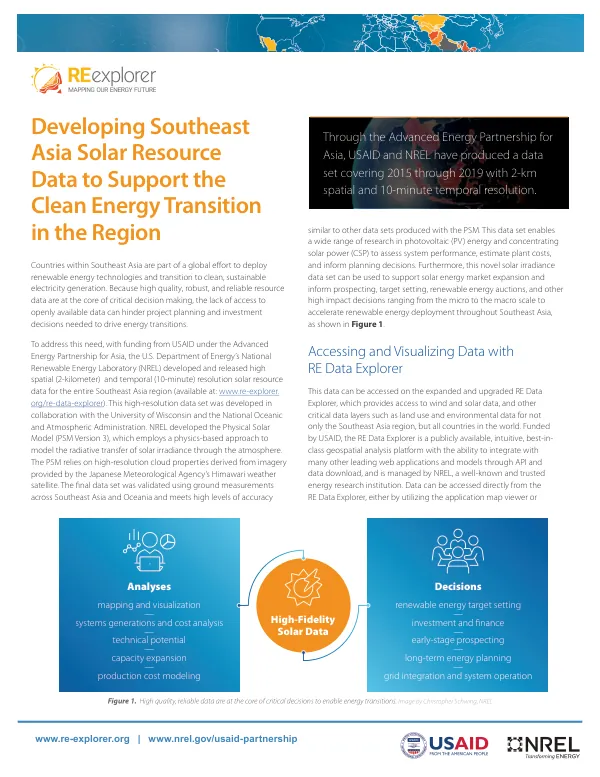
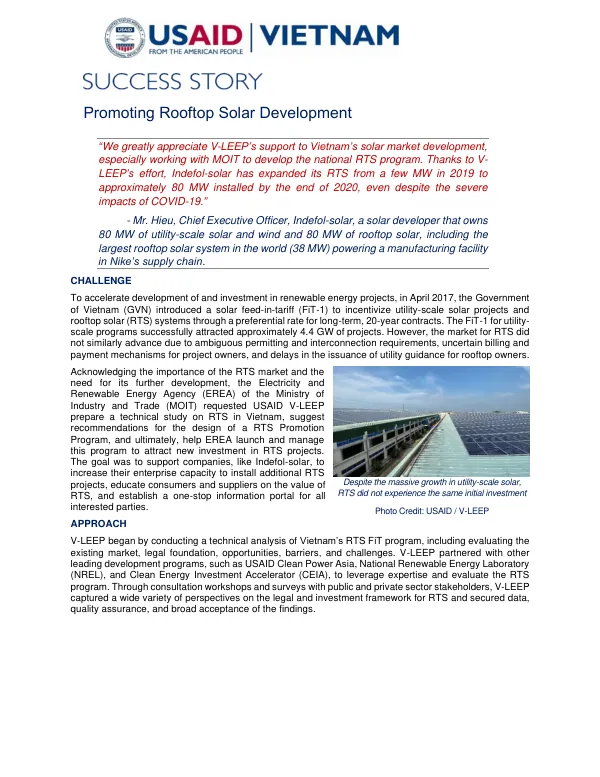
As a result, Indefol-solar, a leading solar developer, expanded its RTS from a few megawatts in 2019 to approximately 80 megawatts installed by the end of 2020, despite the severe impacts of COVID-19. The Government of Vietnam introduced a solar feed-in-tariff (FiT-1) in April 2017 to incentivize utility-scale solar projects and rooftop solar systems through a preferential rate for long-term, 20-year contracts. The FiT-1 for utility-scale programs successfully attracted approximately 4.4 gigawatts of projects. However, the market for RTS did not advance due to ambiguous permitting and interconnection requirements, uncertain billing and payment mechanisms for project owners, and delays in the issuance of utility guidance for rooftop owners. The Electricity and Renewable Energy Agency (EREA) of MOIT requested USAID V-LEEP to prepare a technical study on RTS in Vietnam, suggest recommendations for the design of a RTS Promotion Program, and ultimately, help EREA launch and manage this program to attract new investment in RTS projects. The goal was to support companies like Indefol-solar to increase their enterprise capacity to install additional RTS projects, educate consumers and suppliers on the value of RTS, and establish a one-stop information portal for all interested parties. V-LEEP conducted a technical analysis of Vietnam's RTS FiT program, including evaluating the existing market, legal foundation, opportunities, barriers, and challenges. The organization partnered with other leading development programs, such as USAID Clean Power Asia, National Renewable Energy Laboratory (NREL), and Clean Energy Investment Accelerator (CEIA), to leverage expertise and evaluate the RTS program. Through consultation workshops and surveys with public and private sector stakeholders, V-LEEP captured a wide variety of perspectives on the legal and investment framework for RTS and secured data, quality assurance, and broad acceptance of the findings. Based on the analysis, V-LEEP recommended the design of a new communication mechanism: the RTS Promotion Program, which EREA ultimately recommended to MOIT. The six-year program (2019-2025) set ambitious goals of achieving 100,000 RTS systems (equivalent to 1,000 megawatts installed capacity) nationwide. With EREA's endorsement, V-LEEP took the lead to help design, launch, and manage this RTS Promotion Program. V-LEEP developed a communications strategy for the RTS Promotion Program as well as an official website to enhance public awareness and improve RTS comprehension. The website was continuously updated with the latest policy news, market development trends, installation numbers, and project development tools, such as NREL's solar generation calculator. The RTS Promotion Program was officially launched in Ho Chi Minh City on July 25, 2019, with over 180 individuals from 150 public and private organizations, including 30 media representatives, attending. Officials from MOIT and the U.S. Embassy gave opening speeches, and V-LEEP officially launched the RTS website and shared a video highlighting the value of rooftop solar PV and the current status of Vietnam's RTS program. At the time of the program's launch in July 2019, the total capacity of RTS systems in Vietnam was about 200 megawatts, generated by about 9,300 roof-top solar systems. By the end of 2020, the total capacity of RTS systems had increased to 9,280 megawatts of installed capacity from over 100,000 installations nationwide, significantly exceeding the program's 2025 goals.