USAID DEC
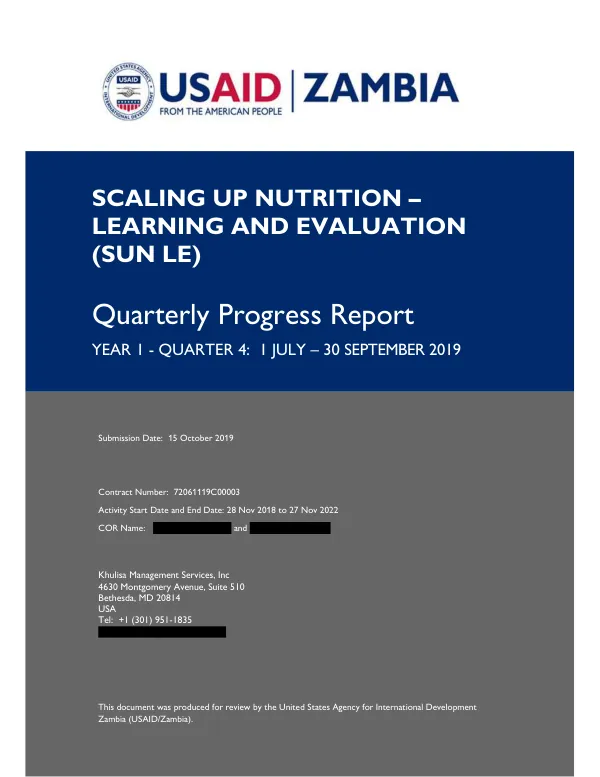
USAID/Zambia Scaling Up Nutrition Learning and Evaluation (SUN LE) Quarterly Progress Report Year 1 - Quarter 4
Sign inICF
USAID/Zambia Scaling Up Nutrition Learning and Evaluation (SUN LE) Quarterly Progress Report Year 1 - Quarter 4
Scaling Up Nutrition - Learning and Evaluation (SUN LE) is a 4-year USAID-funded project implemented by Khulisa Management Services, Inc.
2019 · 26 pages
Sign in to readA free account is required to download.
Abstract
The project aims to improve nutrition outcomes in Zambia by strengthening the capacity of the National Food and Nutrition Commission (NFNC) and other key stakeholders to design, implement, and evaluate nutrition programs. The project focuses on 30 districts across Zambia, covering all 10 provinces. The project's scope includes the development and implementation of a comprehensive Activity Monitoring, Evaluation, and Learning Plan (AMELP), which outlines the project's objectives, indicators, and evaluation framework. The AMELP is designed to ensure that the project's activities are aligned with USAID's goals and objectives, and that progress is regularly monitored and evaluated. The project's implementation is led by Khulisa Management Services, Inc., with support from subcontractors including Indaba Agricultural Policy Research Institute (IAPRI), ICF International (ICF), and The University of North Carolina at Chapel Hill (UNC). The project's major counterpart organizations include the National Food and Nutrition Commission (NFNC), 7 Ministries in Zambia at national level, Provincial/district nutrition coordination committees, and the SUN LE Monitoring, Evaluation, and Research Technical Working Group. The project's geographic coverage includes 30 districts across Zambia, and the reporting period for this quarterly report is 1 July to 30 September 2019. The project's funding sources include EG.3, HL.8, A11, HL.9, A11, A21, and A21, with a total planned expenditure of USD Figure removed. The project's implementation has made significant progress, with key achievements including the development and implementation of the AMELP, the establishment of the SUN LE Monitoring, Evaluation, and Research Technical Working Group, and the conduct of baseline surveys in all 30 districts. The project has also made progress in integrating cross-cutting issues and USAID forward priorities, including gender equality and female empowerment, sustainability mechanisms, environmental compliance, and youth development. The project's management and administrative issues are being addressed through regular meetings with USAID and the SUN LE Monitoring, Evaluation, and Research Technical Working Group. The project's lessons learned include the importance of establishing a strong technical working group and the need for regular communication with stakeholders. The project's planned activities for the next quarter include the conduct of midterm evaluations, the development of a learning agenda, and the establishment of a provincial/district data use workshop. The project's pipeline includes USD Figure removed, with a pipeline months of 3. The project's implementation has been successful in achieving its objectives, with significant progress made in improving nutrition outcomes in Zambia. The project's continued support and funding are essential to ensure the sustainability of the project's achievements and the continued improvement of nutrition outcomes in Zambia. The project's implementation has made significant progress, with key achievements including the development and implementation of the AMELP, the establishment of the SUN LE Monitoring, Evaluation, and Research Technical Working Group, and the conduct of baseline surveys in all 30 districts. The
Related documents