ICF
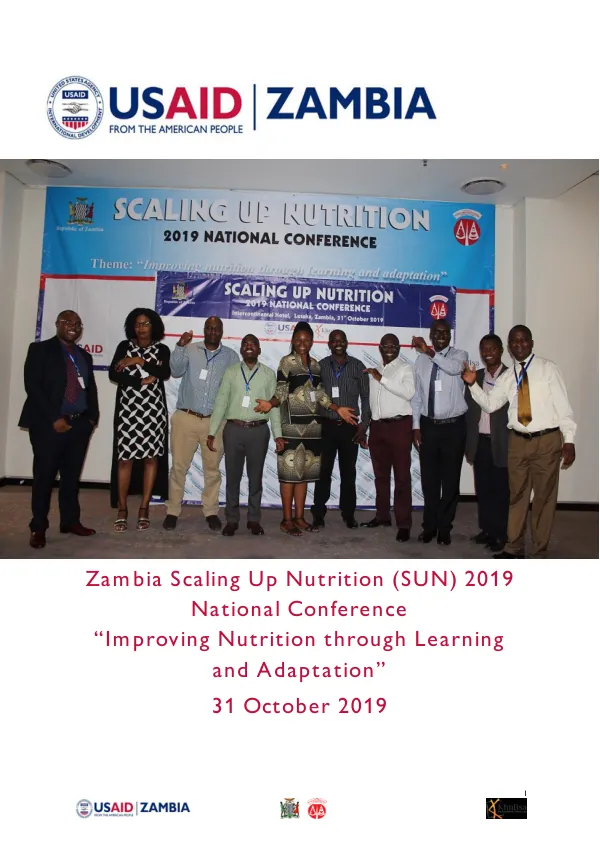
Zambia Scaling Up Nutrition (SUN) 2019 National Conference
The Zambia Scaling Up Nutrition (SUN) 2019 National Conference was organised by the USAID-funded Scaling Up Nutrition Learning and Evaluation (SUN LE) project in collaboration with the Zambia National Food and Nutrition Commission (NFNC).
2019 · 35 pages
Sign in to readA free account is required to download.
Abstract
The conference was conducted as part of SUN LE's wider support to facilitate learning for the Government of the Republic of Zambia's (GRZ's) SUN program and the United States Agency for International Development (USAID) funded Scaling Up Nutrition Technical Assistance (SUN TA) Project, which aims to reduce child stunting in Zambia. The GRZ SUN programme is implemented by 7-line ministries in 30 priority districts, and technically and financially supported by a wide range of development partners. SUN LE supports the GRZ and its partners with survey, research, evaluation, and dissemination services. Through these services, SUN LE aims to support the improvement of SUN 2.0 implementation processes, adaptive and participatory management, and knowledge systems. SUN LE is implemented by Khulisa Management Services, Inc. (Khulisa) in collaboration with 3 institutional partners – Indaba Agricultural Policy Research Institute (IAPRI), ICF, and the University of North Carolina at Chapel Hill (UNC). SUN-LE's four objectives are presented in Box 2. As part of collaborative learning and adaptation, SUN LE supports NFNC to undertake annual national conferences to share data and information relevant to the SUN programme generated during the year, such as baseline surveys, focused studies, and performance audits/assessments. National conferences are also platforms for sharing emerging best practices or lessons learned from implementing SUN 2.0 interventions. The 2019 national conference is the first in a series of annual conferences to be conducted over the life of the SUN LE project. The purpose of the 2019 SUN national conference was to disseminate the findings of the First 1000 Most Critical Days Programme (MCDP II) Baseline Survey to SUN stakeholders at national level. The 2019 conference had two specific objectives: (1) to share findings from the MCDP II baseline survey, and (2) to identify policy and programme implications emanating from the baseline findings. The conference was attended by a wide range of stakeholders, including government officials, development partners, civil society organisations, and technical experts. The conference programme included plenary sessions, presentations of baseline survey results, and thematic group discussions. The conference also featured a plenary question and answer session, where participants had the opportunity to engage with the presenters and discuss the implications of the baseline findings. The conference was well-organised and attended by a large number of participants. The conference planning committee, led by Mr. Mike Mwanza, head of Research and Planning Unit, played a crucial role in ensuring the success of the conference. The event planner, Ms. Linda Mudenda, and her team also made significant contributions to the conference planning and execution. The conference provided a platform for sharing emerging best practices and lessons learned from implementing SUN 2.0 interventions. The conference also facilitated the identification of policy and programme implications emanating from the baseline findings. The conference was a significant step towards achieving the SUN LE project's objectives of building a SUN 2.0 evidence base and facilitating individual and organisational capacity to use data. The conference was supported by a wide range of development partners, including the United States Agency for International Development (USAID), the Government of the Republic of Zambia (GRZ), and the Zambia National Food and Nutrition Commission (NFNC). The conference was also supported by technical experts from various institutions, including the Indaba Agricultural Policy Research Institute (IAPRI), ICF, and the University of North Carolina at Chapel Hill (UNC). The conference outcomes and recommendations will be used to inform the implementation of the SUN 2.0 programme in Zambia. The conference also provided a platform for sharing emerging best practices and lessons learned from implementing SUN 2.0 interventions, which will be useful for other countries implementing similar programmes.
![Measurement Approaches for Effective Coverage Estimation [MR31]](https://covers.devme.ai/gen/138167.webp)