USAID DEC
Useful plants of Amazonian Ecuador : final progress report -- 15 April 1988-15 April 1991
Sign inNEW YORK BOTANICAL GARDEN. INSTITUTE OF ECONOMIC BOTANY
Useful plants of Amazonian Ecuador : final progress report -- 15 April 1988-15 April 1991
Anthropologists commonly focus on the tropical rainforest"s effects in shaping culture, while neglecting to emphasize the role of lowland inhabitants in shaping the forest.
Bennett, Bradley C. · 1991
Sign in to readA free account is required to download.
Abstract
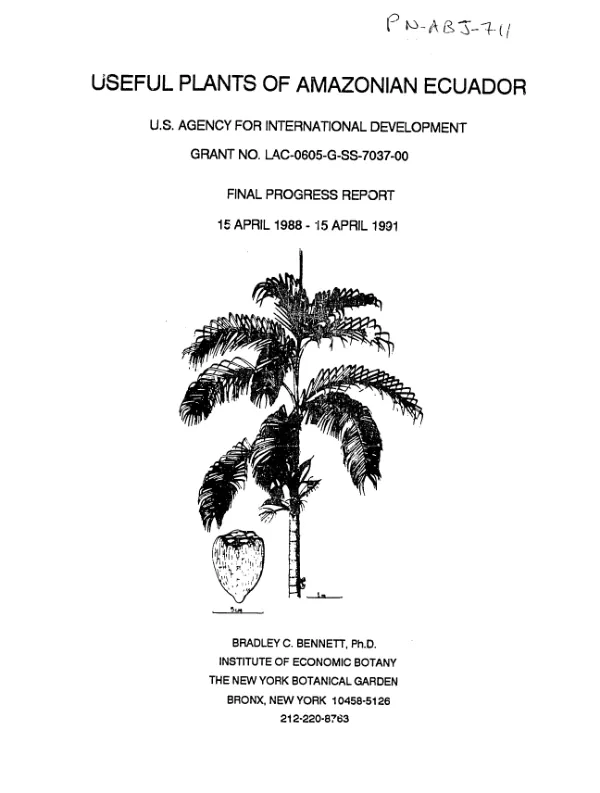
Through non- random harvesting, protection of useful species, artificial selection, and manipulation of animal pollinators and dispersers, humans change the species composition of forests. This report describes a USAID project to study the plants used by some of Ecuador"s lowland people and examine the influence humans can have on native vegetation. The study involves the two largest indigenous groups in Amazonian Ecuador -- the Quichua and the Shuar. Activities have included: collecting, identifying, and describing plants, and assessing their potential economic value; preparing and disseminating specimens; training Ecuadorean scientists; preparing a database; and strengthening professional linkages. The project has collected 1,462 specimens, including 562 used by the Untsuri Shuar, which represent only about half of the plants used by the Shuar. Many of these species have never before been discovered by the scientific community. Unfortunately, acculturation and rainforest destruction are proceeding more rapidly than the project"s efforts to record ethnobotanical knowledge. The project continues to evaluate the economic potential of these plants and to build the research capacity in Ecuador. A species list is appended.