ICF
Using Social Media Data to Understand Changes in Gender Norms: Guidance
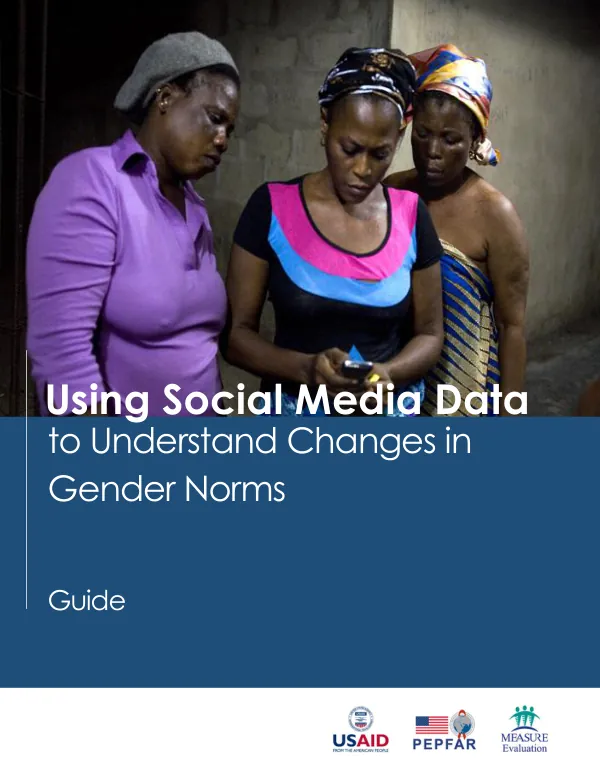
Social media has emerged as a valuable tool for researchers and health workers to understand various health issues, including gender norms.
2018 · 18 pages
Sign in to readA free account is required to download.
Abstract
Gender norms are the socialized expectations about women, men, boys, and girls and the power dynamics between them. These norms can be a significant barrier to achieving health equities, particularly in sub-Saharan Africa. Despite the importance of understanding and changing harmful gender norms, few national and international programs collect data on societal attitudes. A MEASURE Evaluation study explored the feasibility of using large social media data sets to track changes in attitudes toward and gender norms regarding sexual relationships between younger women and older men and gender-based violence (GBV) against women and girls in sub-Saharan Africa. The study selected Twitter as the social media platform due to its data availability and ease of access. Twitter data can be collected retrospectively or prospectively, with historical tweets available through third-party vendors. However, obtaining multiple months' worth of tweets can be expensive. The purpose of this guidance is to provide information on collecting, analyzing, and interpreting Twitter data on gender norms. The guidance discusses when social media can be useful in monitoring, evaluation, and research, what data are available, and methodological challenges including generalization, biases, protecting individual privacy, and considering ethical implications. This guidance is written for monitoring and evaluation officers or data users with some background in Microsoft Excel. Twitter was selected as the social media source due to its reach, applicability, and accessibility of its data. The guidance looks at methods for obtaining and cleaning Twitter data, including writing a script in R, Python, or another language to query Twitter servers. Real-time tweets can be obtained manually using several different approaches, with writing a script in R, Python, or another language providing the most flexibility and power. Data cleaning is a crucial step in preparing Twitter data for analysis. This involves removing irrelevant or duplicate tweets, handling missing values, and converting data into a suitable format for analysis. Data analysis can be performed using various techniques, including natural language processing (NLP) and machine learning algorithms. However, data analysis also poses several challenges, including generalization, biases, and protecting individual privacy. Data ethics is a critical consideration when working with social media data. This includes ensuring that data collection and analysis are conducted in a way that respects individual privacy and adheres to relevant laws and regulations. The guidance provides recommendations for data ethics, including obtaining informed consent from participants, anonymizing data, and ensuring that data are stored securely. In conclusion, social media data can be a valuable resource for understanding changes in gender norms. Twitter data can be collected retrospectively or prospectively, with historical tweets available through third-party vendors. However, obtaining multiple months' worth of tweets can be expensive. Data cleaning and analysis pose several challenges, including generalization, biases, and protecting individual privacy. Data ethics is a critical consideration when working with social media data, and recommendations are provided to ensure that data collection and analysis are conducted in a way that respects individual privacy and adheres to relevant laws and regulations.