USAID DEC
Utilization review and evaluation; tropical soils research program, Cornell and North Carolina state universities
Sign inUSAID. BUR. FOR TECHNICAL ASSISTANCE. OFC. OF AGRICULTURE
Utilization review and evaluation; tropical soils research program, Cornell and North Carolina state universities
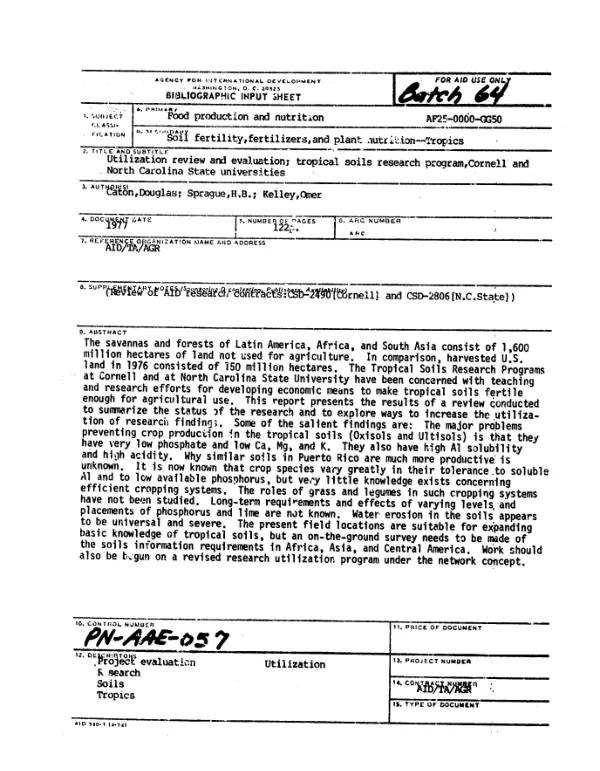
The savannas and forests of Latin America, Africa, and South Asia consist of 1,600 million hectares of land not used for agriculture.
Caton, Douglas D.; Sprague, Howard B. +1 more · 1970
Sign in to readA free account is required to download.
Abstract
In comparison, harvested U.S. land in 1976 consisted of 150 million hectares. The Tropical Soils Research Programs at Cornell and at North Carolina State University have been concerned with teaching and research efforts for developing economic means to make tropical soils fertile enough for agriculture use. This report presents the results of a review conducted to summarize the status of the research and to explore ways to increase the utilization of research findings. Some of the salient findings are: The major problems preventing crop production in the tropical soils (Oxisols and Ultisols) is that they have very low phosphate and low Ca, Mg, and K. They also have high Al solubility and high acidity. Why similar soils in Puerto Rico are much more productive is unknown. It is now known that crop species vary greatly in their tolerance to soluble Al and to small amounts of phosphorus but little is known about efficient cropping systems. The rules of grass and legumes in such cropping systems have not been studied. Long-term requirements and effects of varying levels and placements of phosphorus and lime are not known. Water erosion in the soils appears to be universal and severe. The present field locations are suitable for expanding basic knowledge of tropical soils, but an on-the-ground survey needs to be made of the soils information requirements in Africa, Asia and Central America. Work should also be begun on a revised research utilization program under the network concept.
Related documents