PAN AMERICAN WORLD HEALTH ORGANIZATION
Vector Surveillance and Control in Low-Incidence Malaria Settings
Vector surveillance and control are critical components of malaria prevention strategies.
2016 · 2 pages
Sign in to readA free account is required to download.
Abstract
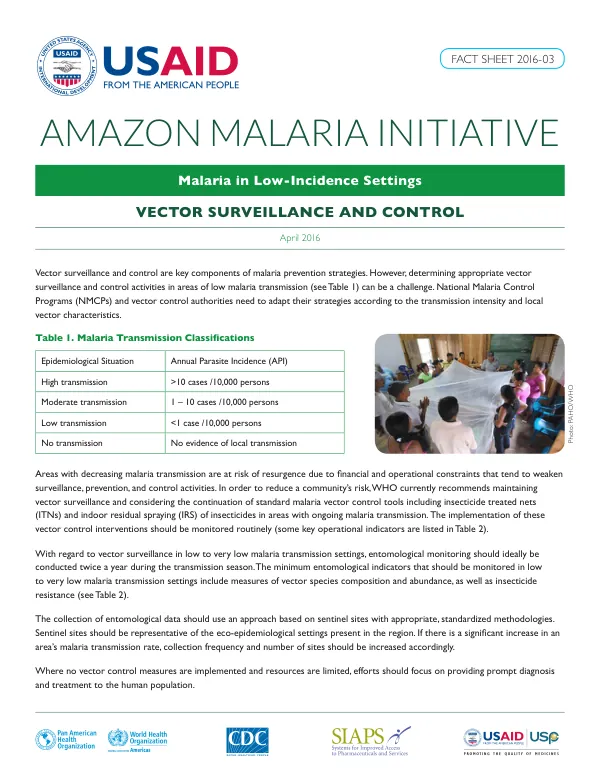
Determining appropriate vector surveillance and control activities in areas of low malaria transmission can be a challenge. National Malaria Control Programs (NMCPs) and vector control authorities need to adapt their strategies according to the transmission intensity and local vector characteristics. Malaria transmission can be classified into four categories based on the annual parasite incidence (API): high transmission (>10 cases/10,000 persons), moderate transmission (1-10 cases/10,000 persons), low transmission (<1 case/10,000 persons), and no transmission (no evidence of local transmission). Areas with decreasing malaria transmission are at risk of resurgence due to financial and operational constraints that tend to weaken surveillance, prevention, and control activities. The World Health Organization (WHO) recommends maintaining vector surveillance and considering the continuation of standard malaria vector control tools, including insecticide-treated nets (ITNs) and indoor residual spraying (IRS) of insecticides, in areas with ongoing malaria transmission. Routine monitoring of vector control interventions is essential, with some key operational indicators including household ownership of ITNs, ITN use, and IRS coverage. In areas with low to very low malaria transmission, entomological monitoring should be conducted twice a year during the transmission season. The minimum entomological indicators that should be monitored include measures of vector species composition and abundance, as well as insecticide resistance. Sentinel sites with standardized methodologies should be used to collect entomological data, and the collection frequency and number of sites should be increased if there is a significant increase in an area's malaria transmission rate. If no vector control measures are implemented and resources are limited, efforts should focus on providing prompt diagnosis and treatment to the human population. In general, vector surveillance and control should remain a part of national malaria control strategies for the long-term, with activities continually adapted to the changing epidemiology of malaria.
Related documents