INTERNATIONAL FINANCE CORPORATION
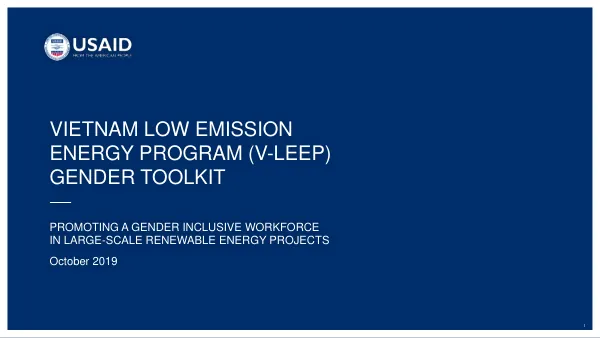
Vietnam Low Emission Energy Program (V-LEEP) Gender Toolkit
Vietnam's Low Emission Energy Program (V-LEEP) supports the Government of Vietnam and private sector actors in strengthening the foundation for low emission energy systems and deploying modern clean energy services.
2019 · 32 pages
Sign in to readA free account is required to download.
Abstract
A cross-cutting effort focuses on the gender dimensions of large-scale renewable energy projects, aiming to promote a gender inclusive workforce in these projects. The toolkit emphasizes the importance of proactive promotion of gender equality and diversity, which can enhance economic output, performance, and reputation of a project or business. Socially inclusive workplaces can increase productivity, flow of information, and quality of service, encourage adherence to rules and policies, and attract diverse points of view and opinions. The business case for a gender inclusive workforce in the renewables sector in Vietnam highlights the benefits of greater diversity, including accelerated innovation, enhanced recruitment and retention, and increased revenues through leveraging women's networks and relationships. The Government of Vietnam prioritizes gender equality and social economic achievement targets, as outlined in the National Strategy on Gender Equality 2011-2020 and National Programme on Gender Equality 2016-2020. Employing local women on renewable energy projects can positively impact business outcomes, livelihoods, and local economies. Case studies, such as LaGeo's geothermal utility in El Salvador and Santo Antonio Energia's hydropower project in Brazil, demonstrate the effectiveness of strategies to promote greater inclusion of women in the workforce. These strategies include institutional gender assessments, training programs, and community education projects that generate local talent pools and prevent vandalism on project sites. The toolkit provides seven distinct tools offering good practice guidance on gender inclusive recruitment, training, and worker protections, particularly during construction and operations and maintenance phases. It aims to support large-scale RE project developers in recruiting local workers, particularly semi-skilled and unskilled women, on local project sites. The toolkit is intended for use by large-scale RE developers in Vietnam, especially those meeting gender-related requirements as per Vietnamese laws and international financier Environmental and Social Impact Assessment (ESIA) criteria. The current opportunities for local women's employment on project sites are detailed in a preliminary and high-level overview of jobs available for semi-skilled and unskilled local women throughout the project lifecycle. Construction and operations and maintenance are shown to be key phases for employment, and RE developers should work with EPC contractors and relevant local stakeholders to conduct a detailed jobs and skills need analysis per project and build relationships with the local women's unions, local authorities, and other stakeholders. Overall, the V-LEEP Gender Toolkit aims to support large-scale RE project developers in promoting a gender inclusive workforce in Vietnam, which can lead to positive business outcomes, livelihoods, and local economies.