TETRA TECH
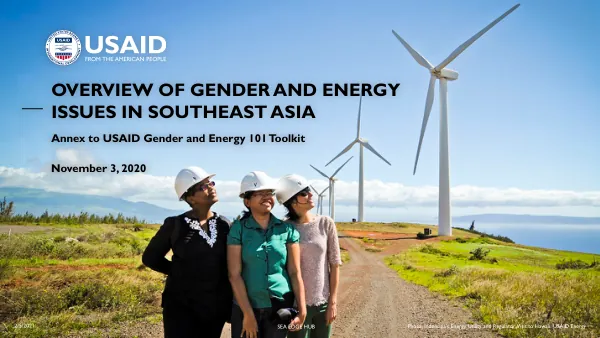
Overview of Gender and Energy Issues in Southeast Asia
National energy frameworks and policymaking in Southeast Asia often fail to account for the ways in which gender norms and barriers modulate energy access and benefit for women, men, girls, and boys.
2021 · 43 pages
Sign in to readA free account is required to download.
Abstract
More than 50% of national energy frameworks in the Indo-Pacific region do not recognize or account for these factors. In contrast, only 13% of renewable energy frameworks in the region include a mention of gender or women. Energy policies and programs in most South Asian countries focus on commercial energy carriers, which do not meaningfully address the realities of the rural poor or women. The lack of gender mainstreaming in the energy sector is a significant concern, as governments struggle to include women in their energy transition efforts. Nepal is the only country in the region with a national energy framework specific to rural energy access and electrification that mentions women. This framework recognizes the adverse health impact of traditional energy sources on women and children and promotes women's engagement in community use organizations. Women are underrepresented in positions and fora where energy policy is debated and decided. Globally, women hold only 10% of national energy ministry and agency positions, 4% of World Energy Council Chair positions, and 18% of World Energy Council Secretary positions. In the Lower Mekong countries, public energy sectors responsible for renewable energy policy and planning are dominated by men, who are mostly engineers by trade. Women are concentrated in finance, administration, and human resources positions. Barriers to women's participation in conferences that influence national energy policy are also evident, as seen in a 2011 renewable energy conference in India, where only 4 out of 200 participants were women. The energy industry remains male-dominated globally and in Southeast Asia, with women making up less than 20% of the energy sector workforce in 2015. However, there are indications that the renewable energy sector may be engaging women at higher rates. In Bangladesh, energy institutions are dominated by male staff at all levels, including front-line units that work with households and small business customers. Women professionals tend to hold administrative and accounting positions, while men occupy technical and field-based jobs. In Cambodia, civil servants in the energy ministry are predominantly men, with women concentrated in finance and accounting. In Thailand, men predominate in leadership of the Department of Alternative Energy Development and Efficiency in the Ministry of Energy, but more gender balance can be found in the energy research unit and international cooperation division.
Related documents