EQUAL ACCESS INTERNATIONAL
Voices for Peace (V4P) Outcome Harvesting Evaluation Report
The Voices for Peace (V4P) program, implemented by Equal Access International, operates in Mali, Burkina Faso, Niger, Chad, and Cameroon.
2020 · 8 pages
Sign in to readA free account is required to download.
Abstract
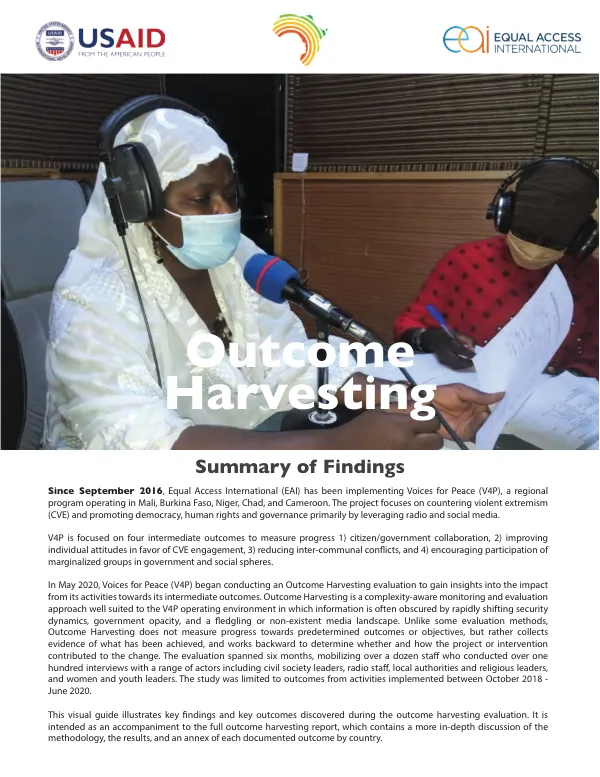
The project focuses on countering violent extremism (CVE) and promoting democracy, human rights, and governance by leveraging radio and social media. V4P aims to achieve four intermediate outcomes: citizen-government collaboration, improving attitudes in favor of CVE, reducing inter-communal conflicts, and increasing participation of marginalized groups in government and social spheres. To measure progress, V4P conducted an Outcome Harvesting evaluation, a complexity-aware monitoring approach suitable for the project's environment. The evaluation spanned six months, involving over a dozen staff members who conducted over 100 interviews with various actors, including civil society, radio staff, local authorities, and women leaders. The study focused on outcomes from activities implemented between October 2018 and June 2020. The evaluation revealed that capacity building activities produced the most outcomes, followed by advocacy efforts, inter-community dialogue, and radio programming. These activities provided communities with the necessary tools, skills, and confidence to lead their own initiatives independent of V4P. For instance, the peaceful conflict resolution between religious groups in Gani and Gani and Gomboro, Burkin Faso, highlights how V4P provides space for communities to discuss grievances that drive violent extremism. The evaluation also found that V4P's radio programming influenced changes in attitudes and behaviors, providing evidence to support the project's theory of change. Communities are working together in coalitions to sustain their local radio, indicating increased trust and importance of inclusive and participatory radio. V4P contributed to significant changes in the condition of marginalized groups at the community and national levels, as evidenced by outcomes such as the integration of Bouduma in Niger into the media and security spheres. Key findings from the evaluation include: * In Mali, extremist groups released three hostages in January 2019, following discussions based on an action plan set up during previous V4P dialogues. * In Burkin Faso, the V4P-supported coalition of associations of the municipality of Gorom-Gorom organized an advocacy campaign to challenge local authorities on the need for better care for IDPs. The municipal council of Gorom-Gorom voted a budget of 20 million CFA and then 50 million to meet IDP food needs. * In Niger, the governor of the Diffa region granted 100 places to young Boudouma in the national guard out of 500 planned for the region. * In Chad, the V4P-trained Karal community engagement group initiated a dialogue with two neighboring communities in conflict, Mouloumri 1 and Mouloumri 2. The two communities struck a peace deal to end lingering conflicts that have endured since 2011. The evaluation identified 67 outcomes, categorized as changes in practice, changes in attitude, and changes in relationships. The most common types of activities that brought about these outcomes were capacity building, radio programming, and advocacy efforts. The evaluation also found that V4P influenced various social actors, including communities, civil society organizations, community engagement groups, traditional leaders, local media partners, and youth. The evaluation concluded that V4P's activities contributed to significant changes in the condition of marginalized groups at the community and national levels. The project's radio programming influenced changes in attitudes and behaviors, and communities are working together in coalitions to sustain their local radio. V4P's capacity building activities provided communities with the necessary tools, skills, and confidence to lead their own initiatives independent of V4P.